


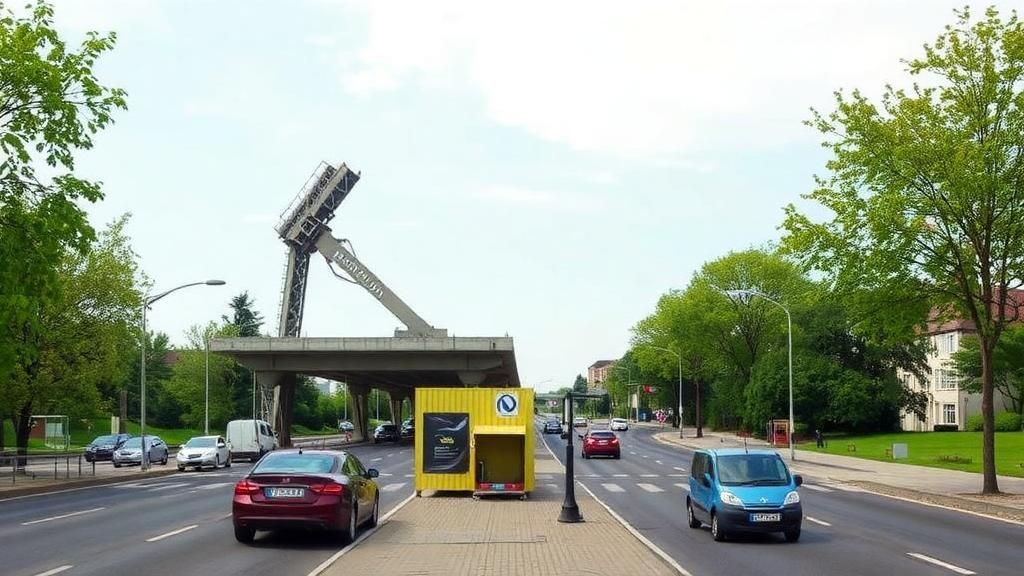
When the journalist Hanjo Seißler returned in the 1990s to Siegen, the small West German city where he had spent childhood vacations in the 1960s, he could barely recognize it. “I wanted to scream. To scream really loud. And cry. But in fact, I was unable to make a sound,” he later wrote in a 1996 article for the Süddeutsche Zeitung magazine that shaped perceptions of the city for decades. What had transformed the tranquil place of his memories was a four-lane, multi-levelled urban expressway, the Hüttentalstraße, threading on massive concrete pillars through a narrow valley barely a thousand meters wide. A new study by historian Daniela Mysliwietz-Fleiß of the University of Siegen, published in Geographica Helvetica, uses this embattled road to trace how a society’s relationship with progress, loss, and the right to shape its own city changed forever between roughly 1960 and 2000.
The expressway was born in an era when nothing about it seemed controversial. After the Second World War, which had destroyed 90 percent of the historic buildings in Siegen’s center, the Federal Republic plunged into the boom years of the 1960s and early 1970s. Cities were redesigned in the “Fordist” model, geared toward production and consumption, and the term “autogerechte Stadt” – the car-friendly city – was coined with genuinely positive connotations. In the narrative of progress that defined modernity, every advance was welcomed, even demanded, and the losses it produced were simply denied. Siegen was no exception: in 1968 the city celebrated the Siegplatte, a concrete deck built over the River Sieg to create parking spaces in the city center, as an unquestioned triumph of modernization.
The idea of a relief road for the Hüttental, the narrow valley where the former towns of Hüttental, Siegen, and Eiserfeld lined up along the Sieg, dated back to the 1930s. A decree from the Inspector General for German Roads in 1936 envisioned a bypass, but war preparations intervened. The district of Siegen revived the plan in 1952, and in 1961, during the planning of the A 45 “Sauerlandlinie” highway connecting South Westphalia with the Ruhr region, the road construction administration of the Landschaftsverband Westfalen-Lippe concluded that the Hüttental road was unavoidable. The topography left little choice: with steep slopes rising on either side of a valley averaging only about 1000 meters in width, the intersection-free expressway would have to cut directly through existing buildings. The explanatory report did not question the demolitions or express regret; it downplayed their significance with wording that belittled the value of the building fabric.
This technocratic confidence reflected the autocratic planning culture of the age. Homes were addressed only as houses, objects whose demolition seemed unproblematic, with no consideration of what displacement meant for spatial identity and belonging. The press echoed rather than challenged this stance. As the Siegener Zeitung put it in 1965, “it has always been clear to all stakeholders that numerous houses will have to be demolished if space is to be created for traffic in the densely populated Hüttental. There is no doubt that this is necessary. Otherwise we will suffocate from traffic in a few years’ time.” The forecast was not far from reality, and the public, informed but not yet alarmed, reportedly “longingly awaited” the road. The plans, modeled on American inner-city expressways and stretching some 24 kilometers through the Sieg valley on concrete pillars above the urban fabric, fit seamlessly into projects already initiated in Hamburg, Essen, Düsseldorf, Hanover, and West Berlin.
Then the ground shifted beneath the planners. The oil shocks and the end of the post-war boom in the early 1970s shattered the belief in eternal progress, and criticism of West German urban development policy swelled. Critics invoked Jane Jacobs’ The Death and Life of Great American Cities and Alexander Mitscherlich’s indictment of the “inhospitality of cities,” and a broad citizens’ initiative movement emerged against functionalist redevelopment. When the first sections of the Hüttentalstraße were finally completed in the mid-1970s, the project collided with a society whose priorities had changed. The focus shifted to the road’s consumption of space, the encroachment on the landscape, the deprivation of light and air, and the destruction of social spaces. A 1979 photograph in the Westfälische Rundschau captured the mood with its caption: “The concrete dragon advances on the city centre.” The paper’s headline spoke of “social sacrifices,” and the car – “the favourite child on wheels” – was identified as the culprit.
Resistance took many forms. When the newly founded University of Siegen opened in the summer of 1972, exacerbating a housing shortage, students occupied a vacant building on Austraße that had been cleared for a feeder road to the yet-unbuilt expressway. The squat combined the fight for living space with demands for a self-managed youth center, challenging the autocratic nature of urban planning and marking an early wave of postwar urban opposition. By 1979, a middle-class initiative calling itself Arbeitsgemeinschaft Rettet Siegen – Rescue Siegen – had gathered around 130 members and a support circle of roughly 1700 citizens, mostly from the threatened Hammerhütte district. Strikingly, the group did not oppose the highway in principle; it wanted to mitigate its effects, warning of residents who would “see them from below in their mighty dimensions, whose world will become darker, who will be exposed day and night to the increased noise and immission levels and whose property will lose value.”
The initiative fought with the tools of the respectable bourgeoisie: expert opinions, public debates, and, remarkably, its own alternative plan. Using private funds, it produced a three-dimensional sketch superimposing the elevated roadway onto an aerial photograph of Hammerhütte, revealing small houses seemingly crushed beneath massive concrete pillars, the elevated roadway blotting out the sky. The group proposed a ground-level design with relocated exits that it argued would be far more respectful of the cityscape. The authorities acknowledged the alternative was superior in urban planning terms but insisted traffic concerns outweighed everything else. Meanwhile, the state and city worked in concert to create facts on the ground, demolishing already-acquired houses years before construction was in sight – a strategy that visibly degraded the neighborhoods and undermined the residents’ protest.
A second, more radical front opened when the former Hotel Klein, a landmark of Hammerhütte with deep symbolic meaning for the neighborhood, faced demolition. A spontaneous group of students, apprentices, and young adults calling itself Initiative für eine lebenswerte Stadt – Initiative for a city worth living in – squatted the building. “Squatting a building is a means of starting a public conversation,” the activists declared. Their manifesto rejected a city made “hostile to people by oversized administrative and insurance palaces, shopping centres and urban highways,” and documented the destruction of established residential areas with decades-old neighborhoods, particularly the fate of elderly residents driven from their homes. The protest was also explicitly ecological, lamenting the loss of green spaces, clean air, and quiet – a hallmark of urban social movements in the late 1970s and early 1980s. When Special Task Forces evacuated the squatters in a seemingly excessive night operation, public sympathy only grew.
Ultimately it was the courts that changed the road’s fate. The Arbeitsgemeinschaft, acting with affected citizens, filed lawsuits through multiple instances, and in 1985 the planning approval decisions for downtown Siegen were revoked, citing the adverse effects on and fragmentation of residential areas. The redesigned layout submitted to the city council in 1986 demanded that noise, separation effects, and space requirements be integrated under the dominant objective of protecting residential areas. The final route tunneled under residential districts, relocated junctions, used existing feeder roads, and lowered the roadway’s height. When the Hüttentalstraße was completed in 1998, official publications celebrated a result achieved “only with the participation and cooperation of federal, state and local politicians as well as critical citizens and associations” – a framing that, as Mysliwietz-Fleiß notes, conveniently ignored the bureaucratic intransigence of the protest years. The Siegen story, with parallels to highway revolts in Philadelphia and San Francisco, shows how new planning cultures emerge from the collision between state decrees and citizen protest, and how the shift from modern to late-modern narratives allowed previously ignored feelings of urban loss to finally demand a hearing.
Subject of Research: Urban loss and civil resistance in the construction of the Hüttentalstraße expressway in Siegen, Germany, circa 1960–2000
Article Title: Between planning euphoria and civil resistance: the construction of the “Hüttentalentlastungsstraße” in Siegen (approx. 1960–2000)
Article References: Between planning euphoria and civil resistance: the construction of the “Hüttentalentlastungsstraße” in Siegen (approx. 1960–2000). (n.d.). https://doi.org/10.5194/gh-81-335-2026
Image Credits: AI Generated
Keywords: urban planning, Hüttentalstraße, Siegen, civil resistance, urban highways, late modernity, citizens' initiatives, squatting, car-friendly city, urban loss, West Germany, spatial identity
Cite Scienmag News
Violet Maxwell. (October 10, 2026). How a German ‘Concrete Dragon’ Turned Highway Planning Into Urban Rebellion. Scienmag. https://scienmag.com/how-a-german-concrete-dragon-turned-highway-planning-into-urban-rebellion/
Violet Maxwell. "How a German ‘Concrete Dragon’ Turned Highway Planning Into Urban Rebellion." Scienmag, 10 October 2026, https://scienmag.com/how-a-german-concrete-dragon-turned-highway-planning-into-urban-rebellion/. Accessed 10 October 2026.
Violet Maxwell. "How a German ‘Concrete Dragon’ Turned Highway Planning Into Urban Rebellion." Scienmag. October 10, 2026. https://scienmag.com/how-a-german-concrete-dragon-turned-highway-planning-into-urban-rebellion/


