


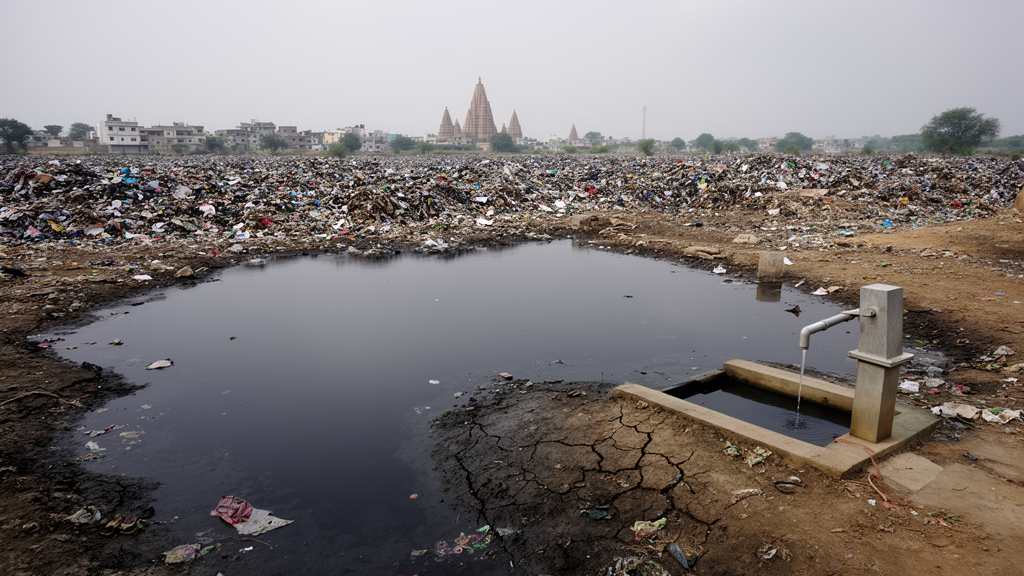
Beneath the bustling streets of Varanasi, one of the world’s oldest continuously inhabited cities, a slow-moving threat is seeping through the soil. A new study published in Environmental Monitoring and Assessment has documented how heavy metals leaching from a municipal solid waste landfill are contaminating nearby groundwater, pushing water quality into the “very poor” category and creating measurable health risks for the people who live closest to the site. The research, conducted by Katina Chachei and Kirpa Ram of Banaras Hindu University, offers one of the most detailed seasonal portraits yet of how landfill pollution behaves across India’s dramatic monsoon cycle, and its findings carry uncomfortable implications for the hundreds of millions of people across South Asia who depend on shallow groundwater for drinking.
Landfills remain the backbone of municipal solid waste disposal in India and much of the developing world, prized for their low cost and operational simplicity. But that simplicity comes at a price. As rainwater percolates through layers of compacted refuse, it dissolves and carries away a cocktail of organic compounds, nutrients, salts, and toxic metals, producing a dark, odorous liquid known as leachate. In engineered landfills, impermeable liners and collection systems trap this liquid for treatment. In many older or under-resourced facilities, however, leachate escapes into the surrounding environment, migrating downward into aquifers that supply wells and hand pumps. The Varanasi study set out to quantify exactly how much of this contamination is escaping, when it escapes, and what it means for human health.
Between 2023 and 2024, the researchers collected an unusually comprehensive set of samples: twenty-six samples each of raw and treated leachate, and twenty-four groundwater samples from wells serving communities within 1.5 kilometers of the landfill. By sampling across multiple seasons, they could track how the monsoon’s arrival and retreat reshaped the chemistry of both the leachate itself and the water that residents actually drink. The team measured a full suite of physico-chemical parameters alongside heavy metals including copper, zinc, chromium, nickel, and lead, then applied a battery of established assessment tools: the leachate pollution index, the water quality index, the heavy metal pollution index, and a formal human health risk assessment framework.
The results were sobering on multiple fronts. Treatment at the facility, it turns out, is only partially working. Most parameters in the treated leachate complied with India’s effluent discharge limits, but two stubborn exceptions stood out: chemical oxygen demand, a measure of organic pollution load, and lead, a metal with no safe threshold for human exposure. When the researchers calculated the leachate pollution index, a composite score of overall contamination potential, both raw and treated leachate failed dramatically. Raw leachate averaged 18.0 on the index, while treated leachate still averaged 9.7, both far above the permissible limit of 7.5. In other words, even after passing through the treatment plant, the liquid leaving the site remained substantially more polluting than regulatory standards allow.
The groundwater data told an even more troubling story. With the exception of copper and zinc, every heavy metal measured exceeded drinking water standards in the sampled wells. The water quality index, which condenses multiple parameters into a single grade, placed the groundwater in the “very poor” category, with scores between 200 and 300, during both the monsoon and post-monsoon seasons. The heavy metal pollution index exceeded 55, the threshold for “high” pollution, in those same seasons. For residents within the study radius, this means that the water flowing from their taps and hand pumps during and just after the rainy season carries a burden of toxic metals well above what health authorities consider acceptable.
One of the study’s most scientifically interesting findings concerns the role of seasonality, and it cuts in two different directions. In the raw leachate, concentrations of copper, chromium, and nickel varied significantly across seasons, suggesting that these metals respond individually to shifts in local hydrogeology and climate, such as changing water tables, dilution by rainfall, and altered redox conditions within the waste mass. Yet in the groundwater itself, metal concentrations remained statistically stable across seasons. This decoupling is significant: it implies that once metals reach the aquifer, they are not simply flushed away during wet periods but persist at consistently elevated levels, a signature of sustained contamination rather than episodic spikes.
To trace where the metals were coming from, the researchers turned to principal component analysis, a statistical technique that groups variables behaving in concert and thereby hints at shared origins. The analysis pointed clearly toward anthropogenic sources, specifically the waste deposited in the landfill itself and agricultural activities in the surrounding area, rather than natural geological weathering. That distinction matters for remediation. Contamination from human activity is, in principle, controllable, whereas geologically derived contamination requires different management strategies. The PCA results reinforce the conclusion that the landfill and surrounding land use practices are the dominant drivers of the metal burden in local groundwater.
The health risk assessment translated these concentrations into human terms, and the numbers are striking. Using standard exposure models, the team calculated hazard indices for residents drinking the contaminated water. For adults, the hazard index through ingestion came to 1.28; for children, it reached 2.94. Any value above 1.0 signals potential non-carcinogenic health risk, meaning that children near the landfill face nearly three times the threshold of concern. Children are particularly vulnerable because they drink more water relative to their body weight and their developing nervous systems are more sensitive to metals like lead. The one relative bright spot: carcinogenic risks from the metals assessed remained within the acceptable range, though the researchers caution that long-term monitoring is essential to confirm this holds over time.
The Varanasi findings arrive amid a broader global reckoning with waste. Humanity now generates roughly two billion tonnes of municipal solid waste every year, a figure projected to climb as urbanization accelerates across Asia and Africa. Studies from Malaysia, Iran, Poland, Ghana, and across India have repeatedly documented similar patterns: leachate escaping containment, metals accumulating in aquifers, and communities living down-gradient bearing the health consequences. What distinguishes the new study is its seasonal resolution and its demonstration that groundwater contamination persists even when surface conditions change, a crucial insight for anyone designing monitoring programs. Sampling only in the dry season, as many assessments do, would miss the monsoon-period degradation while still capturing the persistent baseline contamination.
The authors argue that their findings underscore the need for long-term monitoring that explicitly incorporates seasonal variability, both to understand the fate and migration of landfill-derived metals and to protect the ecosystems and communities downstream of disposal sites. For Varanasi, a city whose ancient wells and rivers hold deep cultural and religious significance, the study is a warning that modern waste infrastructure has not kept pace with modern waste generation. Upgrading leachate treatment to bring chemical oxygen demand and lead into compliance, lining or remediating older disposal cells, and establishing routine groundwater surveillance within at least 1.5 kilometers of landfills would be logical first steps. More broadly, the research adds to mounting evidence that the cheapest waste disposal option is often the most expensive in the long run, with the costs paid in contaminated aquifers and elevated health risks for the people who live closest to the waste.
Subject of Research: Seasonal heavy metal contamination of groundwater by municipal landfill leachate in Varanasi, India
Article Title: Seasonal dynamics of heavy metal concentrations from municipal solid waste landfill leachate in Varanasi: impact on groundwater quality and human health
Article References: Chachei, K., & Ram, K. (2026). Seasonal dynamics of heavy metal concentrations from municipal solid waste landfill leachate in Varanasi: impact on groundwater quality and human health. Environmental Monitoring and Assessment, 198(11), Article 1167. https://doi.org/10.1007/s10661-026-16004-7
Image Credits: AI Generated
DOI: 10.1007/s10661-026-16004-7
Keywords: landfill leachate, heavy metals, groundwater contamination, Varanasi, municipal solid waste, water quality index, health risk assessment, monsoon, leachate pollution index, India, lead contamination, environmental monitoring
Cite Scienmag News
Violet Maxwell. (October 9, 2026). Landfill Leachate Is Quietly Poisoning Groundwater Near an Indian Holy City. Scienmag. https://scienmag.com/landfill-leachate-is-quietly-poisoning-groundwater-near-an-indian-holy-city/
Violet Maxwell. "Landfill Leachate Is Quietly Poisoning Groundwater Near an Indian Holy City." Scienmag, 9 October 2026, https://scienmag.com/landfill-leachate-is-quietly-poisoning-groundwater-near-an-indian-holy-city/. Accessed 9 October 2026.
Violet Maxwell. "Landfill Leachate Is Quietly Poisoning Groundwater Near an Indian Holy City." Scienmag. October 9, 2026. https://scienmag.com/landfill-leachate-is-quietly-poisoning-groundwater-near-an-indian-holy-city/


