


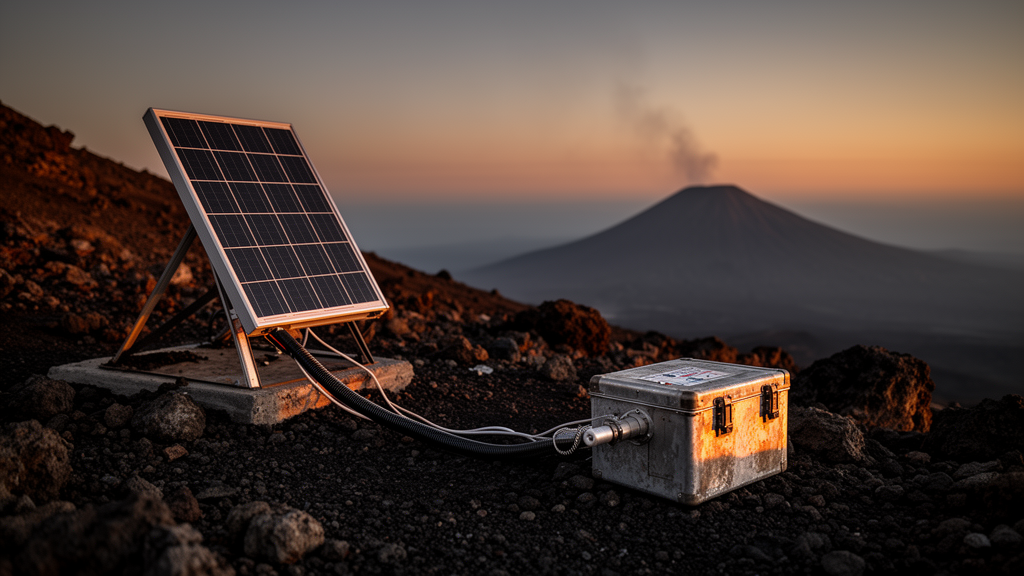
Deep below the threshold of human hearing, the planet is constantly speaking. Volcanic eruptions rumble, earthquakes groan, debris flows hiss down mountain slopes, and all of it travels through the atmosphere as infrasound: acoustic waves below 20 hertz that can circle the globe with remarkably little loss of energy. For decades, scientists have dreamed of turning this planetary murmur into an early warning system for natural disasters. The problem has always been that humans make infrasound too. Rocket launches, chemical explosions, and industrial blasts produce acoustic signatures that can closely mimic the waves generated by genuine geophysical catastrophes, and telling them apart has remained one of the stubborn challenges of global monitoring.
Now a team of researchers at the Rocket Force University of Engineering in Xi’an, China, reports a new artificial intelligence system that appears to crack much of that difficulty. Writing in the journal Natural Hazards and Earth System Sciences, Hongru Li, Xihai Li, and colleagues describe Infra-Net, a parallel decision-making network built around what they call multi-view feature learning. On a public benchmark of infrasound recordings, the system achieved a classification accuracy of 100 percent. On far messier field data supplied by the Comprehensive Nuclear-Test-Ban Treaty Organization (CTBTO), it reached 82.07 percent, a clear lead over competing methods tested on the same material. The work arrives at a moment when automated infrasound classification is becoming central both to disaster early warning and to the verification regime that underpins the nuclear test ban treaty.
The core insight behind Infra-Net is deceptively simple: when data are scarce, squeeze every drop of information out of what you have rather than trying to manufacture more. Major natural hazards are, by their nature, rare. Extreme events in particular yield so few recorded examples that conventional deep learning models, which typically hunger for thousands of training samples, struggle to generalize. Many earlier approaches have leaned on data augmentation techniques such as slicing and shifting signals to inflate the sample count, but the authors argue such tricks can distort the underlying physical distribution of the phenomena. Infra-Net takes a different route, extracting richer representations from each individual signal instead of multiplying them artificially.
The mathematical engine of the new system is the wavelet scattering transform, a technique that shares architectural DNA with convolutional neural networks but uses predefined wavelet filters rather than learned ones. Because those filters require no training, the method sidesteps overfitting in small-sample settings, a persistent weakness of deep networks. The scattering transform computes a semi-discrete wavelet decomposition of a signal and then applies a nonlinear modulus operation, producing features that are translation-invariant and stable under small deformations. That stability matters enormously for infrasound, whose signals are non-stationary and routinely warped by atmospheric turbulence on their way from source to sensor.
Li and colleagues add two twists of their own. First, they apply a logarithmic transformation to the scattering coefficients. Because infrasound frequencies sit between a few tenths of a hertz and a few hertz, the raw scattering features tend to have small magnitudes, and the logarithm, being monotonic but disproportionately sensitive to differences among small values, amplifies the subtle distinctions between, say, an earthquake’s extended rupture signal and a chemical explosion’s sharp impulsive burst. A one-way analysis of variance confirmed that the transformation significantly increased the statistical separability of the feature classes. Second, and more radically, the team abandons the standard practice of treating the full scattering matrix as a single input. Instead, each column of scattering coefficients, corresponding to a distinct set of wavelet scales and scattering paths, is fed into the network as an independent feature vector. A single 150-second recording thus becomes six parallel views of the same acoustic event, each carrying complementary physical information.
Those multiple views then flow into a dual-branch architecture. The first branch, dubbed GA-BiGRU, is a bidirectional gated recurrent unit network equipped with a global attention mechanism. Recurrent networks of this kind are built to capture long-range temporal dependencies in sequential data, and the simplified gating of the GRU keeps the parameter count low enough to converge on limited samples. The attention layer addresses a known weakness of recurrent models: the tendency of the final hidden state to forget early portions of a long sequence. By weighting every hidden state across the entire recording, the mechanism preserves information from beginning to end. The second branch, MSCI-Net, is a deliberately shallow convolutional network built around parallel multi-scale kernels. Small kernels catch fine-grained local fluctuations, while larger ones track energy trends over extended time windows, letting the network respond simultaneously to local anomalies and global patterns without the parameter bloat that deep architectures like VGG-16 impose.
The final piece is a confidence-based fusion module that merges the verdicts of the two branches. Rather than simply averaging their probability outputs, the module first averages the confidence scores across the six feature views within each branch, then takes an inner product of the two branches’ probability vectors, so that a final classification requires joint support from both independent evaluators. In visualized test cases where one branch was wrong and the other right, the fusion module consistently corrected the erroneous branch and delivered the correct answer. Ablation experiments showed that the dual-branch design outperformed either branch alone, and that the confidence-based fusion edged out naive averaging, with the improvement over the closest competing configuration holding up in statistical significance testing.
The benchmark results are striking. On the LOTIS library of typical infrasonic signals, recorded by an array at Windless Bight in Antarctica and containing aurora-driven atmospheric gravity waves, microbaroms, mountain-associated waves, and volcanic eruption infrasound, Infra-Net stabilized at perfect classification accuracy. A comparable prototype-network method previously reported needed 10,000 training iterations to reach 99.07 percent; Infra-Net’s convolutional branch alone hit 99.35 percent in just 300 iterations. Against a field of modern rivals including WST-AMResNet-18, WST-Trans, WST-BiLSTM, and MS-SE-ResNet, the new system posted the highest accuracy and the highest Cohen’s Kappa, a statistic that corrects for agreement expected by chance and therefore guards against inflated scores on imbalanced datasets. On the CTBTO field data, which pit natural earthquakes against chemical explosions under real-world noise, the 82.07 percent figure is lower but still clearly ahead of the pack, with an improvement of 3.55 percent over the strongest competitor and roughly 9 percent over traditional methods.
The authors are candid about the remaining gap between laboratory and field. Long-range propagation distorts signals in ways the current model does not fully capture, and cross-scene generalization remains a work in progress. Their roadmap includes domain adaptation through transfer learning, expansion of the training catalog to cover more event types at varied distances and signal-to-noise ratios, and uncertainty-aware fusion schemes that can better arbitrate when different feature views disagree. Even so, the study demonstrates that a mathematically grounded feature extractor, a multi-view reading of the same signal, and a consensus-driven decision mechanism can together deliver robust classification from remarkably little data. For monitoring stations that must run around the clock, distinguishing a volcanic eruption from a quarry blast in near real time, that combination could mean the difference between a false alarm and a life-saving warning.
Beyond hazard response, the implications reach into arms control verification, where the CTBT’s global network depends on reliably separating nuclear-relevant explosions from natural interference. The researchers note that adapting the system to new event categories requires only adjusting the output layer, not redesigning the architecture, which bodes well for deployment across diverse monitoring scenarios. If subsequent work closes the generalization gap, Infra-Net and its descendants may soon become standard equipment in the growing infrastructure that listens to the Earth’s low-frequency voice, turning an inaudible hum into actionable intelligence about the hazards brewing across the planet.
Subject of Research: Machine learning classification of infrasound signals for natural hazard monitoring and discrimination from anthropogenic events
Article Title: Infra-Net: a robust parallel decision-making network for discriminating natural hazards and anthropogenic infrasound events via multi-view feature learning
Article References: Li, H., Li, X., Liu, J., Luo, S., & Zhang, Y. (2026). Infra-Net: a robust parallel decision-making network for discriminating natural hazards and anthropogenic infrasound events via multi-view feature learning. Natural Hazards and Earth System Sciences, 26(9), 4529-4548. https://doi.org/10.5194/nhess-26-4529-2026
Image Credits: AI Generated
DOI: 10.5194/nhess-26-4529-2026
Keywords: infrasound, natural hazards, machine learning, wavelet scattering transform, deep learning, early warning systems, CTBTO, volcanic eruptions, earthquakes, signal classification, neural networks, geophysical monitoring
Cite Scienmag News
Violet Maxwell. (October 9, 2026). AI Listens for Disasters: New Network Tells Volcanoes and Earthquakes Apart from Human Noise. Scienmag. https://scienmag.com/ai-listens-for-disasters-new-network-tells-volcanoes-and-earthquakes-apart-from-human-noise/
Violet Maxwell. "AI Listens for Disasters: New Network Tells Volcanoes and Earthquakes Apart from Human Noise." Scienmag, 9 October 2026, https://scienmag.com/ai-listens-for-disasters-new-network-tells-volcanoes-and-earthquakes-apart-from-human-noise/. Accessed 9 October 2026.
Violet Maxwell. "AI Listens for Disasters: New Network Tells Volcanoes and Earthquakes Apart from Human Noise." Scienmag. October 9, 2026. https://scienmag.com/ai-listens-for-disasters-new-network-tells-volcanoes-and-earthquakes-apart-from-human-noise/


