


In the complex interplay of child development and healthcare, a groundbreaking study from Penn State has illuminated the vital role that child welfare systems play in identifying and addressing developmental delays in early childhood, particularly for children who have endured abuse or neglect. Spearheaded by Christian Connell, the Ken Young Family Professor in Healthy Children and a distinguished scholar in human development and family studies, this research delves into the nuanced relationship between child welfare involvement and the detection of developmental issues in children under three years old.
Developmental delays encompass a broad spectrum of conditions wherein children lag behind their peers in achieving recognized milestones, such as physical growth, motor skills, social engagement, and language acquisition. These delays, if left unidentified and untreated, can cascade into lifelong challenges, including reduced academic success, behavioral difficulties, and diminished economic prospects. Early intervention is proven to be a linchpin in mitigating these adverse outcomes, underscoring the critical importance of timely diagnosis and support.
Federal mandates require that children under three years of age exposed to abuse or neglect undergo developmental evaluations. However, these guidelines alone are insufficient without engagement from families and robust systems facilitating access to care. Connell and his team sought to understand how interaction with the Pennsylvania child welfare system (CWS) influences whether children are identified with developmental delays and subsequently receive necessary interventions.
Analyzing comprehensive data sets from the Pennsylvania CWS and the Pennsylvania Office of Medical Assistance Programs, the study scrutinized 31,913 infants and toddlers enrolled in Medicaid from 2015 to 2017. The cohort was stratified based on their CWS involvement: children with no child welfare exposure, those with confirmed abuse or neglect but no subsequent services, those receiving in-home child welfare assistance, and children placed in foster care. Importantly, restricting the sample to Medicaid recipients controlled for disparities in healthcare access across the groups.
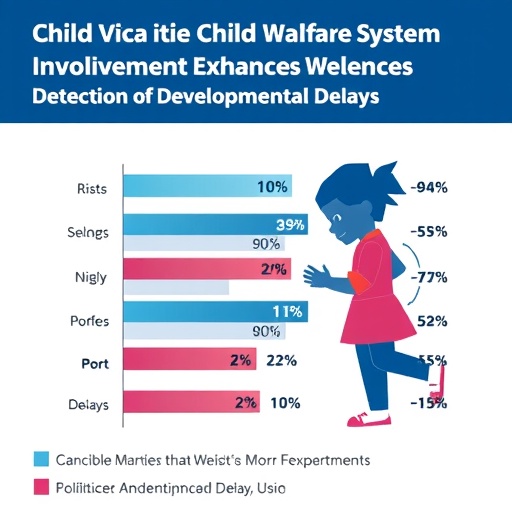
The research revealed a stark gradient in the detection of developmental delays correlated with the intensity of child welfare involvement. Among children with no child welfare contact, around 32% were diagnosed with a developmental delay between ages one and three. This figure increased modestly to 36% for those with abuse or neglect reports but no services received. Notably, children receiving in-home interventions exhibited a 45% rate of diagnosis, while a striking 63% of children placed in foster care were identified with developmental concerns. This ascending pattern suggests that engagement with child welfare services, particularly foster care, greatly enhances the chances of recognizing developmental needs.
The study’s temporal analysis further indicated that developmental delay diagnoses often followed children’s entry into foster care, implying that the child welfare system acts as a catalyst rather than as a causative factor in the emergence of these delays. Prior to CWS involvement, rates of developmental concern identification were comparable, which reinforces the system’s function as an identifier and facilitator of treatment.
Beyond diagnosis, the child welfare system appears to play a transformative role in connecting affected children to medical well-visits and early intervention services such as speech, occupational, and physical therapy. Foster care placement was associated with increased adherence to recommended well-child visits, a crucial channel for developmental surveillance. While improved healthcare engagement partially explains the elevated diagnosis rates, Connell notes that other mechanisms, potentially including advocacy and systematic assessments by caseworkers and foster caregivers, contribute significantly to enhanced service uptake.
This research contextualizes child welfare systems as pivotal actors in bridging gaps for vulnerable populations facing developmental challenges. Families grappling with socio-economic and psychosocial stressors often encounter substantial barriers to accessing voluntary services. Furthermore, some developmental delays remain hidden without systematic screening and professional evaluation. The child welfare system’s structured involvement removes part of this burden by mandating assessments and linking children to services, which can preempt the compounded detriments caused by delayed recognition.
Connell emphasizes that early identification and intervention in developmental delays not only improve immediate child outcomes but have durable impacts on social, educational, and health trajectories. Delays missed in infancy can manifest as learning disabilities, behavioral issues, and increased costs related to prolonged therapeutic needs later in life. The child welfare system’s role in early detection, therefore, carries significant public health importance that extends well beyond immediate child well-being, highlighting the need for cross-sector collaboration among healthcare, social services, and educational systems.
The findings prompt critical reflection on how other systems can emulate the success of foster care in engaging children with developmental supports. There is an imperative for policymakers and practitioners to design coordinated approaches that facilitate early outreach, especially for at-risk families who might otherwise fall through systemic cracks. Enhanced training for healthcare providers, broader implementation of screening protocols, and strengthened family engagement strategies are potential avenues to replicate foster care’s positive influence without necessitating removal from home in all cases.
While the study’s focus on Pennsylvania Medicaid recipients offers robust insights, it also flags the importance of generalizability and equity in other contexts. Given geographic, policy, and population differences across U.S. states, further research is warranted to understand how child welfare systems in diverse settings affect developmental screening and treatment. Moreover, understanding family perspectives and barriers to service uptake remains essential to refining interventions and expanding their reach.
This research was supported by the Eunice Kennedy Shriver National Institute of Child Health and Human Development, underscoring the critical role of continued federal funding in advancing knowledge about child health disparities and system-based interventions. Connell and his collaborators, including doctoral candidate Ziyu Huang, Georgia Tech assistant professor Ezra Goldstein, and Washington University professor Sarah Font, contribute a vital piece of evidence reinforcing the Child Welfare System’s indispensable function in safeguarding the developmental trajectories of vulnerable children.
Ultimately, these findings call for a paradigm shift in how child developmental concerns are addressed within society. By harnessing the protective and proactive capacities of child welfare and allied systems, stakeholders can foster earlier and more effective intervention for children at heightened risk. Such improvements promise not only better individual futures but also broader societal benefits through reduced long-term economic burden and enhanced public health.
Cite Scienmag News
Ophelia Keating. (October 24, 2025). Child Welfare System Involvement Enhances Detection of Developmental Delays. Scienmag. https://scienmag.com/child-welfare-system-involvement-enhances-detection-of-developmental-delays/
Ophelia Keating. "Child Welfare System Involvement Enhances Detection of Developmental Delays." Scienmag, 24 October 2025, https://scienmag.com/child-welfare-system-involvement-enhances-detection-of-developmental-delays/. Accessed 4 September 2026.
Ophelia Keating. "Child Welfare System Involvement Enhances Detection of Developmental Delays." Scienmag. October 24, 2025. https://scienmag.com/child-welfare-system-involvement-enhances-detection-of-developmental-delays/


