


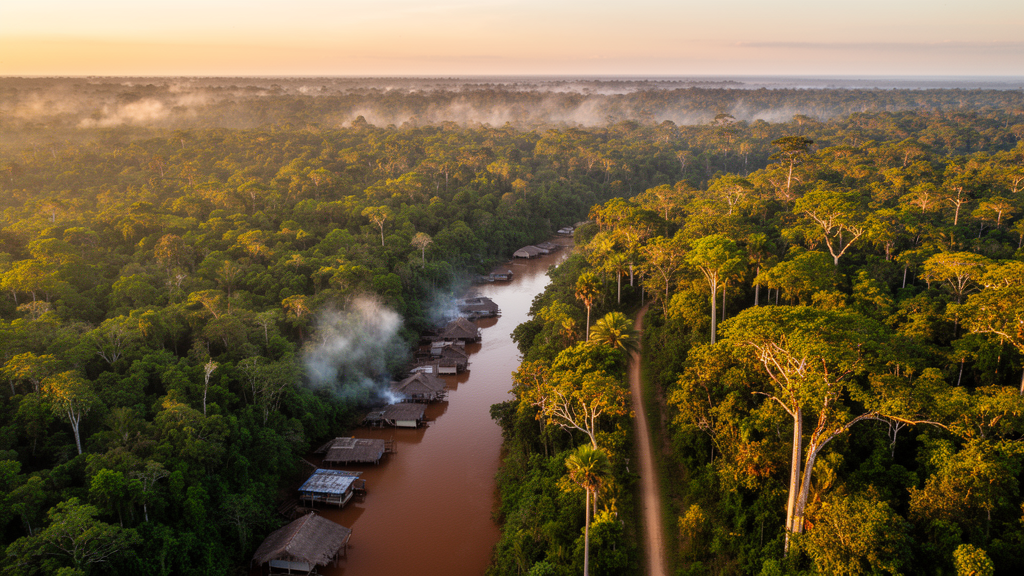
Deep in the western Brazilian Amazon, a forest the size of nearly one million hectares carries the name of a murdered environmentalist—and it is losing the battle he fought to win. The Chico Mendes Extractive Reserve (CMER) in the state of Acre, established in 1990 after the rubber tapper movement’s collective resistance against eviction by large landowners, has long been celebrated as a model for reconciling nature conservation with the sustainable use of natural resources. Yet over the last two decades, deforestation rates inside the reserve have increased significantly. Between 1990 and 2024, 97,786 hectares of forest were lost—roughly 10 percent of the reserve’s total area—making the CMER the protected area in the Brazilian Amazon most threatened by deforestation. A new study published in Frontiers in Built Environment asks a deceptively simple question: if the governance model itself was born from transformative change, why is it now failing to sustain it?
The research, led by Axel Prestes Dürrnagel of RPTU University Kaiserslautern-Landau together with colleagues from the University of Augsburg, the Federal University of Rondônia, and the Peace Academy Rhineland-Palatinate, is based on a qualitative case study design. The team conducted 114 interviews, participant observation, and a photo-based approach over eight weeks of fieldwork across three visits between March 2024 and April 2025. Rather than simply documenting the well-known drivers of deforestation—cattle ranching expansion, illegal land sales, and population growth—the study set out to understand how different actors and institutions interact to shape territorial governance and land use in the reserve, and how these governance arrangements might still serve as a catalyst for transformative change, defined as fundamental, system-wide shifts in views, structures, and practices.
The reserve’s history is inseparable from the man it honors. Chico Mendes, the land rights activist and environmentalist who led the rubber tappers’ non-violent demonstrations and roadblocks known as empates, was assassinated by a cattle rancher in 1988. Two years after his death, the reserve was created as Brazil’s second extractive reserve, spanning seven municipalities and covering 970,570 hectares. The idea had been formulated at the first national meeting of rubber tappers in 1985: instead of fragmenting the forest into individual private properties, as was common during agrarian land reform, extractive reserves would be continuous territories safeguarding traditional communities’ access to natural resources. The model represented a landmark alliance between rubber tappers and Indigenous peoples as the united movement of the Forest Peoples.
Technically, the CMER operates under a distinctive property rights regime. The land belongs to the federal government and cannot be sold. Through long-term concessions formalized in a Contract for the Grant of Real Rights of Use, use rights are contracted to associations and local communities, which must comply with the Utilization Plan—a chapter of the Management Plan that sets binding rules for land and resource use. The socio-spatial unit is the colocação, the family landholding measured in estradas de seringa, forest pathways alongside rubber trees, each equivalent to 100 hectares. According to the Utilization Plan, each colocação should have at least two such streets, or 200 hectares. Families may clear small patches of primary forest for subsistence farming and small-scale animal raising, but complementary activities may occupy no more than 10 percent of the colocação and never exceed 30 hectares. ICMBio, the federal agency formally managing the reserve, is responsible for monitoring compliance.
That monitoring, the study finds, is where the model begins to crack. The Management Plan, drafted in 2006, is outdated and largely ignored. As one ICMBio official told the researchers: It does not describe the reality of the reserve. No one even reads the Management Plan. It is supposed to be the constitution of the reserve, but no one even uses it. Under-equipped staff and limited institutional capacity across the reserve’s vast extent forced a focus on short-term surveillance rather than long-term strategy. Residents describe embargoes on illegally deforested land that are never followed up, allowing offenders to return, burn the area, and raise cattle as if they had never been fined. Meanwhile, the reserve is administered by seven municipalities with competing political interests, and during the run-up to the October 2024 municipal elections, candidates often held positions in associations and syndicates, with local community coordinators using their authority to sway voters.
The market dimension proves equally decisive. The long-term decline in rubber prices pushed extractivists toward cattle ranching as an alternative income source. As one long-term resident explained: Then it went down, and I have to sell very cheaply. I have to look elsewhere. Where did the extractivists look? They looked at cattle. It’s what’s making money, and that’s what people are going to do. The photo-based interviews revealed a striking contradiction: residents associate extensive cattle ranching primarily with bad reputation, yet also with development and progress. Keeping cattle is often described as a savings account, offering immediate financial returns through the sale of a calf, unlike seasonal crops. Cattle prices have since declined—a weaned calf that once sold for R$2,300 now fetches R$1,000—and climate change-driven droughts are eroding profitability further as pastures wither and feed must be purchased.
Yet the study also documents genuine catalysts for change emerging from vertical cooperation with external actors. A partnership with the French company Veja, which buys natural rubber at a subsidized price, has quadrupled the effective rubber price: for cooperative members following certain guidelines, the commercial value of R$3.50 per kilo is supplemented by R$11.50 in payments for environmental services, totaling R$15.00 per kilo. More than 500 families in the municipality of Xapuri alone benefit from this arrangement, and many inhabitants have reengaged in rubber tapping. Agroforestry systems—mixtures of Brazil nut trees, fruit trees, industrial trees, and perennial cash crops that reproduce the diversity of natural ecosystems—were associated in the photo-based interviews even more strongly than cattle with progress and prosperity. One inhabitant who started an agroforest system two decades ago described it as one of the best things I have started, generating income for many years without constant replanting. Research in the eastern Amazon suggests fruit and horticulture products can generate 1,300 percent more income per hectare than cattle, though remote areas still lack the storage, processing, and supply chain infrastructure needed to overcome cattle’s dominance.
Civil society, the third institutional realm, is undergoing profound changes that undermine the reserve’s collective defenses. Population growth within the reserve means that where one family once lived, there are now often two, three, or four, while the 30-hectare limit for complementary activities remains constant regardless of how many families share a colocação. Some properties interpret the rules differently, with 12 families deforesting 24 hectares on a single plot. An influx of outsiders buying up land illegally and clearing everything at once is fragmenting large properties. The grassroots community units known as núcleos de base, which once controlled who entered the reserve and approved new inhabitants, are gradually eroding, particularly along the southern fringes where access is easy. Attendance at community meetings has collapsed—from packed halls to at most eight people. A spreading cattle culture, expressed in cowboy boots, beef consumption, weekend rodeos, and sertanejo music, is reshaping rural identity, and the younger generation sees less of a future in forest extractivism. Some inhabitants even receive threats when they report illicit activities to ICMBio.
Assessing the reserve’s potential for transformative change across four dimensions—multilevel governance, local context, cooperation, and social learning—the researchers find the property rights regime remains its strongest ingredient. The shift from individual land ownership to collective property rights, described by earlier scholars as innovative and idiosyncratic, safeguarded the rubber tappers’ territorial rights and identities. The alternative of conventional land reform would have subdivided the forest into allotments of merely 50 to 100 hectares, catastrophically disrupting the resource patterns on which seringueiros depend. But realizing the model’s full potential now requires genuine devolution of power to the local level. Local coordinators of the núcleos de base possess what anthropologist Fikret Berkes calls scale-specific comparative advantages: they know who enters the reserve and what leaves it—illegal cattle or timber movements that ICMBio cannot detect. Co-management between ICMBio and local communities, with democratically elected local authorities equipped with more resources, could strengthen compliance where the state alone cannot.
The study’s conclusion is ultimately a warning and a blueprint. Transformative change, the authors argue, is not a permanent achievement but an ongoing process requiring continuous adaptation and institutional innovation. Neither the state alone nor the inhabitants can protect the reserve on their own: ICMBio holds the mandate to expel illicit individuals, but the organized community knows about illicit occurrences at the local level. The coordinators of the núcleos de base serve as bridging institutions, linking horizontal cooperation among inhabitants with vertical partnerships that provide economic alternatives to cattle. Beyond the Brazilian Amazon, the findings offer broader lessons for protected areas worldwide seeking to reconcile conservation with sustainable development: a strong state institution cooperating closely with local actors based on trust and participation, combined with external partners that economically strengthen sustainable income opportunities, remains the most promising path. Whether the forest that carries Chico Mendes’s name can still deliver the transformation he died for depends on whether governance can learn as fast as the forces eroding it.
Subject of Research: Environmental Science
Article Title: Territorial governance for transformative change? Insights from the Chico Mendes Extractive Reserve in the Brazilian Amazon
Article References: Territorial governance for transformative change? Insights from the Chico Mendes Extractive Reserve in the Brazilian Amazon. (n.d.). https://doi.org/10.3389/fbuil.2026.1766645
Image Credits: AI Generated
DOI: 10.3389/fbuil.2026.1766645
Keywords: Amazon, Brazil, deforestation, extractive reserves, territorial governance, protected areas, transformative change, Chico Mendes, cattle ranching, sustainable development, Territorial, governance
Cite Scienmag News
Courtney Benton. (October 16, 2026). Chico Mendes Extractive Reserve: Can Amazon Forest Governance Still Deliver Transformative Change? Scienmag. https://scienmag.com/chico-mendes-extractive-reserve-can-amazon-forest-governance-still-deliver-transformative-change/
Courtney Benton. "Chico Mendes Extractive Reserve: Can Amazon Forest Governance Still Deliver Transformative Change?" Scienmag, 16 October 2026, https://scienmag.com/chico-mendes-extractive-reserve-can-amazon-forest-governance-still-deliver-transformative-change/. Accessed 16 October 2026.
Courtney Benton. "Chico Mendes Extractive Reserve: Can Amazon Forest Governance Still Deliver Transformative Change?" Scienmag. October 16, 2026. https://scienmag.com/chico-mendes-extractive-reserve-can-amazon-forest-governance-still-deliver-transformative-change/


