


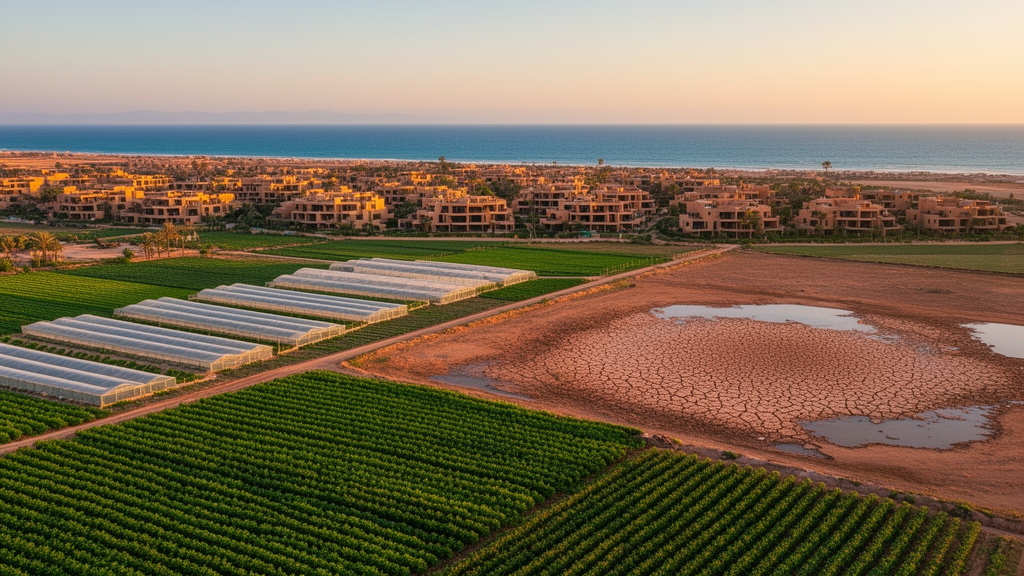
Beneath the coastal plain of Annaba in northeastern Algeria lies an aquifer that has quietly sustained one of North Africa’s most productive agricultural and urban regions for decades. Today, that hidden reservoir is in trouble. A new study published in Frontiers in Earth Science combines artificial intelligence, multivariate statistics, and human health risk assessment to deliver an unusually complete diagnosis of the aquifer’s decline, and its central finding is striking: the biggest threat to this groundwater system is not population growth, as long assumed, but rising per capita income and booming coastal tourism. The research, led by Samir Hani and Nabil Harrat of Badji Mokhtar Annaba University together with colleagues, offers a template that could reshape how water-stressed Mediterranean regions manage their most fragile resource.
The numbers behind the study tell a stark story of shrinking margins. Per capita water availability in the Annaba region has collapsed from 1,500 cubic meters per year in 1962 to roughly 500 cubic meters today, placing the area below the absolute water scarcity threshold defined by the Falkenmark index. A population of approximately two million people depends heavily, and often exclusively, on the coastal aquifer, which is being pumped at an estimated 250 to 280 cubic hectometers per year, a rate that approaches or exceeds the estimated renewable resource. The consequences are visible in the data: piezometric levels are falling by one to two meters per year in central sectors, seawater has pushed inland across a 10 to 15 kilometer coastal band, and nitrate concentrations from inadequate wastewater treatment and agricultural inputs exceed World Health Organization drinking water standards in multiple areas.
Geologically, the Annaba plain is a subsiding tectonic graben wedged between the Edough metamorphic massif, the Numidian fold-and-thrust belt, and the Mediterranean Sea. Its aquifer consists of Quaternary sands, gravels, and clays reaching thicknesses of up to 150 meters in the central plain, resting on Miocene marls that act as a regional aquitard. With mean annual rainfall of 600 to 800 millimeters and potential evapotranspiration exceeding 1,200 millimeters, the hydrological balance is delicate: recharge is limited, and human abstraction increasingly captures water that would naturally discharge toward the sea. This configuration makes the system acutely sensitive to any sustained increase in pumping, and it explains why the authors argue that understanding who is using the water, and why, matters as much as mapping the aquifer itself.
To capture the interplay between economics and hydrogeology, the team built a framework called CWIMSAM, the Conceptual Water Integrated Model for Semi-Arid Mediterranean basins. It organizes the problem using the Driver-Pressure-State-Impact-Response logic adopted by the European Environment Agency: socioeconomic drivers such as income growth and tourism generate abstraction pressures that alter the physical state of the aquifer, producing drawdown, seawater intrusion, and nitrate accumulation, which in turn create health and economic impacts that demand institutional responses. Crucially, the framework closes the loop, feeding observed degradation back into governance levers such as leak reduction, treated wastewater reuse, and progressive water pricing, so that management decisions continuously adjust to changing conditions.
The quantitative heart of the study is a Multi-Layer Perceptron neural network with a 14-7-1 architecture: fourteen socioeconomic input variables, seven hidden neurons, and a single output representing groundwater abstraction. The inputs ranged from population and per capita income to tourism, water pricing, agricultural consumption, and unaccounted-for water losses. Because only 21 municipalities were available as training cases, the researchers took unusual care to avoid overfitting. They tested 500 candidate network configurations, enforced a structural constraint limiting the number of trainable weights relative to sample size, applied automated early stopping, and then subjected the final model to leave-one-out cross-validation, in which each municipality was held out in turn and predicted by a network trained on the other twenty. The cross-validated coefficient of determination of 0.929 and correlation of 0.967 confirmed that the model generalizes genuinely rather than memorizing its small dataset.
The sensitivity analysis that followed produced the study’s most policy-relevant result. Per capita income emerged as the single most influential driver of groundwater withdrawal, with tourism ranked second, followed by agricultural water consumption and per capita consumption. This finding overturns the conventional attribution of overexploitation to population growth and agricultural expansion. The authors interpret the income-abstraction link through multiple demand pathways: greater household appliance ownership, swimming pools, expansion of the commercial and hospitality sector, and the replacement of traditional water-efficient practices with water-intensive modern lifestyles. Tourism is particularly problematic because Algeria’s post-hydrocarbon economic diversification agenda promotes coastal development precisely in the municipalities most vulnerable to seawater intrusion, creating a direct tension between economic strategy and aquifer sustainability that is currently not addressed in Algerian water governance.
Multivariate statistics then translated these findings into a spatial management map. Principal component analysis reduced thirteen variables to three factors explaining 71 percent of the variance, dominated by an abstraction factor linking water withdrawal with stormwater coverage, population, income, and tourism. Hierarchical cluster analysis split the 21 municipalities into two sharply contrasting zones. An inland cluster of 18 municipalities faces vulnerability dominated by diffuse agricultural runoff and urban land-use pressures. A coastal cluster of just three municipalities, Bouteldja, Pont Bouchet, and Salines, forms what the authors call a coastal abstraction and salinization hotspot. These towns sit atop highly permeable unconfined dune sands with hydraulic conductivities of 10 to the minus 4 to 10 to the minus 3 meters per second and no protective clay cover, host the public wellfields supplying the city of Annaba with abstraction exceeding 150 cubic hectometers per year, and show electrical conductivity above 4,000 microsiemens per centimeter and chloride concentrations above 1,000 milligrams per liter, signatures of aggressive seawater intrusion.
The study’s health risk component adds an alarming human dimension. Drawing on the most spatially exhaustive multi-element monitoring dataset available, a 2019 baseline of 20 sampling points around an unlined landfill that receives roughly 200 tons of waste daily, the team quantified cadmium, copper, lead, and zinc exposure under agricultural and livestock scenarios following USEPA and WHO methodologies. The results are sobering. Cadmium ingestion via root vegetables yielded hazard quotients of 31.9 for children and 13.7 for adults, against an acceptable threshold of 1, while lead reached 6.64 in children. In the livestock pathway, zinc exposure through milk consumption exceeded safety limits with hazard quotients of 5.23 for children and 2.61 for adults. Even dermal contact with cadmium-contaminated sludge during agricultural work produced an unacceptable non-carcinogenic risk of 1.59 alongside a carcinogenic excess lifetime risk of 9.67 times 10 to the minus 7. The authors caution that these values represent a conservative baseline profile rather than real-time exposure, since geochemical conditions in coastal aquifers shift over time, but they underscore an urgent need for remediation and continuous monitoring.
What distinguishes this work is its insistence that the findings translate directly into differentiated policy. The authors propose a five-step institutional roadmap for Algerian water authorities, beginning with a shared spatial data platform among the basin agency, water directorate, and utility, then embedding the neural network into an operational decision-support system that triggers early-warning alerts when projected abstraction exceeds sustainable yield. The two management zones would then receive tailored regulation: strict moratoria on new private wells, mandatory metering, and priority allocation of desalinated supplies in the vulnerable coastal cluster, versus managed aquifer recharge with treated wastewater and agricultural best practices inland. Because unaccounted-for water losses run at 30 to 45 percent across the study area, well above the Mediterranean average, network rehabilitation alone could recover an estimated 75 to 105 cubic hectometers per year of supply without asking consumers to reduce demand at all.
The broader significance extends well beyond Annaba. North African coastal aquifers, from Tunisia’s Jeffara plain to Morocco’s agricultural basins, face the same convergence of semi-arid climate, rapid socioeconomic change, and fragile geology, and roughly 70 percent of the region’s agricultural production and domestic supply depends on groundwater. The authors argue that the CWIMSAM framework, with its modular design allowing local recalibration of the neural network and cluster structure, is transferable across these systems, and its explicit linkage to Sustainable Development Goal 6 indicators positions it as a practical instrument for national water security reporting. Future work will integrate CMIP6 climate projections, expand monitoring to sub-municipal resolution, and apply isotope tracers to quantify seawater mixing. But the core message is already clear: in water-scarce coastal regions, managing demand means managing prosperity itself, and the tools to do so now exist.
Subject of Research: Integrated hydrogeological and socioeconomic assessment of groundwater vulnerability in the Annaba coastal aquifer, northeastern Algeria
Article Title: Groundwater resource vulnerability in the annaba coastal aquifer, northeastern Algeria: integrating hydrogeological and socio-economic drivers for sustainable management
Article References: Hani, S., Harrat, N., Hamzaoui, W., & Reghais, A. (2026). Groundwater resource vulnerability in the annaba coastal aquifer, northeastern Algeria: integrating hydrogeological and socio-economic drivers for sustainable management. Frontiers in Earth Science, 14, Article 1888646. https://doi.org/10.3389/feart.2026.1888646
Image Credits: AI Generated
DOI: 10.3389/feart.2026.1888646
Keywords: groundwater, coastal aquifer, seawater intrusion, Algeria, artificial neural networks, water scarcity, heavy metal contamination, health risk assessment, DPSIR framework, tourism, water management, Mediterranean
Cite Scienmag News
Violet Maxwell. (October 16, 2026). Wealth, Not Population, Is Draining a North African Coastal Aquifer, Study Finds. Scienmag. https://scienmag.com/wealth-not-population-is-draining-a-north-african-coastal-aquifer-study-finds/
Violet Maxwell. "Wealth, Not Population, Is Draining a North African Coastal Aquifer, Study Finds." Scienmag, 16 October 2026, https://scienmag.com/wealth-not-population-is-draining-a-north-african-coastal-aquifer-study-finds/. Accessed 16 October 2026.
Violet Maxwell. "Wealth, Not Population, Is Draining a North African Coastal Aquifer, Study Finds." Scienmag. October 16, 2026. https://scienmag.com/wealth-not-population-is-draining-a-north-african-coastal-aquifer-study-finds/


