


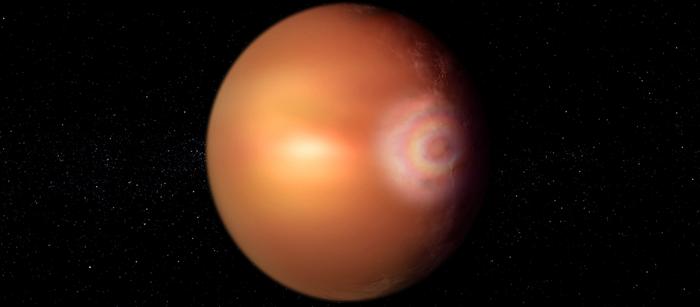
The CHEOPS space telescope, whose scientific operations centre is based at the University of Geneva (UNIGE), is providing new information on the mysterious exoplanet WASP-76b. This ultra-hot giant is characterised by an asymmetry between the amount of light observed on its eastern terminator – the fictitious line that separates its night side from its day side – and that observed on its western terminator. This peculiarity is thought to be due to a ‘‘glory’’, a luminous phenomenon similar to a rainbow, which occurs if the light from the star – the ‘‘sun’’ around which the exoplanet orbits – is reflected by clouds made up of a perfectly uniform substance. If this hypothesis is confirmed, this would be the first detection of this phenomenon outside our solar system. This work, carried out in collaboration with the European Space Agency (ESA) and the University of Bern (UNIBE), is published in Astronomy & Astrophysics.

Credit: © ESA, work performed by ATG under contract for ESA. CC BY-SA 3.0 IGO
The CHEOPS space telescope, whose scientific operations centre is based at the University of Geneva (UNIGE), is providing new information on the mysterious exoplanet WASP-76b. This ultra-hot giant is characterised by an asymmetry between the amount of light observed on its eastern terminator – the fictitious line that separates its night side from its day side – and that observed on its western terminator. This peculiarity is thought to be due to a ‘‘glory’’, a luminous phenomenon similar to a rainbow, which occurs if the light from the star – the ‘‘sun’’ around which the exoplanet orbits – is reflected by clouds made up of a perfectly uniform substance. If this hypothesis is confirmed, this would be the first detection of this phenomenon outside our solar system. This work, carried out in collaboration with the European Space Agency (ESA) and the University of Bern (UNIBE), is published in Astronomy & Astrophysics.
WASP-76b is an ultra-hot giant planet. Orbiting its host star twelve times closer than Mercury orbits our Sun, it receives more than 4,000 times the Sun’s radiation on Earth. ‘‘The exoplanet is ‘inflated’ by the intense radiation from its star. So, although it is 10% less massive than our cousin Jupiter, it is almost twice as big,’’ explains Monika Lendl, assistant professor in the Department of Astronomy of the UNIGE Faculty of Science, and co-author of the study.
Since its discovery in 2013, WASP-76b has been the subject of intense scrutiny by astronomers. A strangely hellish picture has emerged. One side of the planet is always facing its star, reaching temperatures of 2,400 degrees Celsius. Elements that would form rocks on Earth melt and evaporate here, before condensing on the slightly cooler night side, creating clouds of iron that drip molten iron rain.
The crucial contribution of CHEOPS
One of the most disturbing observations for astronomers is the asymmetry between the planet’s two terminators. The terminator is the imaginary line that separates the day and night sides of a planet. In the case of WASP-76b, the observations show an increase in the amount of light from the terminator to the east of the planet compared with the one to the west.
To solve this mystery, astronomers used no fewer than twenty-three observations with the CHEOPS space telescope, spread over three years. The ESA satellite, which is piloted by Switzerland and has its scientific operations centre at the UNIGE Department of Astronomy, observed numerous secondary eclipses of the planet (when it passes behind its star) and several phase curves (continuous observation during a complete revolution of the planet).
Combining these new data with those from other telescopes (TESS, Hubble and Spitzer), the astronomers were able to put forward a surprising hypothesis to explain the excess luminous flux on the eastern side of the planet: ‘‘This unexpected glow could be caused by a strong, localised and anisotropic reflection – i.e. one that depends on direction – what we call a glory,’’ explains Olivier Demangeon, researcher at the Instituto de Astrofísica e Ciências do Espaço in Portugal and lead author of the study.
A first outside our solar system
Glories are common phenomena on Earth. They have also been observed on Venus. The effect, similar to a rainbow, occurs when light is reflected by clouds made up of perfectly uniform droplets. In the case of Earth, the droplets are made out of water, but the nature of these droplets on WASP-76b remains mysterious. It could be iron, as this has already been detected in the planet’s extremely hot atmosphere. The detection of this phenomenon on WASP-76b is the first of its kind outside our solar system.
‘‘The reason why no such glory has ever been observed outside our solar system is that this phenomenon requires very specific conditions. First of all, the atmospheric particles must be almost perfectly spherical, completely uniform and sufficiently stable to be observed throughout a long time. These droplets have to be directly illuminated by the planet’s host star, and the observer – in this case CHEOPS – must be in the right position,’’ explains Olivier Demangeon.
Results to be confirmed
Further data will be needed to confirm with certainty that this intriguing excess of light on the eastern terminator of WASP-76b is a glory. This confirmation would attest to the presence of clouds made up of perfectly spherical droplets that have existed for at least three years, or that are constantly renewing themselves. For such clouds to persist, the temperature of the atmosphere would also have to be stable over time – a fascinating and detailed insight into what could be happening on WASP-76b.
Detecting such tiny phenomena at such a great distance will enable scientists and engineers to identify others that are just as crucial. For example, the reflection of starlight off liquid lakes and oceans – a necessary condition for habitability.
Journal
Astronomy and Astrophysics
Method of Research
News article
Subject of Research
Not applicable
Article Title
“Asymmetry in the upper atmosphere of the ultra-hot Jupiter WASP-76 b”
Article Publication Date
5-Apr-2024
Cite Scienmag News
Grant Pearson. (April 5, 2024). CHEOPS detects a ‘‘rainbow’’ on an exoplanet. Scienmag. https://scienmag.com/cheops-detects-a-rainbow-on-an-exoplanet/
Grant Pearson. "CHEOPS detects a ‘‘rainbow’’ on an exoplanet." Scienmag, 5 April 2024, https://scienmag.com/cheops-detects-a-rainbow-on-an-exoplanet/. Accessed 4 September 2026.
Grant Pearson. "CHEOPS detects a ‘‘rainbow’’ on an exoplanet." Scienmag. April 5, 2024. https://scienmag.com/cheops-detects-a-rainbow-on-an-exoplanet/

