


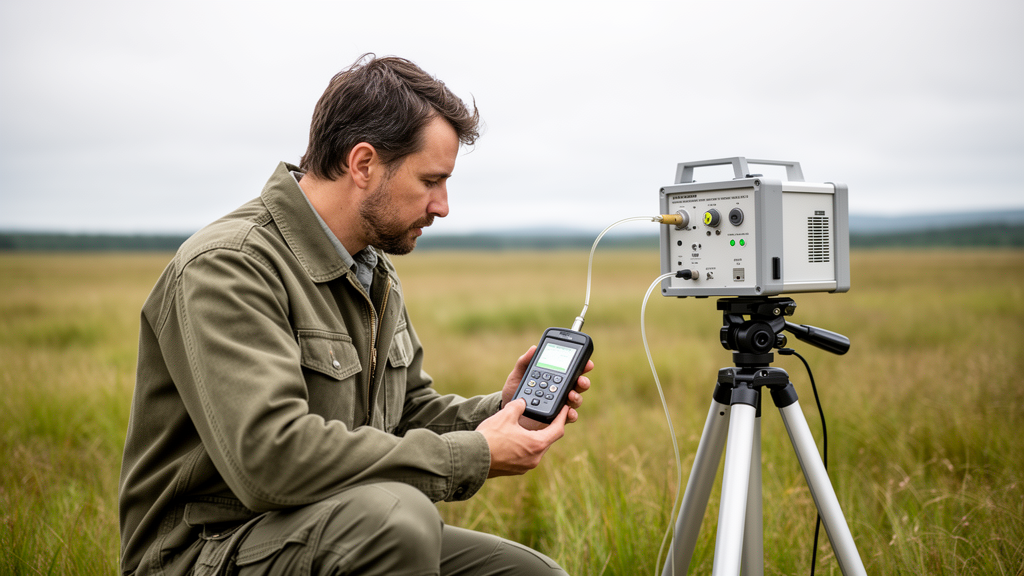
A prototype carbon dioxide sensor built for a fraction of the price of conventional scientific instruments has performed remarkably well in a head-to-head field trial against a state-of-the-art eddy covariance system, according to a new study published in Atmospheric Measurement Techniques. The device, developed by researchers at the University of Helsinki in cooperation with the Finnish measurement technology company Vaisala, achieved a carbon dioxide flux correlation of R² = 0.96 with the reference instrument during the high-flux growing season, a result that could reshape how the world measures the carbon exchanged between land and atmosphere.
The stakes behind this engineering effort are considerable. As countries and companies scramble to verify carbon sinks in forests, farmland, and wetlands, the demand for trustworthy, affordable flux measurements has exploded. Carbon markets, carbon farming schemes, and land-use regulations such as the European Union’s LULUCF framework all depend on knowing precisely how much carbon dioxide an ecosystem absorbs or releases. Yet the standard tool for this job, the eddy covariance technique, relies on instruments that can cost tens of thousands of euros, limiting how widely the method can be deployed.
Eddy covariance works by measuring the vertical wind speed and the gas concentration fluctuations at high frequency, typically ten times per second, allowing researchers to calculate the net exchange of carbon dioxide or water vapour between the surface and the atmosphere over half-hour intervals. The technique is the backbone of global flux networks, but its expense has kept it largely confined to academic observatories. Inventory-based alternatives, such as repeated soil carbon sampling, take five to ten years to yield results, far too slow for markets that need timely verification.
The new prototype was designed to be 50 to 60 percent cheaper than commercially available fast-response analysers without significant compromises in performance. It is an enclosed-path instrument based on Vaisala’s CARBOCAP technology, which uses a single-beam, dual-wavelength non-dispersive infrared method. Instead of fixed emission lines, the sensor employs an electrically tunable Fabry–Pérot interferometer filter that alternates between an absorption wavelength near 4.3 micrometres for carbon dioxide and a nearby reference wavelength with no absorption, with a second band near 2.6 micrometres serving water vapour measurements. A thermopile detector, a small 30.3 cubic centimetre gas cell, and a proprietary micro-hotplate infrared light source complete the optical package.
Two design choices stand out. First, the instrument contains internal temperature and pressure sensors that compensate for temperature, pressure, and water vapour dilution effects in real time. Second, and arguably most important, it features a built-in autocalibration routine that periodically checks the signal against an internal reference. This feature proved to be the crux of the entire project. Early in the field campaign, the autocalibration, which ran roughly every thirty minutes, produced visible jumps in the carbon dioxide signal because the underlying drift, primarily driven by temperature, could not be described by a simple functional relationship.
A major software update on 21 July 2022 changed everything. The firmware was rewritten to apply step-wise corrections for the drift between calibrations using internal signals from the instrument’s components, so that corrections became continuous and the discontinuities after each autocalibration virtually disappeared. Further updates followed in late August, after a maintenance visit in September, and in late October. By the end of the roughly six-month campaign, laboratory testing showed no significant calibration drift at all, a striking result for a low-cost sensor operating outdoors through a Finnish summer and autumn.
The field test took place at the Haltiala cropland in Vantaa, southern Finland, from late June to mid-November 2022, with the site planted in oats. The prototype system and a reference setup built around a Li-Cor LI-7200RS analyser were mounted at the same 2.9 metre measurement height, each paired with a Metek uSonic-3 Scientific sonic anemometer. The prototype sampled at 5 hertz rather than the standard 10 hertz, a deliberate cost-saving choice. The researchers showed that this halving of the sampling rate has essentially no impact on calculated fluxes, since disjunct sampling introduces no systematic bias as long as the sampling interval remains shorter than the integral time scale of the turbulent signal; only the random uncertainty grows slightly.
The performance numbers are impressive for the price class. The prototype achieved a first-order response time of 0.17 to 0.18 seconds for carbon dioxide, close to its laboratory value of 0.2 seconds and only modestly slower than the reference analyser’s 0.08 seconds. This fast response matters because turbulent fluctuations near the surface shift toward higher frequencies under stable stratification, and a sluggish sensor misses them, biasing fluxes low. The prototype’s noise level, initially 2 to 2.5 parts per million, rose temporarily to about 3 ppm when the stability-focused software update traded some noise for signal continuity, then dropped to roughly 1 ppm after the September improvements. That noise corresponds to a flux random uncertainty of about 0.2 to 0.24 micromoles per square metre per second, well below the 10 to 20 percent random uncertainty that the stochastic nature of turbulence itself imposes on any eddy covariance measurement.
The flux comparison told a consistent story. Half-hourly carbon dioxide fluxes from the two systems were highly correlated, with coefficients of determination between 0.85 and 0.96 for carbon dioxide and around 0.90 for water vapour, and the slight underestimation by the prototype diminished after the July software update. In July, the oat field absorbed up to about 30 micromoles of carbon dioxide per square metre per second during the day and released roughly 10 at night, with both systems tracking the strong diurnal cycle and its decline as the crop senesced. Cumulative carbon dioxide fluxes diverged by 13 percent before the software update but by only 18 percent of a much smaller cumulative total afterwards, a difference the authors consider small given the near-zero exchange conditions of late summer. Water vapour fluxes agreed well early on, though cumulative differences grew later in the season, likely reflecting the difficulty of correcting high-frequency losses when water is absorbed and desorbed in the sampling line at high humidity.
There is a bittersweet coda. The researchers conclude that the prototype came close to being a production-ready analyser that could balance a substantially lower price against scientific-grade accuracy, potentially enabling dense networks of flux towers across heterogeneous landscapes or redundant installations at single sites to sharpen annual carbon budgets. Yet a market analysis by Vaisala concluded that in 2022 the market was not large enough to justify the investment, and further development was frozen. The study stands as a proof of concept: the engineering barriers to cheap, reliable ecosystem carbon monitoring have largely fallen, and what remains is the economic and institutional will to deploy such tools at scale as carbon accounting becomes a fixture of the global economy.
Subject of Research: Field intercomparison of a low-cost fast-response carbon dioxide sensor with a standard eddy covariance system
Article Title: Good performance of low-cost fast-response carbon dioxide sensor based on intercomparison with the standard eddy-covariance system
Article References: Rannik, Ü., Mammarella, I., Vesala, T., Väkimies, P., Heiskari-Tuohiniemi, H., & Korkiakoski, M. (2026). Good performance of low-cost fast-response carbon dioxide sensor based on intercomparison with the standard eddy-covariance system. Atmospheric Measurement Techniques, 19(18), 6159-6169. https://doi.org/10.5194/amt-19-6159-2026
Image Credits: AI Generated
Keywords: eddy covariance, carbon dioxide flux, low-cost sensors, NDIR spectroscopy, autocalibration, ecosystem carbon monitoring, water vapour flux, carbon markets, atmospheric measurement, Vaisala, University of Helsinki, cropland
Cite Scienmag News
Russell Cooper. (October 9, 2026). Cheap CO2 Sensor Matches Scientific Gold Standard in Field Trial. Scienmag. https://scienmag.com/cheap-co2-sensor-matches-scientific-gold-standard-in-field-trial/
Russell Cooper. "Cheap CO2 Sensor Matches Scientific Gold Standard in Field Trial." Scienmag, 9 October 2026, https://scienmag.com/cheap-co2-sensor-matches-scientific-gold-standard-in-field-trial/. Accessed 9 October 2026.
Russell Cooper. "Cheap CO2 Sensor Matches Scientific Gold Standard in Field Trial." Scienmag. October 9, 2026. https://scienmag.com/cheap-co2-sensor-matches-scientific-gold-standard-in-field-trial/


