


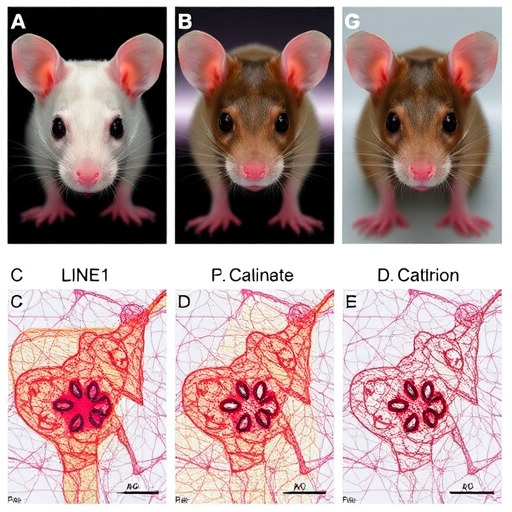
A new study published in Nature Aging reports that mice lacking the enzyme cGAS develop signs of premature aging, accompanied by the abnormal activation of repetitive genetic sequences known as LINE1 elements and a rise in inflammation. The findings place a cellular DNA-sensing pathway at the center of a biological connection between genome instability, transposable elements and age-related decline. Although the work was conducted in mice and does not establish that the same mechanism drives human aging, it offers a detailed explanation for how the failure of an innate immune surveillance system may disturb tissue maintenance over time. The study by Martinez, Morandini, Rechsteiner and colleagues focuses on cyclic GMP–AMP synthase, or cGAS, a protein best known for detecting DNA in the wrong cellular compartment and initiating immune responses. Its absence, the researchers report, does more than weaken antiviral defense: it appears to reshape the molecular environment of aging cells.
cGAS is part of the cGAS–STING pathway, one of the body’s major systems for recognizing abnormal DNA. Under normal conditions, DNA is largely confined to the nucleus and mitochondria. When DNA fragments appear in the cytoplasm, they can signal viral infection, DNA damage or the breakdown of cellular structures. cGAS binds this misplaced DNA and synthesizes the small messenger molecule cyclic GMP–AMP, commonly abbreviated cGAMP. cGAMP activates the adaptor protein STING, which then stimulates signaling cascades involving TBK1, interferon regulatory factors and nuclear factor kappa B. These pathways induce type I interferons and inflammatory genes that help cells respond to invading pathogens and genomic danger. The new research indicates that cGAS also has a less obvious role in preserving long-term cellular stability. Without it, cells may become increasingly vulnerable to the consequences of mobile genetic elements and the chronic inflammatory signals associated with aging.
The study’s central finding concerns LINE1, short for long interspersed nuclear element 1. LINE1 sequences are remnants of ancient retrotransposons that occupy a substantial fraction of the mammalian genome. Unlike most genomic fossils, some LINE1 copies retain the ability to produce RNA and, in certain circumstances, proteins required for their movement. A functional LINE1 element can be transcribed into RNA and translated into two principal proteins, ORF1p and ORF2p. ORF2p contains endonuclease and reverse-transcriptase activities, allowing the element to copy itself and insert a new DNA copy elsewhere in the genome. In healthy, differentiated cells, LINE1 activity is usually restrained by DNA methylation, repressive histone modifications and other layers of epigenetic control. The researchers found that cGAS deficiency is associated with derepression of these elements, meaning that LINE1 sequences become more transcriptionally active than they should be.
The reactivation of LINE1 provides several possible routes to cellular damage. Its RNA can accumulate in the cytoplasm and form RNA–DNA hybrids or other nucleic-acid structures that resemble material produced during infection. LINE1 proteins may also generate DNA breaks while attempting to insert new copies into the genome. Reverse transcription can create additional DNA intermediates, while failed or incomplete transposition may increase replication stress and compromise chromosome integrity. These events can activate innate immune pathways even when no virus is present. In this sense, derepressed LINE1 elements may act as an endogenous source of danger signals: genetic sequences inherited from ancient retroviral activity become capable of provoking antiviral-like inflammation when the systems that normally keep them silent fail.
The reported association between cGAS loss and inflammation is especially significant because inflammation is not simply a secondary feature of aging. Persistent, low-level inflammatory signaling—often called inflammaging—is thought to contribute to tissue degeneration, immune dysfunction and the progression of multiple age-related diseases. Acute inflammation is generally protective and temporary, but chronic activation can damage neighboring cells, alter metabolism and interfere with tissue repair. In cGAS-deficient mice, the increased activity of LINE1 elements may help explain why inflammatory programs remain switched on. Cytoplasmic nucleic acids generated by transposable-element activity could stimulate innate immune sensors, while DNA damage and cellular stress could reinforce the same response through parallel pathways. The result would be a self-amplifying cycle in which weakened genome control promotes inflammation, and inflammation further undermines cellular homeostasis.
The findings also challenge the idea that cGAS is exclusively an inflammatory accelerator. In cancer biology and infection research, cGAS is often discussed as a pathway that detects abnormal DNA and stimulates immune activation. That role can be beneficial when the trigger is a virus or a malignant cell, but excessive cGAS–STING activity can also contribute to inflammatory disease. The new work suggests that the protein’s impact depends heavily on context. In the absence of cGAS, cells may lose an important layer of surveillance or coordination that limits the consequences of transposable-element activity. At the same time, the immune system may still detect the molecular debris produced by damaged or stressed cells through other sensors. The biology therefore cannot be reduced to a simple equation in which more cGAS always means more inflammation and less cGAS always means less.
A key implication is that aging may involve the gradual failure of systems that normally contain ancient genetic parasites. LINE1 sequences are not external pathogens, but their biochemical behavior resembles that of retroviruses. They can produce RNA, encode reverse transcriptase and generate nucleic-acid intermediates capable of activating antiviral defenses. This resemblance has led scientists to investigate whether endogenous retroelements contribute to age-related inflammation. The study adds cGAS to that emerging framework by connecting an innate DNA-sensing protein with the epigenetic repression of LINE1. If the relationship is confirmed in additional models, it could help explain why older tissues often show both greater transposable-element expression and a persistent interferon signature. It may also clarify why genome instability and inflammation frequently appear together rather than as independent features of aging.
The mouse findings could eventually inform strategies aimed at preserving healthy aging, but they do not yet point to an immediate treatment. One possibility would be to suppress LINE1 expression or block the reverse-transcriptase activity needed for its propagation. Experimental research in other settings has examined whether nucleoside reverse-transcriptase inhibitors, drugs originally developed against retroviruses, can reduce retrotransposon-associated activity. Another approach would be to restore epigenetic silencing or selectively interrupt inflammatory signals generated by endogenous nucleic acids. Each strategy carries risks. Broad suppression of innate immunity could weaken antiviral and antitumor defenses, while indiscriminate epigenetic manipulation might affect thousands of genes. Because cGAS also participates in responses to infection and cancer, any intervention would need to distinguish harmful chronic signaling from protective acute activation.
The work also highlights why results from genetically modified mice must be interpreted carefully. A complete, lifelong absence of cGAS may produce effects that differ from the partial decline, altered regulation or tissue-specific dysfunction that occurs during natural human aging. Mice and humans also differ in their repeat-element landscapes, immune systems, lifespans and patterns of disease. The presence of increased LINE1 expression or inflammatory markers in cGAS-deficient animals does not by itself prove that LINE1 drives every feature of their premature aging phenotype. Establishing causality will require experiments that selectively reduce LINE1 activity in cGAS-deficient mice and determine whether tissue degeneration, inflammatory signaling and functional decline are rescued. Studies in human cells and aging tissues will be equally important, particularly to establish whether cGAS activity, LINE1 derepression and inflammaging are consistently linked.
Even with these limitations, the study presents a coherent molecular model for how the loss of a DNA-sensing pathway can influence aging far beyond classical immune defense. cGAS-deficient mice appear to enter a state in which the genome’s repetitive elements become less tightly controlled, endogenous retroelement products accumulate and inflammatory pathways respond as though cells were under continuous microbial attack. The research places mobile genetic elements at the intersection of epigenetic regulation, genome maintenance and innate immunity. It also reinforces a broader view of aging as a systems-level failure involving communication between DNA integrity, cellular surveillance and inflammation. By showing that the repression of LINE1 elements is associated with cGAS-dependent protection against premature aging, the findings open a new line of investigation into whether controlling the genome’s ancient mobile sequences could one day help preserve tissue function and reduce chronic inflammatory damage.
Cite Scienmag News
Beatrice Stafford. (August 26, 2026). cGAS-Deficient Mice Show Premature Aging Linked to LINE1 Derepression and Inflammation. Scienmag. https://scienmag.com/cgas-deficient-mice-show-premature-aging-linked-to-line1-derepression-and-inflammation/
Beatrice Stafford. "cGAS-Deficient Mice Show Premature Aging Linked to LINE1 Derepression and Inflammation." Scienmag, 26 August 2026, https://scienmag.com/cgas-deficient-mice-show-premature-aging-linked-to-line1-derepression-and-inflammation/. Accessed 3 September 2026.
Beatrice Stafford. "cGAS-Deficient Mice Show Premature Aging Linked to LINE1 Derepression and Inflammation." Scienmag. August 26, 2026. https://scienmag.com/cgas-deficient-mice-show-premature-aging-linked-to-line1-derepression-and-inflammation/


