


Researchers at ETH Zurich’s Department of Biosystems Science and Engineering in Basel have developed a method that archives RNA molecules inside living human cells, allowing scientists for the first time to reconstruct which genes were active in a cell’s past rather than only at the moment of measurement. The work, published in Nature Biotechnology under the title “Recordanelles for transcriptome-wide single-cell RNA recording in human cells,” addresses a long-standing limitation of conventional transcriptomics: RNA measurements capture only a snapshot of gene activity, and because the cell is destroyed when its RNA is collected, each cell can be measured exactly once.
The problem this solves is that information on what a cell did a few hours or days ago is generally unavailable to researchers, who can otherwise only measure a cell’s current status. That gap matters when the aim is to understand how immune responses arise or why individual cancer cells survive treatment. Many cellular responses are short-lived: an external stimulus switches specific genes on, and as soon as the stimulus passes, the cell shuts those genes down again. “If you measure too late with the conventional method, you no longer see that the response has even taken place,” says Marcos Manero Carranza, a doctoral student in the group led by ETH professor Randall Platt and first author of the study alongside Christopher Reinkemeier, a postdoc in the same group.
“Among other reasons, this glimpse into the past is of interest because it tells you about a cell’s short-lived responses – of which there are many. Immune and stress responses are just a few examples,” Reinkemeier explains. As part of the study, the researchers in Basel showed how human cells in cell culture respond to a signalling molecule of the immune system, demonstrating that the archive preserves a record of transient gene activity that conventional single-cell RNA measurement would miss if sampling occurred after the response had faded.
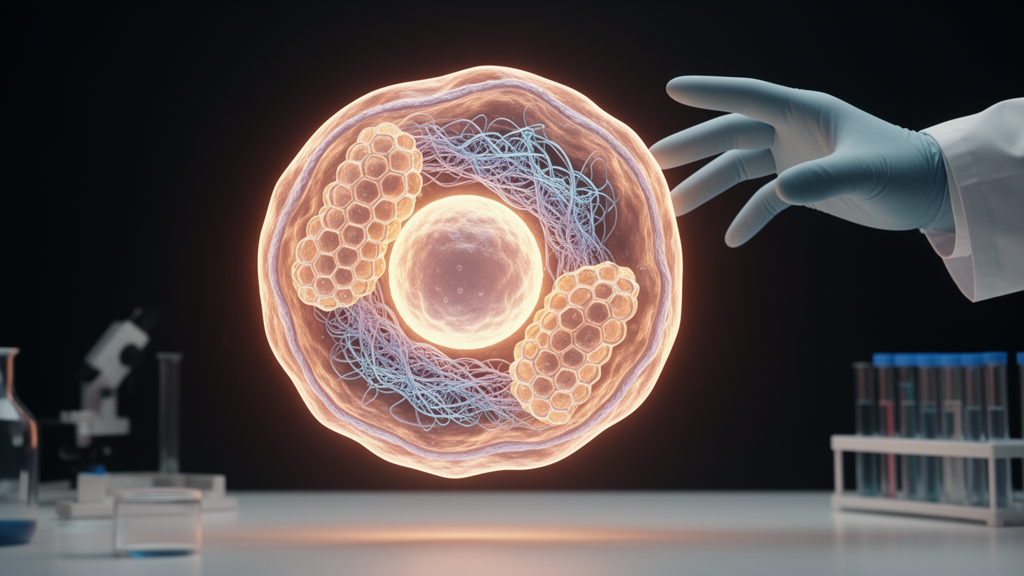
Technically, the archiving system must capture RNA molecules and protect them against natural breakdown, since RNA is normally not made to last. The researchers achieved this by borrowing a protein that occurs naturally in stress granules – accumulations of RNA that form in cells under stress, such as during an infection, when the cell temporarily shuts down parts of its metabolism and saves RNA molecules for later. The team took this stress granule protein and two other proteins and optimised them using biotechnology, creating a system that concentrates a cell’s RNA molecules in a film around the cell’s mitochondria. There, the molecules are shielded from the naturally occurring enzymes inside cells that break down RNA.
The blueprints for the three optimised proteins are introduced into the cells via plasmids, and the cells then assemble the archiving system inside themselves. Per cell, this allows several thousand RNA molecules to be archived over several days. Because the cells build the recording apparatus internally, the method operates transcriptome-wide in human cells and preserves single-cell resolution, meaning the reconstructed gene activity can be attributed to individual cells rather than to a bulk population.
The new approach could be used to detect rare events in cells, which is particularly useful when researchers only find out which cells are of interest in retrospect. In such cases, they can select those cells and then use the RNA archive to investigate which genes were previously active within them. This reverses the usual logic of single-cell experiments, in which the measurement itself is the only chance to observe a cell’s state, and any interesting cell must have been identified before the RNA was collected and the cell destroyed.
One potential area of application are tumour cells that survive a course of chemotherapy. Cells of this kind can subsequently contribute to a cancer’s recurrence, yet at present it is very difficult to investigate which cells will survive treatment and how they previously developed. “Which cells will develop into these persister cells is something that is not known in advance and is poorly understood,” says Reinkemeier. “If we can put our system to use in cancer research, we’ll be able to isolate persister cells and look into their past. This will allow us to research how these cells form and develop and could pave the way for decisive advances in cancer research.”
The researchers have applied for a patent on the new technology and want to develop it further with a view to future applications in animals and cancer research. The published study so far demonstrates the system in human cells in cell culture, including the immune-signalling experiment; extending it to animals and to tumour persister studies remains a stated goal of further development rather than a demonstrated result of the current work.
Subject of Research: New method reveals what a cell did days ago
Article Title: New method reveals what a cell did days ago
Article References: New method reveals what a cell did days ago. Original publication (Bibliographic details unavailable.)
Image Credits: AI Generated
DOI: Not provided
Keywords: method, reveals, cell, days, scientific research, peer-reviewed research
Cite Scienmag News
Juliet Wilcox. (October 26, 2026). Cellular RNA archive lets researchers reconstruct gene activity from days past. Scienmag. https://scienmag.com/cellular-rna-archive-lets-researchers-reconstruct-gene-activity-from-days-past/
Juliet Wilcox. "Cellular RNA archive lets researchers reconstruct gene activity from days past." Scienmag, 26 October 2026, https://scienmag.com/cellular-rna-archive-lets-researchers-reconstruct-gene-activity-from-days-past/. Accessed 26 October 2026.
Juliet Wilcox. "Cellular RNA archive lets researchers reconstruct gene activity from days past." Scienmag. October 26, 2026. https://scienmag.com/cellular-rna-archive-lets-researchers-reconstruct-gene-activity-from-days-past/


