


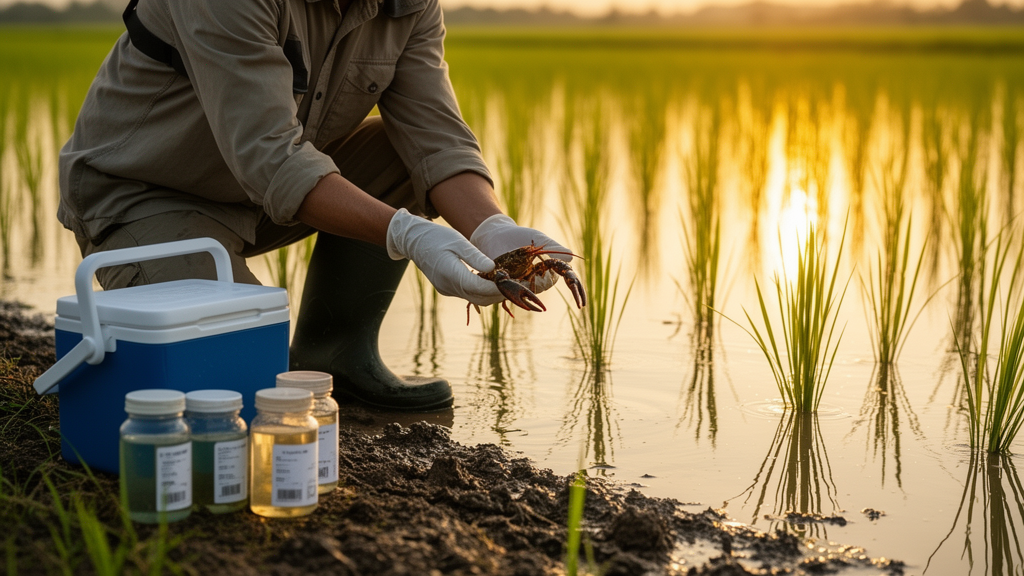
The red swamp crayfish (Procambarus clarkii) is one of the most economically important farmed crustaceans in the world, and in China it is raised under two very different conditions: intensive pond monoculture, where animals receive high-input formulated feed, and integrated rice-crayfish co-culture, where crayfish forage on a low-input natural diet within flooded paddies. A new study from Yunnan Agricultural University, published in Frontiers in Microbiology, examined how these two farming systems shape the crayfish intestine, pairing measurements of digestive, antioxidant, immune barrier and energy metabolism enzymes with 16S rRNA sequencing of the gut content-associated microbiota. The animals were reared under the two systems for 60 days before analysis.
The central result is that the two systems were associated with distinct, coordinated intestinal profiles. Rice paddy-cultured crayfish showed significantly higher amylase activity, consistent with more efficient carbohydrate utilization, together with enhanced activities of the antioxidant enzymes superoxide dismutase (SOD), catalase (CAT) and glutathione peroxidase (GSH-Px). They also had lower levels of malondialdehyde (MDA), a standard marker of oxidative damage to lipids, suggesting that their tissues experienced less oxidative stress. In parallel, these animals displayed higher activities of alkaline phosphatase (AKP) and acid phosphatase (ACP), enzymes commonly used as indicators of immune barrier function, and reduced Na⁺/K⁺-ATPase activity, which the authors interpret as a lower energy transport workload.
Pond-cultured crayfish presented essentially the mirror image. Their intestines showed elevated lipase and total protease activities, reflecting the processing of the protein- and lipid-rich formulated feed delivered in monoculture ponds. At the same time, their immune barrier enzyme activities were lower, and their energy transport workload was greater. The authors frame this as a physiological trade-off: the pond environment appears to push the animals toward a growth-oriented phenotype, with high digestive throughput but increased metabolic load and altered immune status, while the rice paddy environment favors a stress-resistance-oriented phenotype built on antioxidant defense and carbohydrate digestion.
The microbiome data reinforced this contrast. Sequencing of intestinal lumen contents revealed higher lumen-associated microbial diversity in the rice paddy group, with enrichment of the phylum Bacteroidota and of taxa commonly associated with polysaccharide degradation. This fits neatly with the elevated amylase activity observed in the same animals, since a community rich in carbohydrate-processing bacteria would be expected to complement a diet based on natural plant and detrital material in the paddies. The pond group, by contrast, was enriched in Pseudomonadota, the phylum formerly known as Proteobacteria, and included taxa such as Citrobacter and Acinetobacter, which the authors note can include potential opportunistic pathogens.
Phenotype prediction using the BugBase tool added a further layer: the pond group showed a higher relative abundance of sequences predicted to carry potentially pathogenic phenotypes. It is important to read this carefully. BugBase predictions are inferences from amplicon sequence data, not direct isolations of disease-causing organisms, and the study did not report disease outbreaks in either system. What the analysis establishes is an association between the pond environment and a lumen microbiota whose predicted functions include pathogenic potential, alongside lower measured immune barrier enzyme activity in the same animals.
Taken together, the enzyme and microbiome results suggest that the two aquaculture systems are associated with coordinated, system-wide intestinal adaptation patterns rather than isolated changes. In the rice paddy group, enhanced antioxidant defense, efficient carbohydrate utilization, reduced physiological burden and a more diverse lumen microbiota with greater abundance of potentially beneficial taxa appeared together. In the pond group, elevated metabolic load, oxidative stress indicators, altered immune status and opportunistic pathogen enrichment clustered on the other side of the comparison. The authors present these as two distinct adaptation strategies, one oriented toward stress resistance and one oriented toward growth.
The study design supports associations but not causal claims about which factor drives the differences. Diet composition, stocking density, water quality, sediment contact and the physical structure of paddies all differ between the two systems, and any of these could contribute to the observed enzyme and microbial patterns. The 60-day rearing period and the integrated enzyme-plus-sequencing approach, however, give the comparison unusual internal coherence, because physiological measurements and microbial community data point in the same direction for each group.
For aquaculture, the findings carry practical weight. Rice-crayfish co-culture is a low-input system in which crayfish exploit natural dietary resources, and the new data suggest this comes with measurable intestinal advantages, including stronger antioxidant enzyme activities, less oxidative damage and a more diverse gut microbiota. Pond monoculture, meanwhile, delivers the high digestive capacity associated with faster growth on formulated feed, but the accompanying markers of metabolic load and oxidative stress indicate a biological cost. The authors position the work as a basis for further hypothesis-driven research and as information that may help inform sustainable aquaculture practices that balance productivity with animal health and welfare.
Several questions remain open for future work. The study measured enzyme activities and lumen-associated microbiota, but did not establish functional links between specific bacterial taxa and specific host enzymes, nor did it track how these patterns develop over longer production cycles or translate into survival and growth outcomes. Follow-up experiments could test whether the potentially beneficial taxa enriched in rice paddy crayfish directly contribute to antioxidant defense or polysaccharide digestion, and whether the opportunistic taxa enriched in pond crayfish translate into disease risk under stress. As the authors emphasize, the current results provide a foundation for such hypothesis-driven research rather than final answers, marking an early but technically detailed step toward understanding how farming environment and gut biology interact in one of the world’s most farmed crustaceans.
Subject of Research: Intestinal enzyme and microbiome adaptations of red swamp crayfish in pond versus rice paddy aquaculture
Article Title: Intestinal adaptation of crayfish to pond and rice paddy farming: a microbiome-enzyme perspective
Article References: Gao, G., Wei, J., Gan, L., Wang, H., Zhang, H., Yu, X., & Bi, B. (2026). Intestinal adaptation of crayfish to pond and rice paddy farming: a microbiome-enzyme perspective. Frontiers in Microbiology, 17, Article 1989196. https://doi.org/10.3389/fmicb.2026.1989196
Image Credits: AI Generated
DOI: 10.3389/fmicb.2026.1989196
Keywords: Procambarus clarkii, red swamp crayfish, rice-crayfish co-culture, pond monoculture, gut microbiota, 16S rRNA sequencing, antioxidant enzymes, digestive enzymes, oxidative stress, aquaculture, Bacteroidota, opportunistic pathogens
Cite Scienmag News
Alan Morgan. (October 26, 2026). Crayfish Guts Tell Two Stories: Pond Feed Drives Growth, Rice Paddies Build Stress Resistance. Scienmag. https://scienmag.com/crayfish-guts-tell-two-stories-pond-feed-drives-growth-rice-paddies-build-stress-resistance/
Alan Morgan. "Crayfish Guts Tell Two Stories: Pond Feed Drives Growth, Rice Paddies Build Stress Resistance." Scienmag, 26 October 2026, https://scienmag.com/crayfish-guts-tell-two-stories-pond-feed-drives-growth-rice-paddies-build-stress-resistance/. Accessed 26 October 2026.
Alan Morgan. "Crayfish Guts Tell Two Stories: Pond Feed Drives Growth, Rice Paddies Build Stress Resistance." Scienmag. October 26, 2026. https://scienmag.com/crayfish-guts-tell-two-stories-pond-feed-drives-growth-rice-paddies-build-stress-resistance/


