


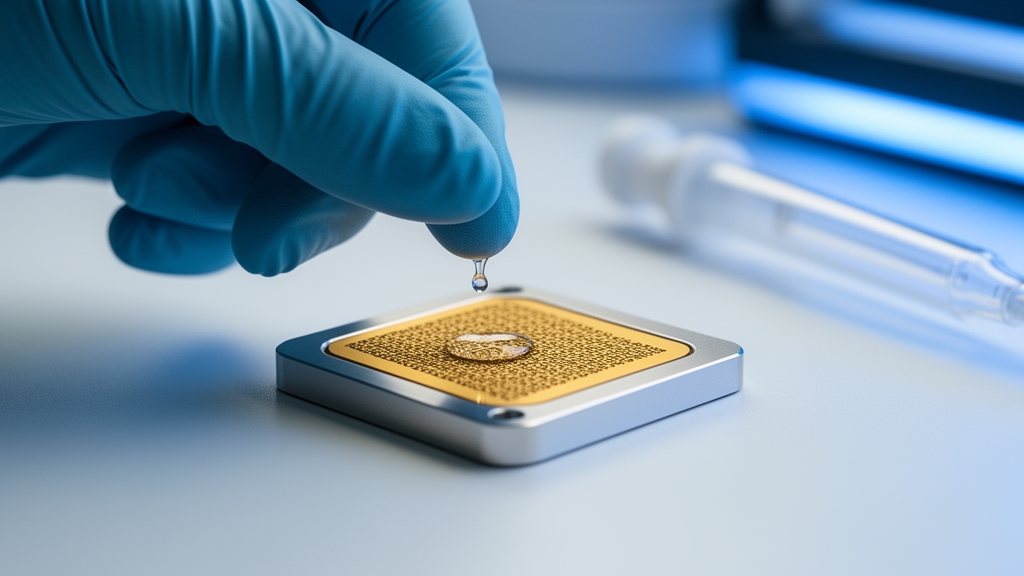
Researchers in Shanghai have built a biomimetic “artificial tongue” that can detect a cancer-associated microRNA in human saliva at concentrations as low as 3.2 femtomolar, and in a preliminary clinical test it separated saliva samples from head and neck squamous cell carcinoma (HNSCC) patients and healthy volunteers with an area under the receiver operating characteristic curve of 0.901. The device, described in Frontiers in Bioengineering and Biotechnology, combines a two-dimensional MBene semiconductor with gold nanoparticles on thin-film transistors, and its 64-channel array can map the spatial distribution of the target molecule across a tongue-shaped surface rather than returning a single averaged reading.
HNSCC is among the most common malignant tumors of the head and neck, and its prognosis remains poor largely because the disease is often diagnosed late. Current diagnostic pathways rely on tissue biopsy and imaging, which are invasive or cumbersome, suffer from poor patient compliance, and catch relatively few tumors at an early stage. Saliva has long attracted attention as an alternative sample: it is easy to collect, non-invasive, and rich in proteins and nucleic acids whose levels track disease status. Among these candidates, microRNA-27a, a small non-coding RNA that regulates processes involved in tumor occurrence, invasion, and metastasis, has been reported as a promising molecular marker for HNSCC-related assessment. The practical obstacle has been the sensitivity and integration of existing detection platforms, which is precisely the gap the new device was designed to close.
The sensing core of the platform is a nanocomposite the team calls AuNPs@MBene. MBene, a two-dimensional material derived by etching aluminum layers from a layered MoAlB precursor with sodium hydroxide, offers high electron mobility, good biocompatibility, and a layered structure that makes it an ideal semiconductor substrate for transistor-based sensing. Gold nanoparticles, produced by the classic sodium citrate reduction of chloroauric acid, were then grafted onto the MBene sheets through a hydrothermal reaction at 120 degrees Celsius for 12 hours. Microscopy showed the resulting hybrid retained its sheet-like morphology while carrying numerous uniformly distributed nanoparticles, and elemental mapping confirmed the characteristic aluminum, boron, and molybdenum signatures of the MBene framework. Functionally, the layered MBene provides a conductive, structurally stable support, while the gold nanoparticles supply abundant anchoring sites for DNA probes and accelerate electron transfer, sharpening the signal response.
To turn the composite into a sensor, the researchers drop-cast a dispersion of the nanocomposite onto the channel region of thin-film transistor chips with pre-sputtered gold source and drain electrodes, then immobilized a thiol-terminated DNA capture probe complementary to microRNA-27a through self-assembled gold-sulfur bonds. A mercaptohexanol blocking step occupied remaining non-specific binding sites. When target microRNA hybridizes with the immobilized probes, it modulates the transistor’s source-drain current, and the relative current change serves as the quantitative readout. The team systematically optimized four parameters: the response peaked at a capture probe concentration of 40 micromolar, plateaued after 30 minutes of incubation, was strongest at neutral pH 7.0 within a tested range of 4 to 9, and was maximal at 37 degrees Celsius within a range of 32 to 45 degrees, matching physiological conditions.
Analytical performance testing showed the device is both sensitive and robust. Stored sealed and dry at 4 degrees Celsius for one month, it lost only 1.12 percent of its signal response to a 100 femtomolar target. Five independently fabricated batches produced responses with a relative standard deviation of just 1.21 percent, indicating strong batch-to-batch consistency. The sensor responded far more strongly to microRNA-27a than to mismatched sequences, non-homologous microRNAs, or blank buffer, demonstrating that the signal arises from specific molecular recognition rather than background adsorption. Across a calibration series spanning 10 femtomolar to 1 nanomolar, the response was linear with a correlation coefficient of 0.9886, and the calculated limit of detection was 3.2 femtomolar at a signal-to-noise ratio of 3.0. Recovery tests in spiked healthy saliva returned values between 98.5 and 101.2 percent with a relative standard deviation of 1.31 percent.
The most distinctive feature of the platform is its geometry. Rather than a single sensing element, the team arranged 64 independent AuNPs@MBene transistors in an 8-by-8 array on a custom printed circuit board, creating what they describe as the first high-channel artificial tongue designed specifically for HNSCC heterogeneity. Because HNSCC tumors are typically unilateral, they can create regional gradients of shed microRNA in the oral cavity that single-point or pooled sampling inevitably averages away. To test the concept, the researchers 3D-printed a silicone tongue mold and placed microRNA standards at concentrations from 10 femtomolar to 1 nanomolar at different positions to simulate a non-uniform distribution. Each channel produced an independent output, and the spatial signal pattern was recorded at three time points, before sample addition and 15 and 30 minutes after, showing that the array can capture both spatial variation and temporal evolution of the target across the sensing surface.
The preliminary clinical evaluation involved 11 healthy volunteers and 13 patients with pathologically confirmed HNSCC, recruited under hospital ethics approval with no statistically significant differences in baseline age or sex between the groups. Early-morning saliva samples, roughly 2 milliliters each, were collected after fasting and mouth rinsing, centrifuged, and stored at minus 80 degrees Celsius. Fifty microliters of supernatant were applied to the device, incubated at 37 degrees Celsius for 30 minutes, rinsed, and measured, with each sample tested in triplicate. Signals from the HNSCC group were significantly higher than those from the healthy controls, with an independent samples t-test yielding p = 0.00027, and ROC analysis produced an area under the curve of 0.901, indicating good separation between the two groups based on the device response.
The authors are careful to frame these clinical results as preliminary validation rather than proof of diagnostic value. The cohort was small and drawn from a single center, the device readings were not compared against a reference method such as quantitative reverse transcription PCR, and the potential interference of salivary matrix components such as mucins on long-term sensor stability has not been systematically investigated. Material characterization also has gaps: the overlap between sputter-coated gold and the nanoparticles prevented definitive confirmation of gold loading by energy-dispersive spectroscopy, and residual aluminum from incomplete etching was not fully eliminated. The study also relies on a single biomarker, laboratory-based sample preparation, and benchtop instrumentation rather than a portable readout.
The team outlines a roadmap for addressing these limitations. Future materials work could explore ternary composites pairing MBene with other two-dimensional materials such as molybdenum disulfide or graphene, or incorporate metal-organic frameworks and conductive polymers to raise carrier mobility and add active sites, while tuning nanoparticle size, morphology, and loading density could further improve interfacial electron transfer for detecting even lower-abundance tumor markers. On the systems side, the researchers envision integrating the array with flexible circuits, wireless transmission, and smartphone terminals to create point-of-care devices, and applying machine learning to multi-channel signal patterns to distinguish different stages or subtypes of HNSCC. The platform could also be extended to multiplexed detection of biomarkers for other oral diseases, including periodontitis and oral precancerous lesions.
Before any of that translates into the clinic, the authors emphasize that larger, multicenter, prospective studies will be needed to establish reference intervals and diagnostic cut-off values for salivary microRNA-27a in healthy populations, and to evaluate whether the artificial tongue genuinely adds value in postoperative recurrence monitoring, treatment response assessment, and screening of high-risk groups. Integrated microfluidic chips that filter, dilute, or enrich saliva online before detection could improve reliability against the complexities of the salivary matrix. For now, the study demonstrates feasibility: a label-free, femtomolar-sensitive, spatially resolved transistor array that reads a cancer-associated microRNA directly from saliva, with encouraging but early discrimination between a small group of HNSCC patients and healthy controls.
Subject of Research: A biomimetic AuNPs@MBene thin-film transistor sensor array for non-invasive salivary microRNA-27a detection in head and neck squamous cell carcinoma assessment
Article Title: A biomimetic AuNPs@MBene-TFT artificial tongue for sensitive non-invasive salivary microRNA-27a detection in HNSCC assessment
Article References: Enhong, X., Penghui, F., Li, C., Zuoheng, S., Weiyu, F., Aonan, G., Longbao, D., Qingyun, Z., Qian, Z., & Huanhai, L. (2026). A biomimetic AuNPs@MBene-TFT artificial tongue for sensitive non-invasive salivary microRNA-27a detection in HNSCC assessment. Frontiers in Bioengineering and Biotechnology, 14, Article 1934495. https://doi.org/10.3389/fbioe.2026.1934495
Image Credits: AI Generated
DOI: 10.3389/fbioe.2026.1934495
Keywords: artificial tongue, biosensor, thin-film transistor, MBene, gold nanoparticles, microRNA-27a, saliva diagnostics, head and neck squamous cell carcinoma, liquid biopsy, limit of detection, 64-channel array, non-invasive detection
Cite Scienmag News
Nathaniel Bowman. (October 26, 2026). Artificial Tongue Sensor Detects Cancer-Linked microRNA in Saliva at Femtomolar Levels. Scienmag. https://scienmag.com/artificial-tongue-sensor-detects-cancer-linked-microrna-in-saliva-at-femtomolar-levels/
Nathaniel Bowman. "Artificial Tongue Sensor Detects Cancer-Linked microRNA in Saliva at Femtomolar Levels." Scienmag, 26 October 2026, https://scienmag.com/artificial-tongue-sensor-detects-cancer-linked-microrna-in-saliva-at-femtomolar-levels/. Accessed 26 October 2026.
Nathaniel Bowman. "Artificial Tongue Sensor Detects Cancer-Linked microRNA in Saliva at Femtomolar Levels." Scienmag. October 26, 2026. https://scienmag.com/artificial-tongue-sensor-detects-cancer-linked-microrna-in-saliva-at-femtomolar-levels/


