


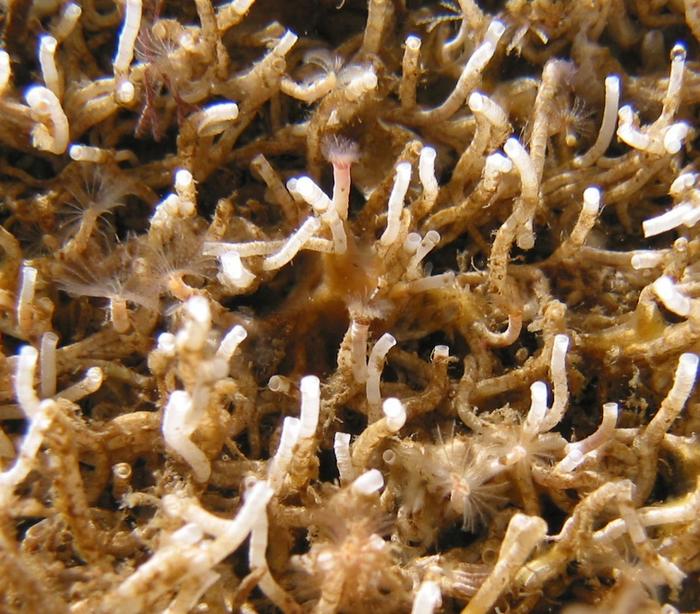
Most bottom-dwelling marine invertebrate animals, such as sponges, corals, worms and oysters, produce tiny larvae that swim in the ocean prior to attaching to the seafloor and transforming into juveniles. A previous study led by researchers at the University of Hawai‘i (UH) at Mānoa School of Ocean and Earth Science and Technology (SOEST) unlocked the mystery of how the floating larvae responsible for establishing marine biofouling settle and metamorphose: specific bacteria in biofilms are a signal that they have found the “right spot.”

Credit: University of Hawai‘i at Mānoa
Most bottom-dwelling marine invertebrate animals, such as sponges, corals, worms and oysters, produce tiny larvae that swim in the ocean prior to attaching to the seafloor and transforming into juveniles. A previous study led by researchers at the University of Hawai‘i (UH) at Mānoa School of Ocean and Earth Science and Technology (SOEST) unlocked the mystery of how the floating larvae responsible for establishing marine biofouling settle and metamorphose: specific bacteria in biofilms are a signal that they have found the “right spot.”
A recent study, led by Marnie Freckelton, a postdoctoral researcher at the Kewalo Marine Lab, a unit of the Pacific Biosciences Research Center (PBRC) in SOEST, revealed that the carbohydrate portion of a complex molecule, called lipopolysaccharide, produced by specific bacteria is responsible for inducing the process in larval marine tubeworms, Hydroides elegans.
“The tubeworm is a dominant member of its benthic communities and a major problem for the shipping industry as it coats the hulls and propellers of ships, as well as piers, the nets of mariculture facilities, and the pipes that bring cooling sea water to electrical and industrial facilities,” said Michael Hadfield, senior author on the paper and emeritus professor in PBRC.
The bacterial communities that first and rapidly coat newly submerged surfaces in the seas are key determinants of what chemicals are produced and therefore what chemical signals are received by marine larvae. The new research is groundbreaking in its analysis of the chemicals on the surfaces of specific biofilm bacterial species that interact with receptors on the surfaces of larvae of this globally distributed, warm-water tubeworm and induce them to settle and transform.
“In this way, biofilm bacteria initially establish and then maintain communities of animals and plants on the ocean bottoms by recruiting their larvae and spores to the sites,” said Freckelton. “The research provides strong evidence for the bacterial-molecular basis of the formation and maintenance of all benthic marine communities in the world’s seas.”
Mysteries remain
Throughout their research, the team of scientists noted that many other – in fact, most – biofilm bacterial species do not induce settlement in the tubeworm larvae. And even among different strains of the same bacteria collected from different habitats, some will induce settling and others will not. The researchers found that extracts of the carbohydrate portion of the lipopolysaccharides retained the same inductive or non-inductive effect. Lipopolysaccharides are incredibly common but diverse bacterial molecules, which means that they are everywhere but specific and could readily explain how different organisms settle in different locations.
“Looking to the future, we are interested in an in-depth structural understanding of the parts of these molecules that induce settlement and metamorphosis in marine species and how they interact in the larvae,” said Freckelton. “We also plan to test the larvae of other marine invertebrates, such as coral, for patterns in their settlement cues.”
Journal
Communications Biology
Method of Research
Experimental study
Subject of Research
Animals
Article Title
Bacterial envelope polysaccharide cues settlement and metamorphosis in the biofouling tubeworm Hydroides elegans
Article Publication Date
19-Jul-2024
COI Statement
The authors declare no competing interests.
Cite Scienmag News
Violet Maxwell. (August 6, 2024). Carbohydrate produced by bacteria triggers marine biofouling. Scienmag. https://scienmag.com/carbohydrate-produced-by-bacteria-triggers-marine-biofouling/
Violet Maxwell. "Carbohydrate produced by bacteria triggers marine biofouling." Scienmag, 6 August 2024, https://scienmag.com/carbohydrate-produced-by-bacteria-triggers-marine-biofouling/. Accessed 4 September 2026.
Violet Maxwell. "Carbohydrate produced by bacteria triggers marine biofouling." Scienmag. August 6, 2024. https://scienmag.com/carbohydrate-produced-by-bacteria-triggers-marine-biofouling/

