


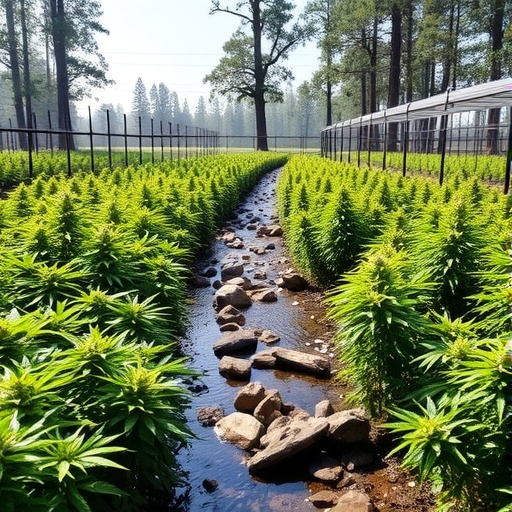
Groundwater pumping to irrigate cannabis farms in California’s Emerald Triangle may be quietly draining the streams that sustain some of the region’s most important salmon habitat, according to a new study by researchers from Simon Fraser University, the University of California, Berkeley, and the United States Department of Agriculture. The research shows that extracting water from underground aquifers in mountainous headwaters can reduce streamflow during the very months when rivers, fish, and ecosystems are already under the greatest pressure from heat and drought.
The study focuses on two watersheds in the Emerald Triangle, a globally recognized cannabis-growing region spanning parts of Northern California. Although the area is known for its rugged terrain, forests, and remote valleys, its water systems are highly sensitive to changes in underground storage. Many small streams in these headwaters appear disconnected from groundwater, but they are often sustained by slow subsurface releases that continue after rainfall and snowmelt have ended. When that hidden water is pumped for irrigation, the impact can eventually appear at the surface.
Using a new modelling approach based on storage-discharge functions, the researchers examined 580 combinations of groundwater use, hydrological conditions, and agricultural demand. Their simulations were designed to capture how water moves through steep upland catchments, where aquifers may store relatively limited amounts of water and where streams can respond quickly to changes in subsurface supplies. The results indicate that realistic levels of agricultural pumping can cause seasonal streams to stop flowing as much as five weeks earlier than they otherwise would.
In some scenarios, streams that normally flow throughout the year could dry up completely during summer. The most severe effects occurred during dry years, when rainfall and snowmelt provide less recharge and the underground reserves supporting streamflow are already depleted. The modelling also showed that watersheds with limited water-storage capacity were especially vulnerable. In these systems, groundwater extraction can reduce the slow, delayed release of water into stream channels, effectively shortening the period during which streams remain connected and flowing.
The findings challenge the common assumption that groundwater and surface water are separate resources. In reality, streams and aquifers often function as parts of the same hydrological system. Water infiltrates into soil and fractured rock, moves underground, and later emerges as springs or diffuse seepage that maintains streamflow between storms. Pumping can intercept that movement before it reaches the channel. The effect may not be visible immediately at the well, but it can emerge weeks or months later as lower flows, warmer water, or an earlier transition from flowing stream to dry channel.
“People often think of groundwater or aquifers as a separate resource from streams. But in many landscapes, they’re connected parts of the same system,” said Jesse Hahm, an assistant professor of geography at Simon Fraser University and a co-author of the study. He emphasized that the timing and location of water use may matter as much as the total volume extracted. Irrigation demand often rises during heat waves and droughts, precisely when aquatic ecosystems have the least water available.
That seasonal overlap could create a dangerous feedback loop for fish. Salmon and other aquatic species depend on cool, connected streams for migration, feeding, and survival. Lower flows can reduce the amount of available habitat, increase water temperatures, and isolate pools that serve as refuges during the dry season. When headwater channels lose water, the effects can also propagate downstream, reducing the amount of water entering larger rivers and potentially affecting ecosystems far beyond the original pumping site.
The researchers found that measurable impacts were possible even when cannabis cultivation occupied only a small fraction of a watershed. This result is significant because it suggests that the hydrological consequences of irrigation cannot be estimated simply by looking at the percentage of land covered by farms. A relatively small agricultural area may still draw heavily on a shared underground system, particularly if wells are concentrated in locations where groundwater contributes directly to nearby streams. The physical connection between pumping and streamflow, rather than the visible size of the cultivated area, determines the risk.
Climate change is likely to intensify these pressures across western North America. Snowpack traditionally acts as a natural reservoir, storing winter precipitation and releasing it gradually through spring and early summer. Warmer winters, declining snowpack, and earlier snowmelt are changing when water enters and leaves mountain watersheds. As natural supplies become less reliable, farms and communities may turn increasingly to groundwater. The new study suggests that this strategy can protect one water source while weakening another, especially during prolonged dry periods.
Published in the Journal of Hydrology, the research provides a framework for evaluating groundwater use in headwater catchments where conventional monitoring may miss delayed connections between wells and streams. By linking underground storage, pumping, and streamflow timing, the approach could help water managers identify vulnerable watersheds before ecological damage becomes obvious. The authors say that understanding these hidden connections will be essential for balancing agricultural production with the protection of salmon habitat, downstream rivers, and the wider environmental systems that depend on mountain water.
Web References: https://www.sciencedirect.com/science/article/pii/S0022169426010620
References: Journal of Hydrology. DOI: 10.1016/j.jhydrol.2026.135965. Article publication date: 5-Jul-2026.
Cite Scienmag News
Alan Morgan. (August 4, 2026). Cannabis cultivation is draining California streams, scientists warn. Scienmag. https://scienmag.com/cannabis-cultivation-is-draining-california-streams-scientists-warn/
Alan Morgan. "Cannabis cultivation is draining California streams, scientists warn." Scienmag, 4 August 2026, https://scienmag.com/cannabis-cultivation-is-draining-california-streams-scientists-warn/. Accessed 4 September 2026.
Alan Morgan. "Cannabis cultivation is draining California streams, scientists warn." Scienmag. August 4, 2026. https://scienmag.com/cannabis-cultivation-is-draining-california-streams-scientists-warn/


