


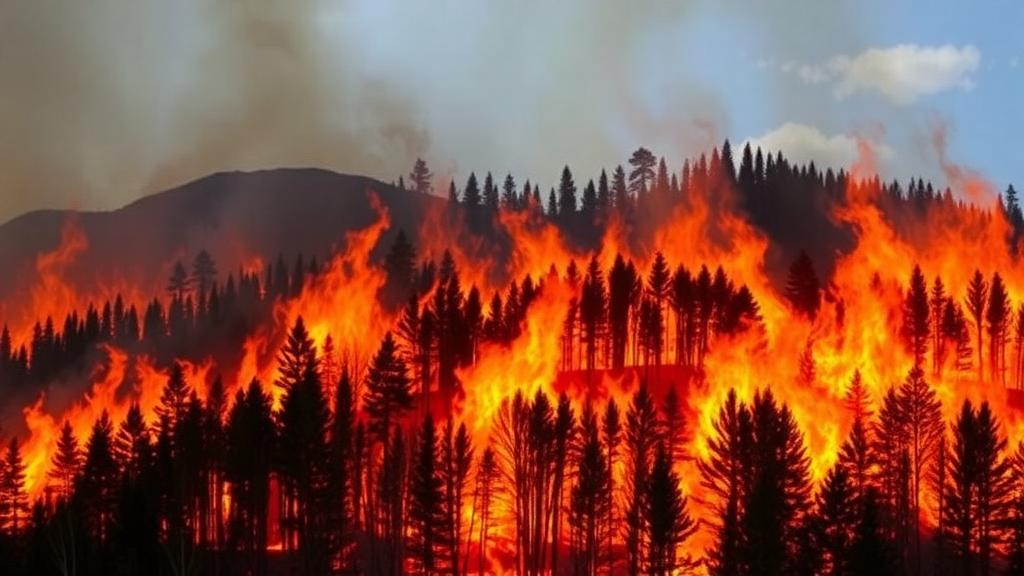
When smoke from Canada’s 2023 wildfires turned the skies over New York an eerie orange and health alerts kept millions of people indoors along the eastern seaboard, something else was shifting quietly behind the scenes: the way journalists wrote about the disaster. A new analysis from Concordia University suggests that the country’s worst wildfire season on record did more than burn more than 15 million hectares of forest. It also appears to have broken a longstanding pattern of caution in mainstream media coverage, in which reporters rarely drew explicit connections between extreme weather events and climate change.
The study, published in the journal Journalism Practice, examined almost 2,000 news stories published between May and December 2023 by six Canadian and US news organizations: The Globe and Mail, Le Devoir, Le Journal de Montréal, The New York Times, The Boston Globe and The New York Post. The sample was deliberately broad, spanning English- and French-language coverage, prestige broadsheets and popular tabloids, and both straight news reporting and opinion writing. That breadth allowed the researchers to ask not only how often climate change came up, but which kinds of newsrooms, formats and contexts made those mentions more likely.
The headline finding is striking for anyone who has followed media scholarship on climate coverage. Nearly 40 per cent of all stories in the sample mentioned climate change, and more than 30 per cent explicitly connected the wildfires to it. Those figures stand far above the levels reported in earlier studies of disaster coverage, which the study’s corresponding author, Amélie Daoust-Boisvert, an associate professor in Concordia’s Department of Journalism, describes as typically ranging from only 2 to around 15 per cent. In other words, the 2023 fires produced some of the highest rates of climate attribution ever documented in mainstream press coverage of a natural disaster.
Daoust-Boisvert says the team was somewhat surprised by the sheer volume of climate mentions and connections they observed, given how low the levels found in previous studies tended to be. She was less surprised to find a gap between legacy broadsheets and tabloids, but noted that even the tabloids were not entirely silent on climate change. The co-author of the study is Brianna Losinger Ross, a PhD candidate in political science. Together, the two researchers combined automated text mining with human coding, a hybrid method that proved essential to the accuracy of their results.
That methodological choice matters. Keyword searches alone could flag climate-related terms in stories where no actual connection to the fires was being made. A phrase such as spreading like wildfire, for example, contains the word wildfire but says nothing about the climate. By manually reviewing the relevant stories, the researchers could distinguish genuine attribution from incidental vocabulary, avoiding the false positives that can inflate counts in purely computational analyses. This distinction between mentioning climate terms and making an explicit causal link is at the heart of the study’s contribution.
The analysis also revealed which factors most strongly shaped whether a story connected the fires to climate change. The likelihood of attribution varied most according to the newsroom producing the story and whether the piece was news or opinion. Language, country and whether a publication was a tabloid or a broadsheet had smaller effects. Opinion writing was by far the most climate-conscious category: almost 78 per cent of opinion pieces mentioned climate change, and about 65 per cent of them explicitly tied the fires to it. News stories lagged behind, with about 34 per cent mentioning climate change and 26 per cent making the explicit connection, a pattern consistent with the traditional reluctance of reporters to editorialize about causes.
One event appears to have acted as a turning point within the coverage period. In August 2023, the international scientific collaboration World Weather Attribution published a report examining the root causes of extreme climate events, concluding that climate change more than doubled the likelihood of the extreme fire weather conditions seen in Quebec. According to the researchers, climate mentions and connections became more pronounced after the report’s publication. Their statistical analysis shows clear trends before and after that date, suggesting that journalists seized on the peer-reviewed attribution work as the authoritative source they needed before asserting that climate change was involved in the catastrophe.
Daoust-Boisvert points out that journalists always need a source before they can write that climate change is involved in or contributing to a natural disaster, and that the World Weather Attribution report provided exactly that. She also notes that the field of extreme weather attribution has expanded considerably over the past few years, which means reporters increasingly feel confident making the link between warming and specific disasters going forward. The researchers suggest that media practices are shifting in part because of journalists’ better understanding of the scientific consensus around climate change and its relationship to extreme weather events. In effect, rapid attribution science is giving newsrooms a defensible factual basis for statements that once would have been treated as too speculative for straight reporting.
The findings arrive with important caveats. Daoust-Boisvert emphasizes that climate remains a politicized and polarizing topic, and that straightforward reporting on it faces pressure from influential voices across the political spectrum. Newsrooms navigating that landscape must weigh scientific evidence against audience expectations, ownership priorities and the risk of accusations of advocacy. The differences the study found between newsrooms and between news and opinion formats reflect those tensions, even in a year when the physical evidence of a climate-fuelled disaster was impossible to ignore.
There is also a subtler risk on the horizon. As extreme weather events become the new normal, Daoust-Boisvert cautions, they could lose their newsworthiness, leading to a decrease in the urgency of addressing anthropogenic climate change. The 2023 wildfire season, fuelled by record-breaking drought and unusually high temperatures, was voted the Canadian Press news story of the year, and its unprecedented scale helped push climate framing into the mainstream. Whether that realignment persists, or fades as such disasters become routine, may determine how effectively the media informs the public about the defining environmental challenge of the era. For now, the study offers quantitative evidence that a historic disaster can move journalistic norms, and that attribution science is becoming the bridge between the newsroom and the climate research community.
Subject of Research: Media attribution of the 2023 Canadian wildfires to climate change
Article Title: Canada’s 2023 wildfires broke longstanding media caution around climate reporting
Article References: Canada’s 2023 wildfires broke longstanding media caution around climate reporting. (n.d.). Original publication
Image Credits: AI Generated
DOI: Not provided
Keywords: climate change, wildfires, journalism, media coverage, attribution science, World Weather Attribution, Concordia University, Canada, news analysis, extreme weather, Journalism Practice, climate communication
Cite Scienmag News
Sloane Callahan. (October 1, 2026). Canada’s Record 2023 Wildfires Pushed Media to Link Disasters to Climate Change. Scienmag. https://scienmag.com/canadas-record-2023-wildfires-pushed-media-to-link-disasters-to-climate-change/
Sloane Callahan. "Canada’s Record 2023 Wildfires Pushed Media to Link Disasters to Climate Change." Scienmag, 1 October 2026, https://scienmag.com/canadas-record-2023-wildfires-pushed-media-to-link-disasters-to-climate-change/. Accessed 4 October 2026.
Sloane Callahan. "Canada’s Record 2023 Wildfires Pushed Media to Link Disasters to Climate Change." Scienmag. October 1, 2026. https://scienmag.com/canadas-record-2023-wildfires-pushed-media-to-link-disasters-to-climate-change/


