


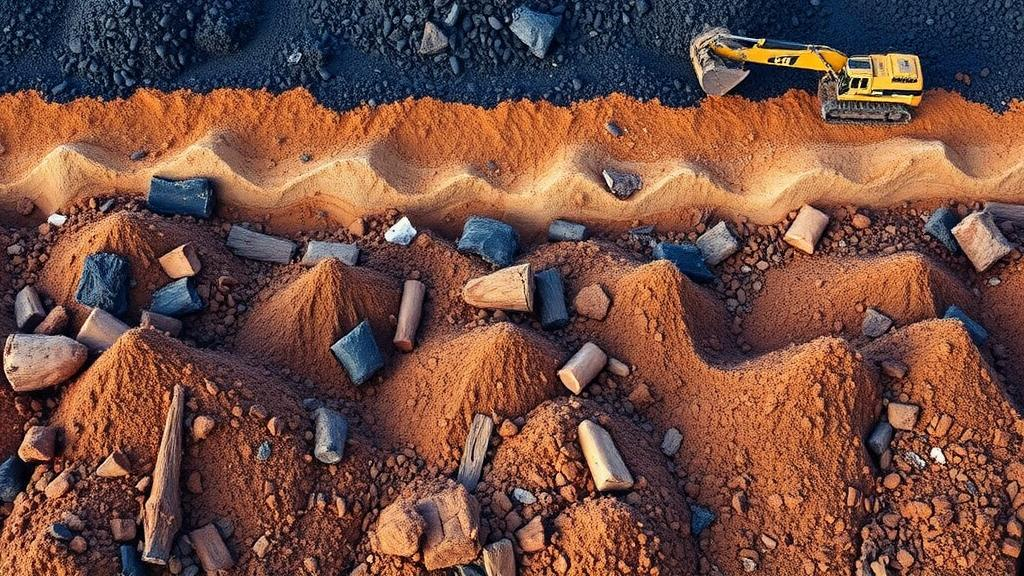
In the coal-rich heart of northern China, where mines, power plants, and cement kilns cluster within a few kilometers of one another, an enormous stream of industrial leftovers piles up every year: heaps of coal gangue, mountains of fly ash, and an endless supply of excavated soil from construction sites. A new study published in Case Studies in Construction Materials shows that these three waste streams, which are usually treated as disposal problems, can be blended into a single high-performance construction material that pours like a liquid, hardens like engineered fill, and cuts both cost and carbon emissions by more than a third compared with conventional cement-based alternatives.
The research, led by Wen Zheng and colleagues at Yulin University, focuses on flowable backfill materials, known in engineering practice as controlled low-strength materials or flowable fill. These self-compacting slurries are pumped into utility trenches, abandoned pipelines, mine voids, and foundation excavations where mechanical compaction is impossible. Conventional formulations rely on ordinary Portland cement and virgin sand, which makes them technically reliable but environmentally costly. The team’s alternative replaces up to 40 percent of the cement with calcined coal gangue and fly ash, while using local excavated soil as the bulk filling phase rather than quarried aggregate.
The key innovation is what the authors call a resource-coupling mode, demonstrated at Jinjie Industrial Park in the Shanxi–Shaanxi–Inner Mongolia energy triangle. There, the coal preparation plant supplying gangue, the coal-fired power plant supplying fly ash, and the cement plant all sit within a two-kilometer radius. This geographic proximity allows the gangue to be calcined at around 700 degrees Celsius using waste heat from cement production, then ground and blended with fly ash and cement into a standardized binder that is mixed with excavated soil and water on site. Transport distances, and the emissions and costs they carry, effectively collapse to zero.
The chemistry behind the system is a carefully balanced three-way partnership. Calcining coal gangue transforms its kaolinite content into reactive metakaolin-like aluminosilicate phases. When cement hydrates, it releases calcium hydroxide, and these reactive phases consume it in pozzolanic reactions that form additional calcium silicate hydrate and calcium aluminosilicate hydrate gels, the glues that bind the matrix together. Fly ash plays a different role: its smooth spherical particles act as internal ball bearings that dramatically improve slurry flow, while also contributing to particle packing and later-age strength. Each material compensates for the other’s weaknesses.
To quantify this complementarity rather than merely assert it, the researchers ran a two-stage statistical experiment. A constrained mixture design first varied the proportions of cement, calcined gangue, and fly ash while holding soil content and water-to-solid ratio fixed. The fitted models showed that fly ash contributed most to flowability, while calcined gangue outperformed fly ash in strength: at equal 50 percent cement replacement, the gangue blend reached 3.61 megapascals at 28 days against 2.63 megapascals for the fly ash blend. A second central composite design then explored how soil fraction and water content interact, revealing that soil content was the dominant strength-limiting factor because the soil acts purely as an inert filler.
From these models the team identified a feasible processing window of 80 to 84 percent excavated soil and a water-to-solid ratio between 0.39 and 0.45, satisfying thresholds of at least 200 millimeters of flow spread and 0.8 megapascals of seven-day strength. The optimized reference formulation, 60 percent cement, 25 percent calcined gangue, and 15 percent fly ash, achieved a flow spread of 222 millimeters, a bleeding rate of 3.52 percent, and 28-day strength of 3.62 megapascals, beating both binary blends by 14.6 and 27.5 percent respectively.
Microscopic analysis explained why the ternary blend wins. X-ray diffraction and thermogravimetry showed that the optimized mix retained moderate calcium hydroxide levels, evidence that the calcined gangue was actively consuming the cement’s hydration byproduct in secondary reactions. Scanning electron microscopy revealed unreacted gangue and fly ash particles bridged together by needles of ettringite and gel-like hydration products, forming an interconnected load-transfer network. Nuclear magnetic resonance confirmed that the ternary system refined the pore structure, shifting the distribution toward finer pores relative to either binary system, and regional elemental mapping showed calcium-rich zones consistent with abundant cementitious gel.
The economic and environmental accounting is striking. Under a cradle-to-gate boundary, the optimized formulation reduced material cost by 34.6 percent and carbon emissions by 40.3 percent, from 217.2 to 129.6 kilograms of carbon dioxide equivalent per cubic meter, compared with a pure cement reference. At a production scale of 100,000 cubic meters per year, the authors estimate the approach would valorize roughly 99,000 tonnes of excavated soil, 4,700 tonnes of calcined coal gangue, and 2,800 tonnes of fly ash, saving about 20 mu of land and avoiding approximately 8,760 tonnes of carbon dioxide equivalent annually. The team also proposed scenario-specific recipes: a strength-oriented mix for load-bearing backfill, a flow-oriented mix for pumpable filling, and a cost-oriented mix for bulk disposal.
The authors are careful to note the limits of their work. The results rest on laboratory testing up to 28 days with specific local raw materials, and long-term durability under freeze–thaw cycling, sulfate attack, drying shrinkage, and contaminant immobilization remains unverified. The leaching screening of raw fly ash showed chromium slightly above a groundwater reference value, though hardened-material leaching was not assessed. Even so, the study offers a compelling template for energy-intensive regions worldwide: instead of shipping waste away and hauling virgin materials in, co-located industries can couple their residual streams into locally usable, performance-tuned construction materials, turning three disposal burdens into a single low-carbon product.
Subject of Research: Resource utilization of excavated soil and coal-based solid wastes in flowable backfill materials
Article Title: Resource utilization of excavated soil and coal-based solid wastes under resource coupling mode in energy agglomeration areas: A case study on flowable backfill materials
Article References: Zheng, W., Liu, W., Wei, F., Li, Y., Liu, N., & Ai, X. (2026). Resource utilization of excavated soil and coal-based solid wastes under resource coupling mode in energy agglomeration areas: A case study on flowable backfill materials. Case Studies in Construction Materials, 25, Article e06569. https://doi.org/10.1016/j.cscm.2026.e06569
Image Credits: AI Generated
DOI: 10.1016/j.cscm.2026.e06569
Keywords: flowable backfill, controlled low-strength materials, coal gangue, fly ash, excavated soil, solid waste utilization, low-carbon construction, pozzolanic reaction, mixture design, carbon emissions, energy agglomeration areas, resource coupling
Cite Scienmag News
Denise Maddox. (October 1, 2026). Turning Excavated Soil and Coal Waste Into Low-Carbon Flowable Backfill. Scienmag. https://scienmag.com/turning-excavated-soil-and-coal-waste-into-low-carbon-flowable-backfill/
Denise Maddox. "Turning Excavated Soil and Coal Waste Into Low-Carbon Flowable Backfill." Scienmag, 1 October 2026, https://scienmag.com/turning-excavated-soil-and-coal-waste-into-low-carbon-flowable-backfill/. Accessed 4 October 2026.
Denise Maddox. "Turning Excavated Soil and Coal Waste Into Low-Carbon Flowable Backfill." Scienmag. October 1, 2026. https://scienmag.com/turning-excavated-soil-and-coal-waste-into-low-carbon-flowable-backfill/


