


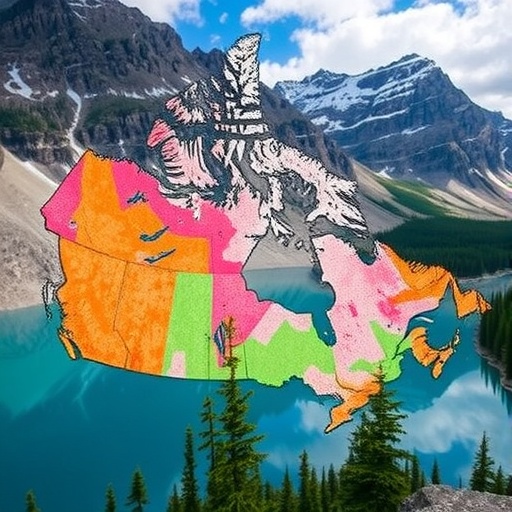
In recent decades, climate change has dramatically altered the rhythm of Canada’s natural environment, rendering its seasons increasingly erratic, its weather patterns more extreme, and its ecosystems less predictable. Scientists at the University of British Columbia Okanagan campus have broken new ground by creating the first comprehensive national map pinpointing the regions where this growing environmental unpredictability, or stochasticity, is most acutely impacting biodiversity. This unprecedented study delves deeply into the nuanced ways in which random, hard-to-forecast environmental variations are reshaping the natural landscapes across the country’s vast 9.8 million square kilometers.
Published in the prestigious journal Communications Earth & Environment, the research exposes a critical misalignment between the locations experiencing the highest environmental variability and the existing network of protected areas in Canada. Contrary to expectations, the findings suggest the areas most buffered from climate-driven chaos are paradoxically those least safeguarded by parks and conservation zones. This unsettling discovery challenges the foundational assumptions guiding conservation efforts and highlights urgent gaps in the protection of habitats most vital to biodiversity resilience in the face of accelerating climate dynamics.
Dr. Michael J. Noonan, leading the Quantitative Ecology Lab at UBC Okanagan, describes their approach as an effort to “predict the unpredictable.” The team capitalized on an extensive dataset comprising over 40 years of daily satellite-derived vegetation observations, spanning 1981 to 2025. These high-resolution temporal data allowed the researchers to produce spatially explicit models that capture the stochastic fluctuations in environmental conditions with unparalleled precision. By quantifying how variable levels of stochasticity affect ecosystems, the study bridges a critical gap in understanding the interplay between climate instability and biodiversity health on a continental scale.
The term stochasticity, central to this analysis, refers to the random, inherently unpredictable variation in environmental factors that species must endure and, ultimately, adapt to survive. Over the decades studied, environmental stochasticity in Canada has not remained static but shows a troubling trend of steady escalation. More alarmingly, this variability does not distribute evenly across regions; some ecozones are buffeted by greater environmental swings, while others retain relative stability. This uneven pattern has profound implications for species richness and ecosystem functionality.
A compelling outcome of this research is the negative correlation identified between environmental instability and species diversity. Regions where stochasticity is elevated tend to harbor significantly fewer plant and animal species, a relationship that holds true even when controlling for overall ecosystem productivity. This indicates that unpredictability itself, independent of how fertile or resource-rich an area might be, places intrinsic limits on biodiversity. As stochasticity intensifies alongside increasing occurrences of extreme temperature events, ecosystems face compounded stress, increasing vulnerability to local extinctions and biodiversity loss.
Geographically, the research highlights that ecozones such as the Pacific Maritime, Montane Cordillera—including southern British Columbia and southwestern Alberta, notably the Okanagan—and the Atlantic Maritime present consistently higher unpredictability levels. These areas contend not only with amplified environmental variation but also with more frequent episodes of extreme temperatures, factors that exacerbate biological stress. Conversely, other ecozones maintain lower stochasticity rates, offering relatively stable conditions that promote richer biodiversity.
Despite these insights, there emerges a stark incongruity: Canada’s existing protected areas are largely decoupled from this variability gradient. The study finds no meaningful correlation between a region’s environmental stability and its protection status, indicating that many of the most biologically productive and stable areas lack formal conservation measures. This disconnect signals vulnerabilities in the current network’s ability to shield biodiversity amidst a climate crisis that is expected to increase environmental variability further.
Lead researcher Rekha Marcus emphasizes the consequential risks posed by rising environmental variability on conservation effectiveness. High stochasticity escalates extinction risk and undermines the protective function of conservation areas, which were often established without considering climate-driven environmental fluctuations. This recognition underscores the necessity for revised conservation planning frameworks informed by dynamic environmental metrics rather than static averages, to create resilient networks responsive to ongoing climate unpredictability.
One of the significant contributions of this study is the identification of more than 2.7 million square kilometers of unprotected land that currently fall within the top 30 percent most stable and productive regions in Canada. These zones represent strategic conservation priorities that could bolster the robustness of Canada’s protected areas network, enhancing its ability to sustain biodiversity under future climate scenarios. By strategically expanding protection in these areas, Canada can help buffer ecosystems against escalating stochasticity and enhance ecological persistence.
Within the broader context of Canada’s ambitious “30 by 30” conservation commitment to protect 30 percent of its land and ocean by 2030, this research injects crucial nuance. With only 13.8 percent of land currently under formal protection, the country faces the monumental challenge of prioritizing new conservation areas effectively within a shrinking timeline. Traditional approaches that prioritize average environmental characteristics risk neglecting regions whose day-to-day variability threatens species survival. Including stochasticity metrics offers an essential dimension to selection criteria, ensuring conservation delivers genuine resilience benefits.
Additionally, the study sheds light on another critical conservation gap in Canada’s northern regions. Areas subject to frequent extreme temperature anomalies—linked to broad-scale climate change impacts—are currently underrepresented in the protected areas portfolio. These zones might function as ecological stress hotspots, necessitating urgent designation and management to safeguard vulnerable species and preserve ecosystem services amid intensifying climate pressures.
Dr. Noonan underscores that as global climates become increasingly volatile and difficult to forecast, the capacity of protected areas to buffer biodiversity declines unless they are strategically located with environmental variability in mind. The analytical tools developed through this research provide Canadian policymakers and conservation planners with novel, scientifically rigorous means to optimize protected area networks. Incorporating spatially explicit stochasticity assessments can transform conservation outcomes, ensuring protections are adaptive and effective not only today but resiliently structured for the challenges of coming decades.
In summary, this landmark investigation provides robust empirical evidence linking rising environmental stochasticity with diminishing biodiversity and exposes significant mismatches between climate variability and conservation coverage across Canada. By emphasizing the need for reactive, data-driven conservation strategies that anticipate environmental unpredictability, the study marks a paradigm shift in ecological stewardship. As climate change continues to disrupt natural norms, this research will guide efforts to safeguard Canada’s rich biodiversity heritage through more informed, forward-looking conservation design.
News Publication Date: January 9, 2026
Web References:
https://www.nature.com/articles/s43247-025-03166-4
DOI: 10.1038/s43247-025-03166-4
Cite Scienmag News
Margaret Porter. (April 22, 2026). Canada’s Protected Areas Were Designed for the Past; New Research Reveals They May Fall Short for the Future. Scienmag. https://scienmag.com/canadas-protected-areas-were-designed-for-the-past-new-research-reveals-they-may-fall-short-for-the-future/
Margaret Porter. "Canada’s Protected Areas Were Designed for the Past; New Research Reveals They May Fall Short for the Future." Scienmag, 22 April 2026, https://scienmag.com/canadas-protected-areas-were-designed-for-the-past-new-research-reveals-they-may-fall-short-for-the-future/. Accessed 4 September 2026.
Margaret Porter. "Canada’s Protected Areas Were Designed for the Past; New Research Reveals They May Fall Short for the Future." Scienmag. April 22, 2026. https://scienmag.com/canadas-protected-areas-were-designed-for-the-past-new-research-reveals-they-may-fall-short-for-the-future/


