


Permafrost is warming at a global scale, and Canada holds the majority of Earth’s frozen ground. Yet until now, the temperature records that scientists rely on to track thaw across the country were scattered across dozens of incompatible databases, unpublished spreadsheets, and decades-old government reports. A team of more than 50 researchers has changed that, publishing a standardized collection of ground temperatures from over 900 sites across Canada that is set to become the benchmark for permafrost research nationwide.
The new dataset, described in the journal Earth System Science Data, was compiled by Olivia Meier-Legault, Nicholas Brown, Stephan Gruber, and colleagues at Carleton University and partner institutions across Canada, the United States, and Germany. It integrates records from 29 published datasets and 13 unpublished contributions, encompassing 427 ground temperature sites and 491 ground surface temperature sites spanning British Columbia, Labrador, the Northwest Territories, Nunavut, Québec, and Yukon. The collection includes measurements from 1960 through 2025, with observations reaching depths of up to 300 meters.
Ground temperature is an essential climate variable for monitoring the thermal state of permafrost, developing models, and conducting fundamental research. Temperatures are typically measured at multiple discrete depths in boreholes equipped with sensor chains, while surface measurements come from loggers buried in the uppermost ground layers. Individual time series are useful for local-scale studies, but large standardized collections are what allow scientists to evaluate models, monitor permafrost change, and investigate regional patterns. In Canada, that bigger picture has been hampered by inconsistent file formats, a lack of metadata standardization between organizations, and varied temporal resolutions.
The fragmentation has real consequences. Permafrost models are often evaluated using ad-hoc methods based on small and differing sets of data, meaning results from different studies can hardly be compared. While reference datasets are commonly used to benchmark software including land surface models, hydrological models, and even computer vision systems like ImageNet, suitable benchmark datasets against which permafrost model results can be compared have hardly existed. The new collection is designed to fill that gap, acting as a reliable nationwide benchmark for synthesis and model evaluation.
Building the dataset required an enormous amount of manual work. The team searched scientific, northern, and permafrost-specific repositories including Nordicana D, the Yukon Geological Survey’s Permafrost Database, the Northwest Territories Geological Survey’s database, the Arctic Data Center, Borealis, Mendeley Data, and Natural Resources Canada’s Open Science and Technology Repository. They also sent personal requests and received unpublished ground temperature data from individual researchers. To qualify for inclusion, each dataset needed at least one year of measurements at daily resolution, site coordinates, and contact information for the principal investigator.
Quality control was performed using tempcf, a newly developed Python software tool with a graphical interface for inspecting and cleaning ground temperature data. In-situ temperature sensors are liable to sensor drift, displacement from their reference position, thermal disturbance from drilling, and short-circuiting. Each sensor time series was manually inspected to identify or remove anomalous values. For a given time period, values diverging from the normal readings of other sensors within the same borehole were removed. Measurements influenced by drilling disturbances, which can temporarily elevate ground temperatures as boreholes equilibrate to subsurface conditions, were excluded up to the point where temperatures stabilized. Every modification was automatically documented in log files, making the resulting data traceable to the original observations and foundational for reproducibility.
The team also applied automated quality control tests, removing ground temperatures outside the range of −50 to 30 °C and ground surface temperatures outside −65 to 40 °C, based on an established permafrost data quality workflow. Sub-daily measurements recorded in local time were converted to Coordinated Universal Time and aggregated to daily means. All included time series feature at least one year of daily measurements. The longest individual record comprises 34 consecutive years of daily data with no more than 10 percent missing data per year; on average across all sites and depths, records span 6 years.
The final product is standardized into NetCDF files adhering to Climate and Forecast, Attribute Convention for Data Discovery, and Integrated Ocean Observing System metadata standards, as well as a compatible permafrost-specific metadata profile developed within NSERC PermafrostNet. Data are provided as both individual NetCDF files and text files, and are fully accessible through Zenodo and an ERDDAP server following FAIR principles, making them discoverable on data aggregators such as Google Dataset Search. Landform descriptions use the same vocabulary as the Canadian Permafrost Electrical Resistivity database, with terms formalized using the Simple Knowledge Organization System and stable identifiers.
The statistics reveal both the richness and the limits of permafrost monitoring in Canada. Approximately 90 percent of recording depths are shallower than 10 meters, and most measurements occur after 2008. Only 9 sites have sensors deeper than 50 meters. Sixty percent of ground temperature sites record permafrost, determined from at least two years of daily measurements during which no temperatures exceeded 0 °C. Temperatures in the dataset range from −49.8 to 33.6 °C, and the distribution is negatively skewed for both surface and deeper ground temperatures. Many sites in Yukon and the Northwest Territories are situated near major transportation corridors, reflecting the practical constraints of drilling and instrumenting remote terrain.
The authors are candid about remaining limitations. At 134 sites, the UTC offset of source datasets was not known with certainty, and at an additional 64 sites, data were obtained as daily averages from observations in local time, introducing a possible error of up to 8 hours in the daily averaging window. Sensor depth uncertainties of ±5 cm apply for surface loggers and borehole cables, and site coordinates carry estimated accuracies of 10 to 50 meters depending on when sites were established. Spatial sampling is also inherently biased toward fine-grained soils and open areas that are easier to drill, with a possible slight cold bias in discontinuous permafrost zones where sensors are preferentially placed in colder ground.
Beyond the dataset itself, the team argues that Canada has both a responsibility and an opportunity to lead in the stewardship of permafrost data. The Canadian Tri-Agency Research Data Management Policy requires that digital research data supporting published conclusions be deposited in a trusted repository, yet norms for sharing in permafrost science remain inconsistent. Establishing a durable disciplinary norm, the authors write, will require socio-technical support that lowers the burden on data providers across government, academia, and professional societies, alongside continued funding for the field specialists and technicians without whom instrumentation and data acquisition would not be possible. Without increased accessibility and usability, the societal benefits from the large public investment in permafrost ground-temperature monitoring cannot materialize completely. As an Arctic nation, building the capacity to generate, manage, and interpret northern data can go hand in hand with contributing high-quality, interoperable records for global benefit.
Subject of Research: A standardized permafrost ground temperature collection for Canada 2025
Article Title: A standardized permafrost ground temperature collection for Canada 2025
Article References: Meier-Legault, O., Brown, N., Adjun, L., Allard, M., Alvarez, A., Auclair, M., Bevington, A., Bilodeau, S., Cable, W., Carpino, O., Castagner, A., Chen, L., Chiasson, A., Connon, R., Coulombe, S., Crompton, J., Cronmiller, D., Davesne, G., Dominico, M., … Gruber, S. (2026). A standardized permafrost ground temperature collection for Canada 2025. Earth System Science Data, 18(10), 7515-7534. https://doi.org/10.5194/essd-18-7515-2026
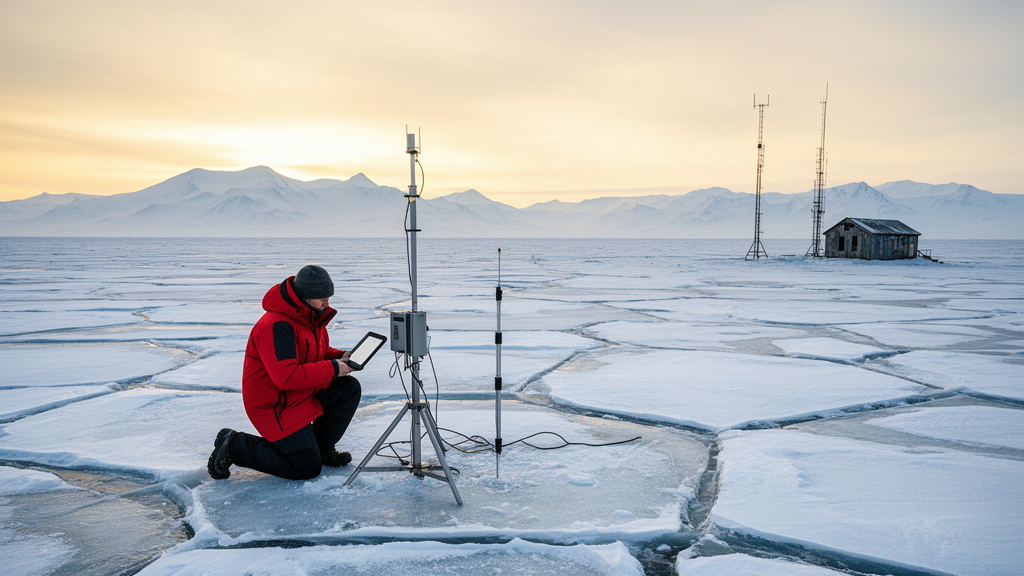
Image Credits: AI Generated
DOI: 10.5194/essd-18-7515-2026
Keywords: standardized, permafrost, ground, temperature, collection, Canada, scientific research
Cite Scienmag News
Violet Maxwell. (October 15, 2026). Canada’s Frozen Ground Gets a Single Source of Truth. Scienmag. https://scienmag.com/canadas-frozen-ground-gets-a-single-source-of-truth/
Violet Maxwell. "Canada’s Frozen Ground Gets a Single Source of Truth." Scienmag, 15 October 2026, https://scienmag.com/canadas-frozen-ground-gets-a-single-source-of-truth/. Accessed 15 October 2026.
Violet Maxwell. "Canada’s Frozen Ground Gets a Single Source of Truth." Scienmag. October 15, 2026. https://scienmag.com/canadas-frozen-ground-gets-a-single-source-of-truth/


