


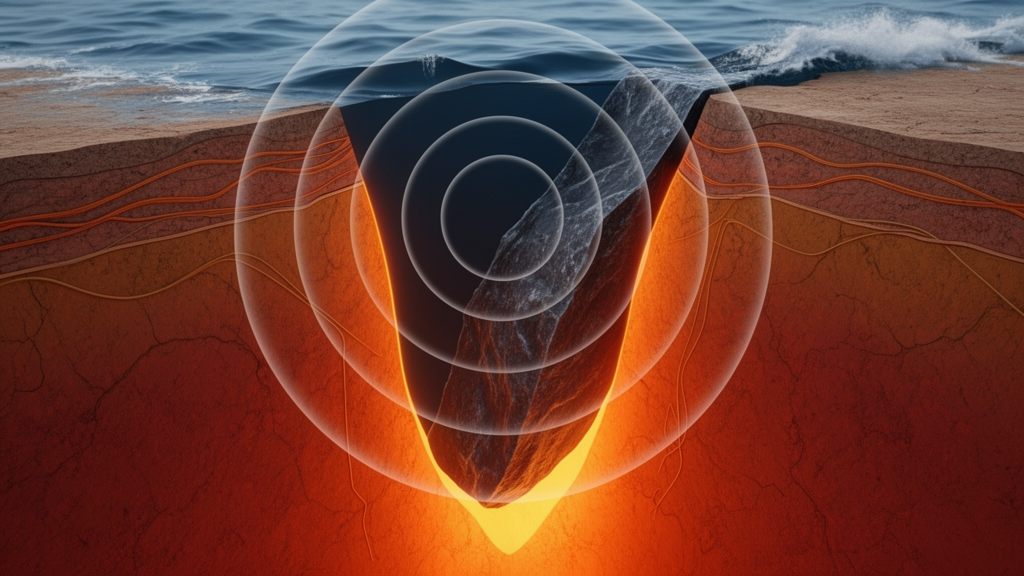
Deep beneath the subduction zones where oceanic plates plunge into the Earth’s interior, seismologists have spent decades picking up puzzling echoes. Seismic waves bounce off faint boundaries in the mid-mantle, the vast region between roughly 660 and 2,000 kilometers deep, even though no known change in mineral chemistry or pressure-driven phase transformation should exist there. A new study published in Nature Communications offers a strikingly simple explanation: those invisible walls may be made of nothing more than deformed rock. By combining simulations of sinking slabs with laboratory-constrained behavior of the mantle’s dominant mineral, bridgmanite, a team led by John Keith Magali of the University of Münster shows that the gradual, pressure-driven switching of crystal deformation mechanisms can carve a detectable seismic boundary at around 1,000 kilometers depth, deepening to about 1,400 kilometers directly beneath flattened slabs.
The key player is bridgmanite, the magnesium-iron silicate that makes up roughly 80 percent of the lower mantle in the standard pyrolite model. Like many minerals, bridgmanite crystals are intrinsically anisotropic: seismic waves travel faster along some crystallographic directions than others. When rocks deform slowly over millions of years, dislocation creep causes grains to rotate and align into a crystallographic preferred orientation, or CPO, and the aggregate as a whole becomes anisotropic. In the average lower mantle, diffusion creep is often cited as the dominant deformation mechanism, which would scramble any fabric. But numerical models and seismic observations agree that in high-stress regions such as subduction zones, dislocation creep remains active, allowing fabrics to persist and grow to great depths.
What makes the new work possible is a recent set of laser-heated diamond anvil cell experiments that deformed pyrolitic material at true lower-mantle pressures and temperatures. Those experiments revealed something unexpected: bridgmanite does not deform the same way at all depths. Below about 24 gigapascals, the easiest slip system is (100)[001], but as pressure climbs toward 50 gigapascals, corresponding to roughly 1,250 kilometers depth, the critically resolved shear stresses of the (100)[001] and (010)[100] systems cross at about 40 gigapascals, near 1,050 kilometers. Past that crossover, (010)[100] takes over as the dominant slip system. The transition is gradual, spread across the depth range from about 670 to 1,250 kilometers, yet its consequences for seismic imaging turn out to be sharp.
To translate this mineral physics into a seismic prediction, the team coupled a two-dimensional thermo-mechanical model of intraoceanic subduction, built with the open-source geodynamics code ASPECT, with viscoplastic self-consistent fabric calculations that track the orientations of 3,000-grain aggregates advected through the simulated mantle flow. They modeled a slab that flattens near 1,000 kilometers depth, the so-called deeply flattened configuration seen in regions such as the Western Java subduction zone, and compared it with a shallowly stagnating slab trapped near the 660-kilometer boundary. Bridgmanite was treated as the only phase that develops meaningful texture, since davemaoite and ferropericlase showed no coherent fabrics in the experiments and were assigned random orientations.
The result is a deformation-induced anisotropic discontinuity. As mantle material is entrained around the slab and accumulates strain, the pressure-dependent slip transition produces a layer where the anisotropy index, a scalar measure of the total anisotropy in the elastic tensor, shows a persistent local minimum. In the mantle wedge and subslab regions, this discontinuity emerges near 1,000 kilometers and progressively deepens toward the slab, reaching about 1,400 kilometers directly beneath it. Remarkably, even though the underlying change in slip systems is smooth, the resulting seismic boundary appears sharp: at locations where natural strain exceeds 2, the half-width of the discontinuity is only about 40 to 54 kilometers, compared with roughly 80 kilometers where strain is weaker. Where the slab stagnates shallowly and strains stay low, the discontinuity persists near 1,000 kilometers but becomes markedly fainter.
The crucial question is whether such a subtle feature could actually be seen by seismometers. The team computed reflection coefficients for underside reflections, the SS precursor phases that seismologists use to probe mantle discontinuities, at three locations along the modeled boundary. Because the medium is anisotropic, the reflection coefficients vary with both azimuth and epicentral distance, and their polarities flip depending on the local flow pattern: negative for all azimuths where poloidal flow dominates, predominantly positive where slab-driven flattening stretches entrained aggregates. At the most strongly strained location, reflection amplitudes reach about 0.02, comparable to coefficients computed for textural interfaces invoked to explain deep-mantle reflections and to those generated by the well-known transition-zone discontinuities. P-wave reflections, by contrast, were negligible, indicating that the boundary is essentially a shear-wave feature.
Full waveform simulations sealed the detectability argument. Using the spectral-element code AxiSEM3D, the researchers built a three-dimensional global model of the anisotropic mantle and recorded synthetic seismograms at a virtual array of 3,000 stations. Array processing with slowness vespagrams revealed a clear SS precursor generated by the anisotropic discontinuity alone, with no isotropic velocity contrast required. The precursor-to-SS amplitude ratio of 0.0084 exceeds the global detectability threshold of 0.0065 established in earlier surveys of mid-mantle reflectors. An isotropic model containing only the slab’s compositional velocity anomaly produced a much shallower and closer-in reflection from the slab-mantle interface, suggesting that where both a shallow and a deep reflector are observed, as in some global SS precursor studies, a flattened slab and its deformation halo could simultaneously supply both.
The pressure-dependent fabric also reconciles long-standing puzzles in mantle anisotropy. Previous forward models that imposed a single bridgmanite slip system could match some features of radial anisotropy, expressed as the ratio of horizontally to vertically polarized shear-wave speeds, but always failed somewhere: one fabric produced too little subslab anisotropy, another generated strong anisotropy everywhere including the mantle wedge where observations show the opposite sign. The new models, with slip systems shifting smoothly with depth, reproduce the fast horizontal shear beneath the slab and the faster vertical shear in the mantle wedge, matching tomographic images of the Western Java subduction zone. Modeled shear wave splitting also matches source-side observations beneath Western Java, with trench-parallel fast directions for downdip rays and trench-perpendicular fast directions for updip rays, although computed delay times remain somewhat low, plausibly because anisotropic phases such as akimotoite and phase D, shape-preferred orientation, and receiver-side complexity all add to the path-integrated signal.
The implications reach beyond subduction zones. The enigmatic 1,000-kilometer discontinuity has been variously attributed to a viscosity jump caused by grain-size variations in ancient bridgmanite-enriched domains, to stiff periclase-rich material, or to sluggish pyroxene-to-garnet transformations in cold slabs. The new mechanism does not replace these thermo-chemical hypotheses, the authors stress, but adds a purely deformation-driven alternative that requires no compositional contrast at all, only accumulated strain and the pressure sensitivity of bridgmanite’s crystal plasticity. Candidate testing grounds include the Cocos, Northern Peru, and Kamchatka slabs, which all show mid-mantle flattening, while vertically penetrating slabs such as the Marianas should instead produce narrow, slightly dipping anisotropic boundaries hugging the slab tip, an equally plausible explanation for the dipping reflectors imaged there. Looking ahead, the team proposes that fabric evolution in bridgmanite may even feed back on slab dynamics, softening the mantle around descending plates much as olivine fabric eases plate motion in the asthenosphere. If so, the deepest architecture of our planet may be written not only in chemistry and temperature, but in the strained, aligned grains of its most abundant mineral.
Subject of Research: Deformation-induced seismic anisotropy and mid-mantle discontinuities beneath subduction zones caused by depth-dependent bridgmanite deformation
Article Title: Mid-mantle discontinuities beneath subduction zones linked to depth-dependent deformation of bridgmanite
Article References: Magali, J. K., Merkel, S., Pisconti, A., Gay, J., Wookey, J., & Thomas, C. (2026). Mid-mantle discontinuities beneath subduction zones linked to depth-dependent deformation of bridgmanite. Nature Communications, 17(1), Article 10494. https://doi.org/10.1038/s41467-026-78212-6
Image Credits: AI Generated
DOI: 10.1038/s41467-026-78212-6
Keywords: bridgmanite, subduction zones, mid-mantle discontinuity, seismic anisotropy, crystallographic preferred orientation, mantle dynamics, SS precursors, shear wave splitting, mineral physics, lower mantle, geodynamics, seismology
Cite Scienmag News
Iris Watkins. (October 15, 2026). Hidden Mirror 1,000 Kilometers Down: Sinking Slabs May Stamp Seismic Seams Into Earth’s Mantle. Scienmag. https://scienmag.com/hidden-mirror-1000-kilometers-down-sinking-slabs-may-stamp-seismic-seams-into-earths-mantle/
Iris Watkins. "Hidden Mirror 1,000 Kilometers Down: Sinking Slabs May Stamp Seismic Seams Into Earth’s Mantle." Scienmag, 15 October 2026, https://scienmag.com/hidden-mirror-1000-kilometers-down-sinking-slabs-may-stamp-seismic-seams-into-earths-mantle/. Accessed 15 October 2026.
Iris Watkins. "Hidden Mirror 1,000 Kilometers Down: Sinking Slabs May Stamp Seismic Seams Into Earth’s Mantle." Scienmag. October 15, 2026. https://scienmag.com/hidden-mirror-1000-kilometers-down-sinking-slabs-may-stamp-seismic-seams-into-earths-mantle/


