


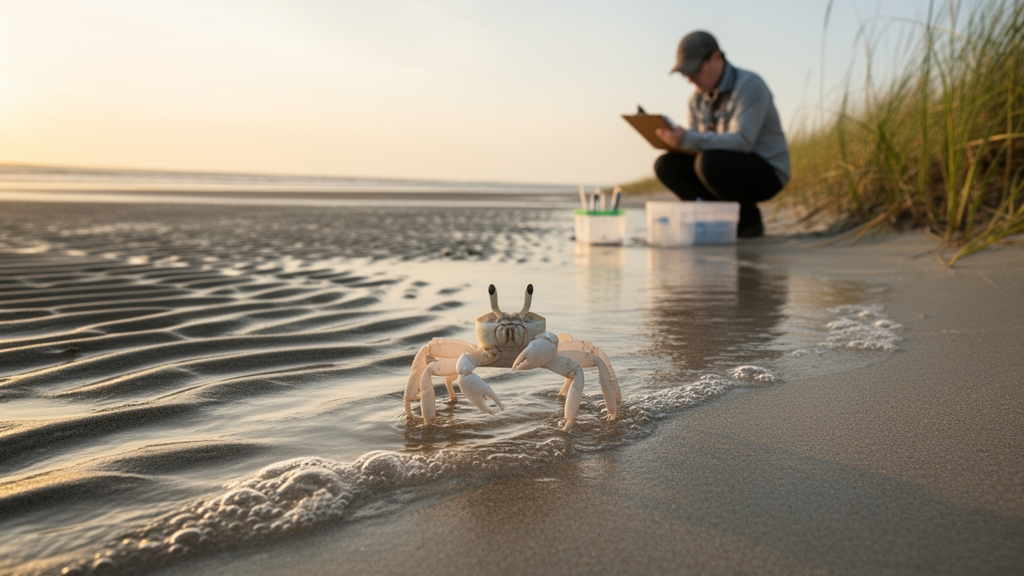
On the sandy shores of southern Brazil, a small, quick-footed crab has become one of the most trusted sentinels of beach health. The Atlantic ghost crab, Ocypode quadrata, spends its life digging burrows in the upper beach and dunes, linking marine and terrestrial food webs as an omnivorous predator and scavenger. Because its burrows are easy to count and its body size responds to environmental stress, scientists routinely use the species as a bioindicator to gauge how beaches are coping with urbanization, vehicle traffic, trampling, and climate change. But a new year-long study suggests that the ghost crab’s readings may be more complicated than monitoring programmes have assumed, because natural seasonal rhythms and the physical character of each beach can shape crab populations just as powerfully as human disturbance.
The research, published in the journal Environmental Monitoring and Assessment, followed ghost crab populations on three subtropical beaches along the central–northern coast of Santa Catarina from March 2017 to February 2018. The team, led by Julia Gomes do Vale of the Federal University of São Carlos together with colleagues at several Brazilian institutions, deliberately selected beaches spanning a morphodynamic gradient, the classification scientists use to describe how wave energy, sediment grain size, and beach slope interact. Barra Velha represents a reflective beach, with coarse sand, a steep slope, and a narrow surf zone. Navegantes is dissipative, with fine grains, a gentle slope, and a broad surf zone, while Brava Beach in Itajaí sits in between as an intermediate system. The Itajaí-Açu estuary separates the latter two beaches, adding another layer of environmental complexity through freshwater discharge and nutrient transport.
Each month, two researchers surveyed one rotating section of each beach over a standardized two-hour period, timed to coincide with the crabs’ peak surface activity. That timing matters more than it might seem. Ghost crabs are largely nocturnal during the warm spring and summer months but shift to daytime activity in the colder autumn and winter, so the team adjusted their sampling schedule seasonally to avoid mistaking changes in crab behaviour for changes in crab abundance. Within each survey, they first counted burrows in replicate two-by-two-metre transects running from the waterline toward the dunes, then captured active crabs across a wider stretch of sand for laboratory measurements of biomass, carapace width, carapace length, and a physiological index called the relative condition factor, which compares an individual’s actual weight to the weight expected for its size.
The results paint a picture of a species whose population signals depend heavily on which metric is measured, where, and when. In total, the team captured 660 crabs for direct morphological analysis. Biomass and the two carapace dimensions varied significantly both among beaches and among seasons, with the largest, heaviest crabs generally found on the reflective Barra Velha beach during summer, while the intermediate and dissipative beaches produced their biggest individuals in winter. Burrow density, by contrast, was remarkably stable: despite fluctuating between roughly 0.13 and 0.50 burrows per square metre across sites and seasons, it showed no statistically significant variation with either season or beach type.
Perhaps the most striking seasonal signal came from the relative condition factor, a measure of how well-nourished individual crabs are. Across all three beaches, body condition peaked consistently in autumn and dipped to its lowest levels in spring and summer, the very seasons when one might expect abundant food and favourable temperatures to produce the healthiest animals. The authors point to a likely explanation rooted in crab biology rather than crab hunger: Ocypode quadrata reproduces primarily in spring and summer, and both reproduction and moulting impose heavy energetic demands that drain somatic reserves. In other words, crabs may look leaner in the breeding season not because the beach is degraded but because they are pouring their energy into making the next generation.
The spatial patterns were equally revealing. The finding that crabs on the reflective beach grew larger despite previous work showing lower stomach fullness at that site fits a framework ecologists call the habitat safety hypothesis. This idea proposes that animals living in physically stable environments can afford to channel energy into growth rather than into constant maintenance and disturbance avoidance. On a steep, coarse-grained reflective beach, the crabs appear to benefit from conditions that favour investment in body size, an outcome of environmental filtering rather than short-term feeding intensity. The team also notes that the estuary between Navegantes and Itajaí may modify sediment dynamics, salinity, and resource availability on the adjacent beaches, a source of variability that future studies should quantify directly.
Vegetation emerged as the strongest common thread running through the data. Using generalized linear models, the researchers found that every descriptor they examined, from burrow density to biomass, carapace dimensions, and body condition, increased significantly with the area of beach and dune vegetation. Navegantes, the beach with the greatest vegetation cover, also stood out in the pairwise comparisons of habitat area. The mechanism is likely mechanical as much as biological: plant roots stabilize sediment, reduce erosion, and help burrows persist, lowering the energetic cost of burrow maintenance and providing shelter from predators and harsh conditions. Because ghost crabs are considered an umbrella species, protecting the vegetation they depend on may simultaneously safeguard a broader community of macrofauna and shorebirds that share the dune habitat.
For the growing number of coastal managers who count ghost crab burrows as a quick, non-invasive proxy for beach quality, the study carries a practical warning with a silver lining. The stability of burrow density across seasons and beach types suggests the metric carries low natural background variability, which could make it especially reliable for detecting deviations caused by human disturbance. Biomass and carapace dimensions, in contrast, respond strongly to both season and morphodynamic context, so comparisons using these measures must explicitly control for when and where samples were taken, or risk confusing natural variability with environmental damage. The condition factor sits somewhere in between: stable across beaches but strongly seasonal, making it useful for spatial comparisons yet unreliable for tracking change through the year without seasonal correction.
The broader context makes these refinements urgent. Sandy beaches worldwide face what researchers have called a triple whammy of intensifying urbanization, overexploitation of natural resources, and declining resilience to climate change, compounded by off-road vehicles, trampling, sand compaction, coastal armouring, and the removal of native dune vegetation. Climate-driven shifts in temperature and precipitation accelerate erosion and beach degradation, squeezing dune systems and the species they support. Against this backdrop, bioindicators like the ghost crab are among the most cost-effective tools available for assessing ecological condition, but only if the natural noise in their signals is understood and accounted for.
The study’s central message is that no single ghost crab measurement tells the whole story. Size-related descriptors capture spatial and seasonal patterns in population structure, the condition factor isolates seasonal energetic trade-offs, and burrow density offers a comparatively quiet baseline against which disturbance can stand out. Used together, and interpreted with explicit attention to season, beach morphodynamics, and vegetation cover, these complementary metrics can turn a familiar beach crab into an even sharper instrument for coastal conservation. And as dune vegetation continues to disappear under coastal development, the finding that crabs thrive where plants persist adds a straightforward prescription: preserve the green fringe of the beach, and the crabs, along with much of the biodiversity they shelter, are likely to follow.
Subject of Research: Seasonal, morphodynamic, and vegetation drivers of ghost crab (Ocypode quadrata) population descriptors on subtropical sandy beaches in southern Brazil
Article Title: Seasonal, morphodynamic, and vegetation drivers of ghost crab (Ocypode quadrata) populations on subtropical sandy beaches
Article References: do Vale, J. G., Chahad-Ehlers, S., Barrilli, G. H. C., Gomes, D. F., Rocha, O., & Branco, J. O. (2026). Seasonal, morphodynamic, and vegetation drivers of ghost crab (Ocypode quadrata) populations on subtropical sandy beaches. Environmental Monitoring and Assessment, 198(9), Article 1038. https://doi.org/10.1007/s10661-026-15876-z
Image Credits: AI Generated
DOI: 10.1007/s10661-026-15876-z
Keywords: ghost crab, Ocypode quadrata, sandy beaches, bioindicator, morphodynamics, dune vegetation, burrow density, body condition, seasonality, coastal monitoring, Brazil, conservation
Cite Scienmag News
Violet Maxwell. (October 15, 2026). Ghost Crabs Reveal Hidden Seasonal Pitfalls in Beach Health Monitoring. Scienmag. https://scienmag.com/ghost-crabs-reveal-hidden-seasonal-pitfalls-in-beach-health-monitoring/
Violet Maxwell. "Ghost Crabs Reveal Hidden Seasonal Pitfalls in Beach Health Monitoring." Scienmag, 15 October 2026, https://scienmag.com/ghost-crabs-reveal-hidden-seasonal-pitfalls-in-beach-health-monitoring/. Accessed 15 October 2026.
Violet Maxwell. "Ghost Crabs Reveal Hidden Seasonal Pitfalls in Beach Health Monitoring." Scienmag. October 15, 2026. https://scienmag.com/ghost-crabs-reveal-hidden-seasonal-pitfalls-in-beach-health-monitoring/


