


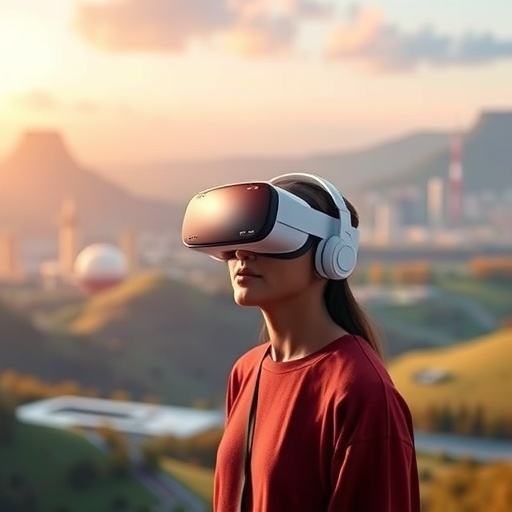
Virtual reality (VR) technology has long been associated with thrilling entertainment experiences and, more recently, therapeutic applications that primarily focus on inducing fear or anxiety to create immersive narratives. However, emerging research spearheaded by Murdoch University’s School of Information Technology is now illuminating VR’s untapped potential to evoke positive emotional states, offering profound implications across education, healthcare, urban planning, and psychological therapy. This innovative investigation systematically dissects the visual components within hyper-realistic virtual environments that could serve as catalysts for emotions such as awe, joy, and serenity.
At the heart of this groundbreaking study is the recognition that visual design elements in VR are not merely aesthetic enhancements but pivotal contributors that modulate the user’s emotional engagement. The research, led by PhD candidate Tom Goates, adopts a methodical approach, analyzing four core visual factors—geometry, lighting, material surfaces, and color—and their associated sub-factors to establish how these elements coalesce to engender emotional realism in virtual spaces. These components influence the perception of the virtual environment’s authenticity, thereby directly affecting the psychological responses of users.
One of the primary revelations of the study is the power of geometry, particularly scale and proportion, in eliciting emotional reactions. Large-scale natural features such as mountains and forests within VR can invoke a profound sense of awe, fostering emotional states that have historically been difficult to achieve through technology alone. This geometric manipulation not only enriches the immersive experience but may also reinforce perceptual comfort and visual coherence, contributing to feelings of calm and well-being.
Lighting, another critical visual factor, plays a substantial role in modulating mood within virtual realities. Dynamic lighting, including elements such as global illumination and nuanced shadow casting, can create atmospheres that enhance tranquility or stimulate joy. These lighting techniques simulate the natural interplay of light and shadow, deepening users’ emotional immersion and promoting states conducive to relaxation and mental restoration. This insight opens avenues for leveraging VR in therapeutic contexts aimed at stress reduction.
The material surfaces within virtual environments, characterized by qualities such as textures and reflective properties, also markedly influence emotional engagement. Fine-tuning surface reflections and textures can augment the sense of realism, making scenes more tangible and emotionally resonant. For example, realistic water surfaces with dynamic reflections or textured foliage heighten the sensory plausibility of the environment, thus amplifying positive user reactions and fostering a deeper connection to the virtual space.
Color, encompassing values and tonal variations, is understood to have a fundamental psychological impact that VR designers can strategically harness. The study highlights how precise manipulation of color palettes within virtual settings can steer emotional responses, from soothing hues that promote calmness to vibrant schemes that evoke joy and excitement. This nuanced consideration of color dynamics marks a vital step towards crafting VR environments capable of nuanced emotional modulation.
Mr. Goates emphasizes the novelty of these findings by contrasting them with earlier VR research, which predominantly centered on negative emotions such as fear, often for gaming or exposure therapy applications. His work introduces a paradigm shift, illustrating that VR’s visual sophistication can transcend fear and instead evoke the complex spectrum of positive emotions that are foundational to psychological well-being and therapeutic interventions.
The implications of this research extend beyond entertainment or therapy, touching fields as diverse as urban design and education. By understanding how these visual factors influence emotional states, VR can be employed to simulate urban environments that foster well-being or create immersive learning experiences that heighten engagement and memory retention. This interdisciplinary potential situates VR as a transformative tool that bridges human-computer interaction with tangible societal benefits.
Crucially, the study identifies significant gaps in existing literature regarding the interplay of visual factors and emotional outcomes in VR. This recognition of knowledge deficits calls for targeted, design-focused research integrating both psychological and physiological metrics to validate and refine the proposed frameworks. Such rigorous inquiry promises to optimize VR content for maximal emotional efficacy, whether for therapeutic relief, educational immersion, or wellbeing enhancement.
In detailing the framework, the researchers propose that comprehensive VR designs integrate harmonious interactions among geometry, lighting, material surfaces, and color. This integrative approach underpins the creation of hyper-realistic natural environments that not only simulate physical spaces with high fidelity but also evoke and sustain positive emotional experiences. These environments could revolutionize how users interact with digital realms, emphasizing emotional health alongside cognitive engagement.
The potential applications of this evolving understanding are vast and compelling. Therapeutic settings could harness these findings to design VR scenarios that deliberately evoke relaxation and awe, offering innovative mental health interventions. Similarly, game developers and simulation designers could enrich user experience by embedding emotionally positive triggers through refined visual designs, expanding the scope of immersive content beyond adrenaline-driven responses.
Murdoch University’s study, published in the International Journal of Human-Computer Interaction, thus marks a pivotal step in VR research, firmly anchoring emotional engagement as a design goal in virtual reality environments. By elucidating the visual factors that trigger positive emotions, this work lays the foundation for a new generation of virtual spaces that promote human flourishing through digital means.
As VR technology continues to evolve rapidly, the insights from this research reinforce the importance of interdisciplinary collaboration between computer scientists, psychologists, designers, and healthcare professionals. Together, these stakeholders can harness subtle, yet powerful visual cues to craft experiences that holistically engage users emotionally, cognitively, and physiologically, ultimately transforming how we learn, heal, and interact within virtual worlds.
By pioneering a scientifically grounded framework for VR design that prioritizes positive emotional elicitation, this research opens the door to VR’s broader societal integration. The promise is a future where virtual reality environments are not merely escapist or utilitarian but become immersive spaces that enrich mental health, education, and social wellbeing—offering profound benefits in our increasingly digital era.
News Publication Date: 3-Mar-2026
Web References:
https://www.tandfonline.com/doi/full/10.1080/10447318.2026.2630068
References:
Murdoch University PhD candidate Tom Goates et al., International Journal of Human-Computer Interaction, 2026.
Cite Scienmag News
Courtney Benton. (April 13, 2026). Can Hyper-Realistic Virtual Worlds Enhance Our Well-Being? Scienmag. https://scienmag.com/can-hyper-realistic-virtual-worlds-enhance-our-well-being/
Courtney Benton. "Can Hyper-Realistic Virtual Worlds Enhance Our Well-Being?" Scienmag, 13 April 2026, https://scienmag.com/can-hyper-realistic-virtual-worlds-enhance-our-well-being/. Accessed 4 September 2026.
Courtney Benton. "Can Hyper-Realistic Virtual Worlds Enhance Our Well-Being?" Scienmag. April 13, 2026. https://scienmag.com/can-hyper-realistic-virtual-worlds-enhance-our-well-being/


