


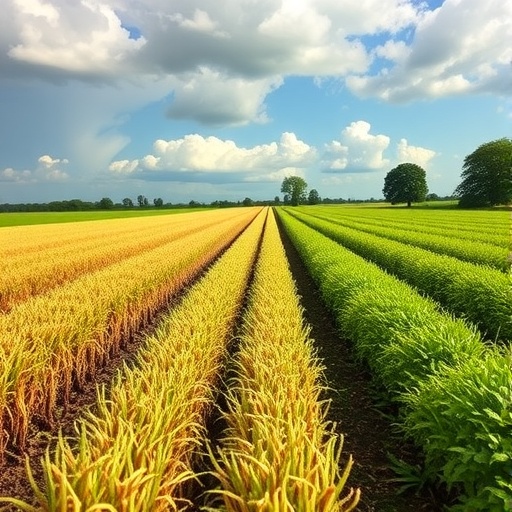
A groundbreaking study from the Norwegian University of Science and Technology (NTNU) reveals a pathway to reconciling the urgent demands of crop production, climate action, and biodiversity conservation across Europe without diminishing food output. The research dismantles the prevailing notion that safeguarding the environment must come at the expense of agricultural productivity, presenting a data-driven strategy that exploits advances in satellite imaging and ecological modeling to optimize land use on a continental scale.
Agriculture today is a paradoxical powerhouse—it feeds billions globally yet contributes substantially to environmental degradation. Responsible for roughly one-third of global greenhouse gas (GHG) emissions, conventional crop production depletes biodiversity, consumes massive quantities of freshwater, and introduces hazardous nutrient runoff into aquatic ecosystems. Francesco Cherubini, professor and Director of the Industrial Ecology Programme at NTNU, underscores this dilemma, emphasizing agriculture’s heavy toll on natural ecosystems and the urgent necessity for transformative solutions that decouple food production from environmental harm.
The NTNU team embarked on extensive analysis utilizing high-resolution European satellite data to map all cultivated lands producing staple cereals and vegetables, consciously excluding grasslands devoted to animal fodder. Their comprehensive survey delineated regions characterized by steep slopes, fragmented plots, and inherently low yields—factors that render these areas ‘sub-optimal’ for crop cultivation. Collectively, these lands account for an astounding 24 million hectares across Europe, about 14% of active agricultural operations, including a significant portion within Norwegian borders.
Current approaches to sustainability often involve setting aside certain tracts for forest regrowth or biodiversity protection, which inadvertently cannibalize valuable terrain needed for food production. This study convincingly argues for a nuanced land management paradigm. By strategically withdrawing sub-optimal, ecologically sensitive farmland from cultivation and restoring it to natural vegetation, while concurrently intensifying production on highly fertile and better-connected agricultural parcels, farmers can significantly reduce GHG emissions by up to 40%. This reallocation also offers a robust 20% reduction in pressures on endangered species and vital habitats, all without sacrificing aggregate food yields.
The ecological mechanisms underpinning this dual strategy center on soil health and carbon sequestration. Trees and native vegetation reestablish intricate root networks that enhance nutrient retention, prevent erosion, and elevate soil organic carbon. These processes improve the resilience and fertility of marginal lands, allowing optimized cropland to support greater yields via targeted intensification. Extensification methods—reducing dependency on synthetic fertilizers and pesticides while integrating natural elements like agroforestry—complement this approach by fostering biodiversity and ecosystem services on landscapes suited for light production.
Crucially, extensive modeling predicted that intensification efforts in Europe’s prime farmland could boost crop output by 10-20%, compensating for areas restored to semi-natural states. Crop selection tailored to local climatic and soil conditions further maximizes caloric yield per hectare. The researchers suggest emphasizing traditional cereals such as maize, wheat, and barley, grown where they have proven successful, to enhance efficiency while preserving cultural agricultural practices.
Norway represents a distinct case within this framework. Although approximately one-third of Norwegian arable land demonstrates low productivity, much of the country’s agriculture revolves around grasslands that were excluded from this research. Gunnar Austrheim, professor at the NTNU University Museum, describes Norway’s situation as exceptional but acknowledges the untapped potential in optimizing land allocation. Existing national initiatives aimed at restoring wetlands, moorlands, and forests dovetail with the study’s recommendations, highlighting avenues for immediate application.
Implementing such a comprehensive land management overhaul faces social, cultural, and political challenges. Many low-yielding regions maintain agricultural activity due to deeply rooted community ties and policy frameworks subsidizing their upkeep. However, reconciling these factors with environmental mandates, such as the UN Biodiversity Agreement commitments—to halve nutrient surpluses and pesticide usage while restoring 30% of natural habitats—is imperative. Integrating ecological restoration with efficient food production systems promises progress towards these ambitious targets.
Cross-border collaboration across European nations is vital to actualize this vision. Coordinated land reallocation to favor steep or fragmented regions for ecological restoration, balanced by intensified cultivation of prime farmland, aligns with broader European Union sustainability goals. Developing cohesive policies, sharing best practices, and leveraging satellite-based land assessments can craft a unified approach that supports climate resilience, food security, and biodiversity.
This NTNU study redefines the agriculture-environment nexus, demonstrating that climate action and nature conservation are not inherently antagonistic to food production. By harnessing technological advances and ecological insights, Europe can pioneer a sustainable agricultural model that reverses emissions trends, preserves biodiversity, and ensures future food security. Such transformative strategy offers a beacon for global agricultural systems striving to meet the complex demands of the 21st century.
Cite Scienmag News
Alan Morgan. (February 17, 2026). Can European Agriculture Reduce CO2 Emissions by 40%? Scienmag. https://scienmag.com/can-european-agriculture-reduce-co2-emissions-by-40/
Alan Morgan. "Can European Agriculture Reduce CO2 Emissions by 40%?" Scienmag, 17 February 2026, https://scienmag.com/can-european-agriculture-reduce-co2-emissions-by-40/. Accessed 3 September 2026.
Alan Morgan. "Can European Agriculture Reduce CO2 Emissions by 40%?" Scienmag. February 17, 2026. https://scienmag.com/can-european-agriculture-reduce-co2-emissions-by-40/


