


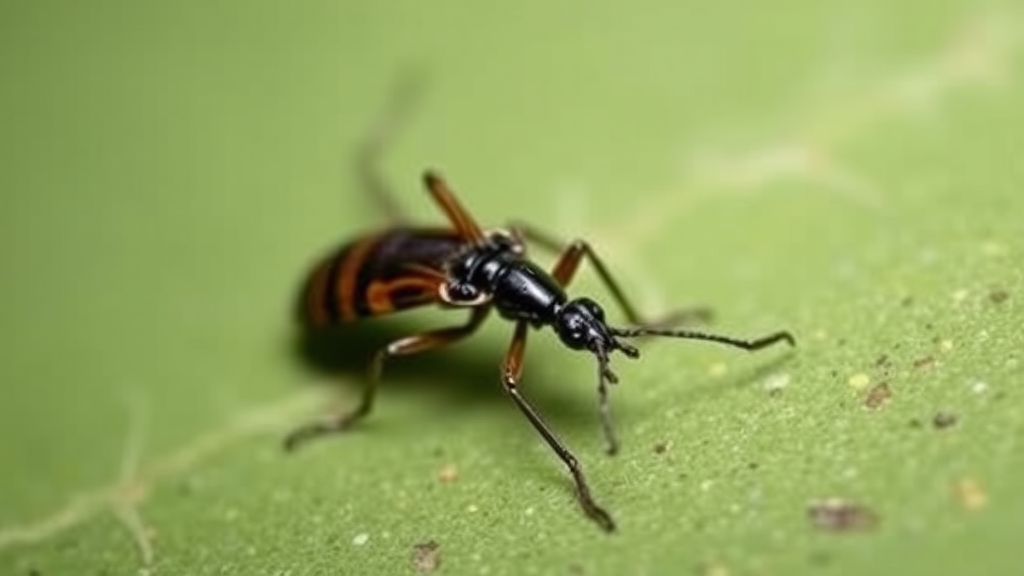
In the semiarid backlands of northeastern Brazil, two closely related species of blood-sucking insects have been hiding in plain sight, and from each other. Rhodnius neglectus and Rhodnius nasutus are triatomine bugs, the vectors responsible for transmitting Trypanosoma cruzi, the parasite that causes Chagas disease. For decades, field entomologists have relied partly on overall body coloration to tell these species apart. A new study published in Parasites & Vectors now shows that this trusted visual cue can fail dramatically when the insects share the same distinctive habitat: the carnaúba palm, Copernicia prunifera. The research reveals a striking case of phenotypic convergence, in which natural selection appears to have pushed two different species toward remarkably similar outward appearances, complicating species diagnosis in insects of direct medical importance.
The investigation was led by Márcio Galvão Pavan of the Oswaldo Cruz Institute (Fiocruz) in Rio de Janeiro, together with Rodrigo Gurgel-Gonçalves of the University of Brasília and colleagues, including Fernando Abad-Franch and Fernando Araujo Monteiro, who contributed equally to the work. The team set out to answer a deceptively simple question: when light-colored bugs turn up inside carnaúba palms, are they R. nasutus, the species whose primary habitat these palms represent in northeastern Brazil, or could they actually be R. neglectus wearing, in effect, a different species’ colors? The answer, according to the combined genetic and morphological evidence, is frequently the latter.
The study’s foundation lies in an ecological and biogeographical puzzle. Rhodnius nasutus is typical of the Caatinga, Brazil’s seasonally dry, thorny scrubland biome, where it dwells chiefly in the crowns of Copernicia prunifera palms and is characteristically light brown in color. Rhodnius neglectus, by contrast, is a core-Cerrado species associated with Mauritia flexuosa palms and typically shows a much darker brown body. Because the Caatinga and Cerrado intergrade across a broad transition zone, the two palm species, and the bugs that inhabit them, occasionally come into geographic contact. That overlap set the stage for the color confusion the researchers document.
To untangle the situation, the team sampled triatomines from C. prunifera palms across the semiarid Caatinga and the Caatinga-Cerrado transition, comparing them with specimens collected from core-Cerrado M. flexuosa palms. Every insect was first identified by phenotype, meaning its visible color pattern and morphology. The researchers then turned to genetics, sequencing clones of the mitochondrial cytochrome b gene, a standard barcoding marker, and the nuclear ribosomal DNA internal transcribed spacer 2, or ITS2. This two-marker strategy allowed the team to compare signals from the maternally inherited mitochondrial genome with those from the nuclear genome, a contrast that proved decisive.
The morphological results were clear at the extremes but murky in the middle. Adult specimens from core-Cerrado Mauritia palms consistently displayed the dark brown coloration typical of R. neglectus, while adults from core-Caatinga localities showed the light brown hue typical of R. nasutus. But in bugs captured in carnaúba palms from the Caatinga-Cerrado transition zone and parts of the central-western Caatinga, color patterns were dubious, matching neither type reliably. Specimens that looked like typical light brown R. nasutus could not confidently be assigned on appearance alone, raising the possibility that field identifications based on color might have been systematically wrong in exactly these regions.
Genetics began to resolve the ambiguity. Bayesian genealogies built from cytochrome b sequences placed the dubious-phenotype specimens that resembled typical R. nasutus in a sub-clade that is sister to typical R. neglectus from Mauritia flexuosa palms, with roughly 2% mean cytb divergence separating the two sub-clades. In other words, the bugs that looked like R. nasutus carried mitochondrial genomes pointing to R. neglectus ancestry. This mitochondrial signal effectively dissolved the taxonomic uncertainty created by the shared coloration, demonstrating that insects occupying carnaúba palms in the transition zone belong, at least by maternal lineage, with R. neglectus.
The nuclear ITS2 marker told a less tidy story. ITS2 genealogies recovered both R. neglectus and R. nasutus as paraphyletic, meaning individuals of each nominal species were scattered across the gene tree rather than clustering neatly by species. Such patterns often arise when recently diverged species still share ancestral genetic variation. When the researchers applied a multispecies-coalescent analysis, a statistical framework designed to account for this shared ancestry, the dubious-phenotype bugs from C. prunifera clustered with typical R. neglectus. The analysis suggested that the messy ITS2 picture reflects incomplete lineage sorting, the retention of ancestral polymorphisms, rather than hybridization or misassigned species limits. The mito-nuclear discordance observed in the study is thus itself scientifically informative, illustrating how different genomes can carry different historical signals during the early stages of species divergence.
Why would two species converge on the same color? The authors propose that predator-driven natural selection is the most plausible mechanism. Triatomine bugs live in palm crowns where the substrate color is set by the palm’s dried leaf bases and fibers. In the core Cerrado, dark Mauritia crowns favor dark R. neglectus; in the core Caatinga, the lighter carnaúba substrate favors pale R. nasutus. But when R. neglectus colonizes carnaúba palms, individuals whose coloration better matches the light palm-crown substrate presumably enjoy better camouflage against visual predators such as birds and lizards. Over time, this selection pressure could produce R. neglectus populations whose light brown bodies are nearly indistinguishable from typical R. nasutus. This is a textbook scenario of adaptive phenotypic convergence, conceptually related to classic camouflage and mimicry systems in evolutionary biology, but documented here in disease vectors, where species identity has public health consequences.
The practical implications are significant. Chagas disease remains a major neglected tropical disease in Latin America, and surveillance programs depend on correctly identifying which vector species are present in a given area, because species differ in habitat preferences, domestic invasion behavior, and epidemiological relevance. If R. neglectus can masquerade as R. nasutus, field records based on color alone may misattribute vectors to the wrong species and thereby misguide control strategies. The study’s findings, the authors argue, call into question the widespread use of overall body color as a key phenotypic character in triatomine taxonomy. As molecular tools become more accessible, integrating DNA-based confirmation into routine vector surveillance may be essential wherever palm-dwelling Rhodnius species co-occur or share similar microhabitats.
Beyond the immediate applied concerns, the work contributes to a broader understanding of how color variation evolves in triatomines and how convergence can erode the morphological signals taxonomists depend on. The researchers received support from Brazil’s CAPES and CNPq funding agencies, and sampling was conducted under permit from the country’s biodiversity authority, ICMBio. By combining careful field collection across two biomes with mitochondrial and nuclear sequence analysis and modern coalescent modeling, the team has shown that even a character as apparently straightforward as body color can be shaped powerfully by ecology, and that species identities written in DNA may diverge sharply from those written on the insect’s back. For the bugs of the carnaúba palms, looking like the neighbor may be good for survival, but it makes life considerably harder for the scientists trying to tell them apart.
Subject of Research: Phenotypic convergence in the Chagas disease vector bugs Rhodnius neglectus and Rhodnius nasutus inhabiting Copernicia prunifera palms in Brazil
Article Title: Phenotypic convergence in Chagas disease vectors: Rhodnius neglectus from Copernicia prunifera palms may express the typical Rhodnius nasutus color phenotype
Article References: Pavan, M. G., Gurgel-Gonçalves, R., Corrêa-Antônio, J., Morelli, K. A., Bahia, A. C., Abad-Franch, F., & Monteiro, F. A. (2026). Phenotypic convergence in Chagas disease vectors: Rhodnius neglectus from Copernicia prunifera palms may express the typical Rhodnius nasutus color phenotype. Parasites & Vectors. https://doi.org/10.1186/s13071-026-07651-3
Image Credits: AI Generated
DOI: 10.1186/s13071-026-07651-3
Keywords: Triatominae, Rhodnius, Chagas disease, phenotypic convergence, convergent evolution, camouflage, Copernicia prunifera, cytochrome b, ITS2, incomplete lineage sorting, mito-nuclear discordance, Brazil
Cite Scienmag News
Gavin Prescott. (September 12, 2026). Camouflage Confuses Chagas Bug Identification as DNA Steps In. Scienmag. https://scienmag.com/camouflage-confuses-chagas-bug-identification-as-dna-steps-in/
Gavin Prescott. "Camouflage Confuses Chagas Bug Identification as DNA Steps In." Scienmag, 12 September 2026, https://scienmag.com/camouflage-confuses-chagas-bug-identification-as-dna-steps-in/. Accessed 5 October 2026.
Gavin Prescott. "Camouflage Confuses Chagas Bug Identification as DNA Steps In." Scienmag. September 12, 2026. https://scienmag.com/camouflage-confuses-chagas-bug-identification-as-dna-steps-in/


