A six-year survey of a privately owned patch of Brazil’s Atlantic Forest has documented 492 species of plants, animals and fungi using little more than mobile phones, camera traps, telephoto lenses and free artificial intelligence applications. The study, published in PLOS One, combined digital photography, sound recording and citizen science platforms to build one of the most complete multi-group species inventories ever attempted for this critically reduced biome, where only about 15% of the original forest cover remains.
The work was carried out by Manoel Luis Costa and Claudia Mermelstein, two cell biologists at the Federal University of Rio de Janeiro who are not professional ecologists. They focused their survey on Brejal, a rural area in the mountains of Petrópolis, in the state of Rio de Janeiro, at an altitude of 910 meters within the Serra do Mar biogeographical sub-region. The property has been owned by the authors’ family since 1960 and contains remnants of dense broadleaf forest alongside restored areas, pastures and small vegetable farms, all embedded in a landscape of nearby protected areas.
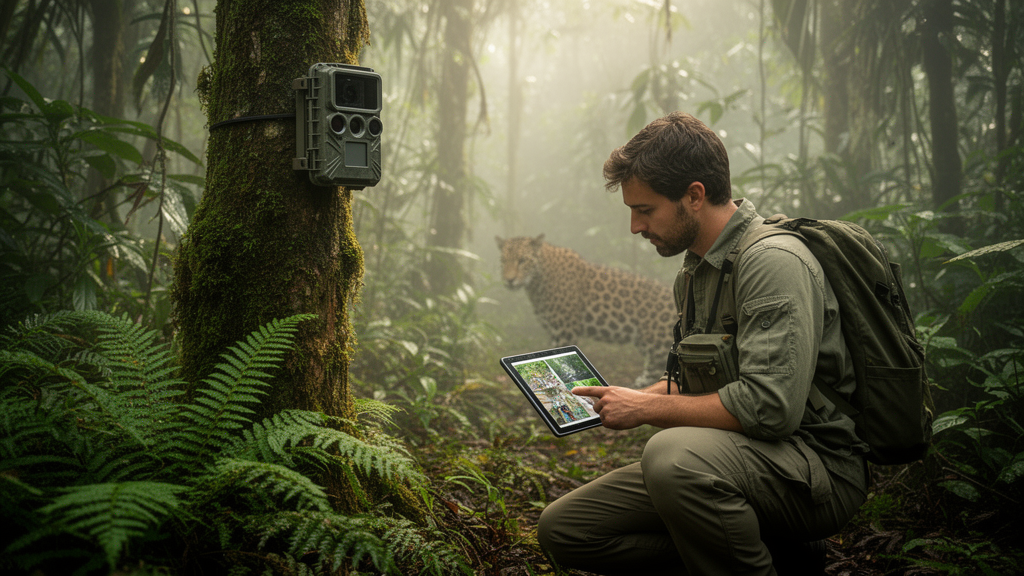
Between August 2020 and January 2026, the authors photographed and recorded organisms across ten groups: amphibians, arachnids, birds, crustaceans, fungi, insects, mammals, mollusks, plants and reptiles. Different organisms demanded different tools. Plants were mostly photographed with cellphones; birds were captured with a Nikon D3200 reflex camera fitted with 150–600 mm and tele-macro lenses, and identified partly through the Merlin bird-sound application developed by the Cornell Lab of Ornithology; mammals were recorded mainly with night-vision camera traps; and small animals and fungi were shot with macro lenses or phones. Every image was uploaded to the iNaturalist platform, where automated artificial intelligence suggestions were then refined by human identifiers.
The scale of the camera-trap effort was substantial. Traps were placed at ten locations roughly 200 meters apart, always near the ground, covering an estimated 100,000 square meters and accumulating around 1,600 camera-trap days. These devices produced approximately 10,000 images, of which about 4,000 were empty frames and around 3,800 were wild animal observations; the remainder showed humans or domestic animals. The AddaxAI software, which applies computer vision models to camera-trap data, was used to filter blank images and sort the rest by species, with manual checks afterwards to correct misidentifications. Surveillance cameras added an estimated 2,200 camera-days of video, from which still images of animals were extracted for classification.
In total, 1,515 iNaturalist records from the project were downloaded in December 2025, and 495 individual identifiers from the iNaturalist community contributed to classifying the observations. More than 90% of the observations were identified to species level, although some groups lagged behind: only 20% of fungi and 40% of insects and plants reached research-grade species identifications, compared with 98% for birds and 95% for mammals. The authors note that iNaturalist identifications are not perfect, but that most are made by taxonomic experts, and that community validation caught cases the AI could not, including hybrid marmosets.
Insects and plants dominated the species counts, with 146 species each, followed by birds with 100, fungi with 33, arachnids with 19, mammals with 20, reptiles with 15, amphibians with 9, mollusks with 3 and a single crustacean, the freshwater crab Trichodactylus fluviatilis. Birds, however, generated the largest number of individual observations, followed by insects and plants. Among insects, Lepidoptera — butterflies and moths — accounted for a striking 50% of all species recorded, a result the authors attribute to their visibility, light-attracting behavior in moths and comparatively well-known taxonomy.
The survey also documented twelve species listed as threatened on the IUCN Red List: four plants, including the Brazilian pine Araucaria angustifolia; four mammals, including the southern tiger cat, the buffy-tufted marmoset, the Brazilian cottontail rabbit and the mountain lion; three birds, including the saffron toucanet and the white-browed woodpecker; and one reptile, the Brazilian snake-necked turtle. Amphibians stood out for endemism, with 60% of their species found nowhere else in Brazil but within the country, including the leopard tree frog and the rock river frog — a reflection of Brejal’s humid, waterlogged terrain and small streams.
Among the most notable findings was the detection of the puma (Puma concolor), a species classified as near threatened in Brazil, recorded exclusively by night-vision trail cameras. The authors suggest these wide-ranging cats may be moving from the nearby Parque Municipal Montanhas de Teresópolis, and argue that the observation underscores the role of private properties as complementary reservoirs within networks of formally protected areas. Camera traps also revealed that ten species — among them the crab-eating fox, spotted lowland paca, nine-banded armadillo, tayra and crab-eating raccoon — were recorded only by these devices, and that the most frequently captured animals were the slaty-breasted wood rail, spotted lowland paca, black-eared opossum and dusky-legged guan.
The study was not without blind spots. Bats were never photographed, because the authors used only non-invasive methods and bats are nocturnal, fast-flying and difficult to capture on camera, although they were seen flying at sunset; a nearby national park is known to host 23 bat species. Rodents were recorded by camera traps but could not be classified from images alone and were excluded. Mammal counts also exclude bats and rodents by design. Several mammals known from the wider region, such as the jaguar — extinct locally — as well as agouti, capybara and sloth, were not observed.
The authors also documented conservation pressures. Besides the endangered marmoset Callithrix aurita, they identified hybrids of C. aurita with the invasive C. jacchus and C. penicillata, marmoset species introduced through illegal trade that threaten the native marmoset through competition and genetic erosion. Many plants recorded in the area were introduced, including invasive ginger lilies that compete with native marsh flora. The inventory data have been shared through the Global Biodiversity Information Facility and the Brazilian Biodiversity Information System, and the authors argue that their approach — combining affordable hardware, AI-assisted identification and community validation — can be replicated by non-professional naturalists on other small properties to accelerate biodiversity assessment in endangered ecosystems.
Subject of Research: A six-year citizen science survey using cameras, sound recordings and AI applications to inventory the biodiversity of an Atlantic Forest area in southeast Brazil.
Article Title: Integrating images, sounds, citizen science and AI to assess the biodiversity of the Atlantic Forest of Brazil
Article References: Costa, M. L., & Mermelstein, C. (2026). Integrating images, sounds, citizen science and AI to assess the biodiversity of the Atlantic Forest of Brazil. PLOS One, 21(10), e0360070. https://doi.org/10.1371/journal.pone.0360070
Image Credits: AI Generated
DOI: 10.1371/journal.pone.0360070
Keywords: Atlantic Forest, biodiversity, citizen science, iNaturalist, camera traps, artificial intelligence, Puma concolor, endemic species, threatened species, Brazil, PLOS One, Lepidoptera
Cite Scienmag News
Gavin Prescott. (October 28, 2026). Cameras, AI and citizen science reveal 492 species in Brazil’s Atlantic Forest. Scienmag. https://scienmag.com/cameras-ai-and-citizen-science-reveal-492-species-in-brazils-atlantic-forest/
Gavin Prescott. "Cameras, AI and citizen science reveal 492 species in Brazil’s Atlantic Forest." Scienmag, 28 October 2026, https://scienmag.com/cameras-ai-and-citizen-science-reveal-492-species-in-brazils-atlantic-forest/. Accessed 28 October 2026.
Gavin Prescott. "Cameras, AI and citizen science reveal 492 species in Brazil’s Atlantic Forest." Scienmag. October 28, 2026. https://scienmag.com/cameras-ai-and-citizen-science-reveal-492-species-in-brazils-atlantic-forest/