


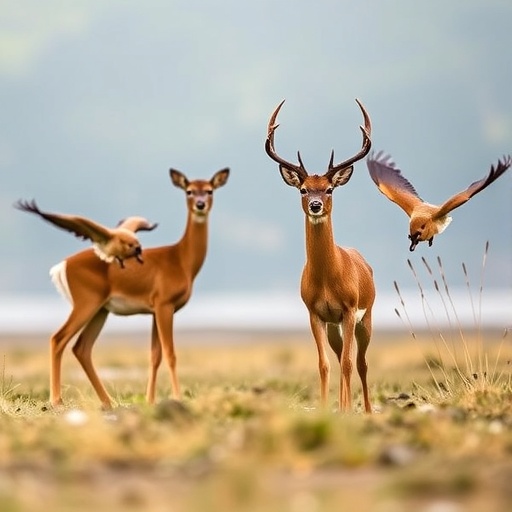
In a groundbreaking study published in PLOS One, researchers have unveiled new insights into the cognitive capacities of the red brocket deer (Mazama americana), a species often overlooked in behavioral and training research. Contrary to popular belief that deer are untrainable due to their skittish nature, this study reveals that red brocket deer possess the ability to learn commands, with individual temperaments significantly influencing training success. These findings have important implications for wildlife management, conservation efforts, and our broader understanding of animal cognition.
The study, conducted by a team of scientists in Brazil, focused on assessing how the innate reactivity and temperament of individual deer impacted their ability to respond to training cues. The red brocket deer, native to South American forests, typically exhibits reactive behaviors intended to evade predators. However, the researchers hypothesized that with appropriate conditioning, even these flighty animals could acquire and perform learned behaviors. Through carefully designed behavioral protocols, the team investigated responses to commands such as “Come,” a fundamental cue for recall.
A key methodological component involved habituation and desensitization processes to facilitate positive human-animal interactions. For example, one deer named ‘Chico’ underwent a habituation phase characterized by calm and rewarding encounters with the trainer, strengthening the animal’s trust and facilitating learning. Another individual, ‘Ariel,’ was subjected to a desensitization protocol aimed at reducing sensitivity to startling stimuli such as spray noise, which is commonly associated with aversive reactions in wild deer populations. These processes were essential in mitigating stress responses and creating conducive learning environments.
The researchers employed operant conditioning techniques, using positive reinforcement to encourage the deer to follow commands. Training schedules incorporated gradual exposure to stimuli, increasing the difficulty in stages while monitoring each deer’s behavioral responses. It was observed that individuals with naturally calmer dispositions demonstrated faster acquisition of commands and more consistent performance during training sessions. Conversely, highly reactive deer struggled with attentional focus, often exhibiting flight responses that hindered the conditioning process.
Quantitative analyses revealed significant correlations between behavioral reactivity scores and training efficiency measures. Deer exhibiting lower baseline cortisol levels—a physiological marker of stress—were more amenable to training interventions and showed increased propensity to engage with trainers. These findings suggest that physiological stress metrics can serve as predictive indicators of learning capacity in cervid species. This knowledge is particularly valuable for developing strategies to manage captive deer populations and improve welfare outcomes.
Importantly, the study sheds light on the cognitive plasticity of red brocket deer, emphasizing their capacity for associative learning despite evolutionary adaptations favoring rapid evasion. This challenges the entrenched notion that prey species inherently lack trainability due to survival instincts. The findings open new avenues for incorporating behavioral conditioning techniques in wildlife rehabilitation programs and controlled breeding initiatives, where human-animal communication is paramount.
The research also highlights the role of individualized training approaches tailored to each animal’s behavioral profile. Standardized one-size-fits-all methods proved inadequate for highly reactive deer, underscoring the necessity for tailored protocols accounting for temperament variability. Such insights are transferable beyond cervids and could inform training practices for other wildlife species exhibiting complex behavioral repertoires.
Beyond practical applications, this study contributes to the broader field of animal cognition by demonstrating that affective states and stress responses modulate learning capacities. Understanding these dynamics enriches interpretations of animal behavior in both natural and anthropogenic contexts and informs ethical considerations for human interactions with wildlife. The data-driven approach employed by the researchers integrates behavioral science with physiological monitoring, exemplifying holistic methodologies in contemporary animal research.
The inclusion of visual documentation depicting positive trainer-deer interactions during habituation and desensitization phases adds depth to the study’s narrative, illustrating subtle nuances in behavioral responses. These images serve as a valuable tool for disseminating methodological frameworks to researchers and practitioners in related fields. Additionally, transparent disclosure of funding sources and conflict-of-interest statements enhances the study’s credibility and reflects robust scholarly standards.
In conclusion, the pioneering work on red brocket deer training efficiency underscores the nuanced relationship between temperament and learning performance in wild ungulates. By identifying behavioral and physiological markers predictive of training success, the research sets a precedent for evidence-based management practices. These advances are poised to influence conservation protocols, improve animal welfare standards, and deepen scientific appreciation for the cognitive landscapes of non-domesticated species.
Moving forward, further investigations could explore neural correlates underlying differential learning capacities among red brocket deer, integrating neurobiological tools to map cognitive processes. Longitudinal studies tracking retention and generalization of learned behaviors across varying environmental contexts would also enrich understanding. The implications extend to ecological dynamics, wherein conditioned responses in prey species could influence predator-prey interactions and habitat utilization patterns.
Such innovative research exemplifies a paradigm shift in wildlife science, bridging ethology, physiology, and applied conservation in a cohesive framework. By embracing the complexity of animal individuality, the scientific community can foster more humane and effective approaches to coexistence with the animal kingdom. The red brocket deer’s demonstrated potential for learning invites a reevaluation of animal capabilities previously thought limited by evolutionary pressures, inspiring novel perspectives on interspecies communication and cooperation.
News Publication Date: 8-Oct-2025
Web References:
http://dx.doi.org/10.1371/journal.pone.0315488
Cite Scienmag News
Margaret Porter. (October 8, 2025). Calm Red Brocket Deer Can Learn “Come” and Other Commands, While the Flightiest Struggle. Scienmag. https://scienmag.com/calm-red-brocket-deer-can-learn-come-and-other-commands-while-the-flightiest-struggle/
Margaret Porter. "Calm Red Brocket Deer Can Learn “Come” and Other Commands, While the Flightiest Struggle." Scienmag, 8 October 2025, https://scienmag.com/calm-red-brocket-deer-can-learn-come-and-other-commands-while-the-flightiest-struggle/. Accessed 4 September 2026.
Margaret Porter. "Calm Red Brocket Deer Can Learn “Come” and Other Commands, While the Flightiest Struggle." Scienmag. October 8, 2025. https://scienmag.com/calm-red-brocket-deer-can-learn-come-and-other-commands-while-the-flightiest-struggle/


