

Thursday, July 9, 2026
Science
No Result
View All Result
  • Login
  • HOME
  • SCIENCE NEWS
  • CONTACT US
  • HOME
  • SCIENCE NEWS
  • CONTACT US
No Result
View All Result
Scienmag
No Result
View All Result
Home Science News Biology

California Gray Wolves Mainly Consume Cattle, Raising Human-Wildlife Conflicts

July 9, 2026
in Biology
Reading Time: 2 mins read
0
California Gray Wolves Mainly Consume Cattle, Raising Human-Wildlife Conflicts

California Gray Wolves Mainly Consume Cattle, Raising Human-Wildlife Conflicts

65
SHARES
587
VIEWS
Share on FacebookShare on Twitter
ADVERTISEMENT

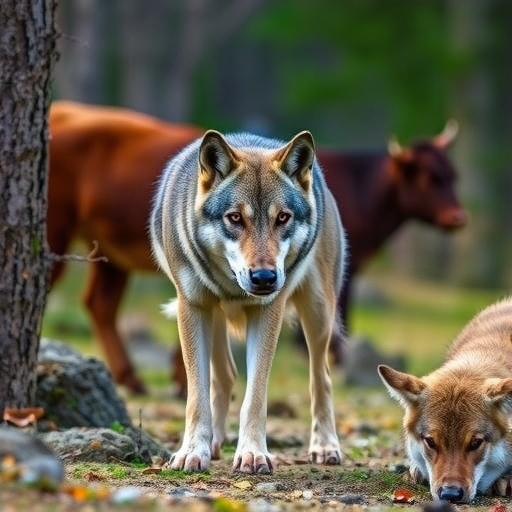
In a groundbreaking study investigating predator-prey dynamics within human-altered environments, researchers reveal that gray wolves in California predominantly consume cattle, accompanied by mule deer and smaller mammals. This dietary pattern challenges conventional understanding of wolf ecology and underscores the complex interface between wildlife and human activities.

The study, published in PLOS One, meticulously analyzed the stomach contents and scat samples of gray wolves inhabiting California’s human-dominated landscapes. Employing advanced molecular techniques to accurately identify prey species, the team confirmed cattle as the primary food source. This finding diverges from traditional wolf diet studies, which emphasize wild ungulates as dominant prey, suggesting that anthropogenic factors have substantially influenced wolf feeding behavior.

California’s landscape is a mosaic of ranches, urban areas, and fragmented natural habitats, creating a novel ecological context for apex predators. The high prevalence of cattle in the wolves’ diet reflects the abundant availability of domestic livestock juxtaposed with limited wild prey populations. This presents a critical conservation puzzle: balancing the ecological role of wolves with the protection of economically important cattle operations.

Ecologists emphasize that the reliance on cattle as prey may heighten human-wolf conflicts, posing formidable challenges for coexistence. Predation on livestock not only affects ranchers’ livelihoods but also triggers retaliatory killings, undermining wolf conservation efforts. The study advocates for integrative management strategies that consider predator behavior, livestock protection measures, and habitat restoration to support sustainable coexistence.

Technically, the research utilized isotope analysis combined with DNA metabarcoding—a cutting-edge approach—to dissect dietary composition with high resolution. These methodologies allowed researchers to differentiate between closely related prey species and quantify relative consumption rates, providing robust evidence for the unexpected dietary trends observed.

Funding for this investigation came from the Rustici Rangeland and Cattle Endowment and the California Cattle Council, highlighting a collaborative approach between academia and the agricultural sector. Importantly, the researchers maintained scientific independence, ensuring unbiased analysis and interpretation.

This study not only advances our understanding of gray wolf ecology in anthropogenic landscapes but also sparks essential discourse on wildlife management amidst expanding human footprint. As wolves adapt their diet to available resources, wildlife managers must innovate to foster harmonious human-predator relationships, preventing unnecessary losses on both sides.

Ultimately, insights from California’s gray wolves serve as a cautionary tale and a call to action for wildlife conservationists globally. The intricate food web changes driven by human presence require nuanced, adaptive management to preserve biodiversity while respecting socio-economic realities.


Subject of Research: Gray wolf diet in human-dominated landscapes
Article Title: Gray Wolf Diet Composition in California’s Human-Dominated Landscape
News Publication Date: 8-Jul-2026
Web References: http://dx.doi.org/10.1371/journal.pone.0351768
Image Credits: Anthony Sebbo, Unsplash, CC0
Keywords: Gray wolf, diet composition, livestock predation, human-wildlife conflict, ecological adaptation, molecular diet analysis

Tags: balancing wildlife conservation and livestock protectionCalifornia gray wolf dietconservation challenges of gray wolvesecological consequences of human-dominated environmentseffects of human-altered habitats on predator-prey dynamicshuman-wildlife conflict in Californiaimpact of domestic livestock on wolf ecologyinnovative research on wolf feeding habitsmolecular analysis of wolf preyurban and rural landscape impacts on predator behaviorwolf-cattle predation
Share26Tweet16
Previous Post

GLP-1 Receptor Agonists Aid Weight Management in Mental Illness

Next Post

USC Rossier Traces 250 Years of Youth-Led Educational Change

Related Posts

New Genetic Screen Advances Understanding of Human Development
Biology

New Genetic Screen Advances Understanding of Human Development

July 9, 2026
Improved survival rates found for babies with severe fetal disorders
Biology

Improved survival rates found for babies with severe fetal disorders

July 9, 2026
Standard fetal growth charts frequently miss identifying at-risk babies
Biology

Standard fetal growth charts frequently miss identifying at-risk babies

July 9, 2026
ECNP Notes Growing Citations Highlight Interest in Mental Health Biology
Biology

ECNP Notes Growing Citations Highlight Interest in Mental Health Biology

July 9, 2026
ISSCR 2026 Launches in Montréal with Global Stem Cell Science Summit
Biology

ISSCR 2026 Launches in Montréal with Global Stem Cell Science Summit

July 8, 2026
Over Half of NYC Free-Roaming Cats Carry Zoonotic Roundworm Parasites
Biology

Over Half of NYC Free-Roaming Cats Carry Zoonotic Roundworm Parasites

July 8, 2026
Next Post
USC Rossier Traces 250 Years of Youth-Led Educational Change

USC Rossier Traces 250 Years of Youth-Led Educational Change

  • Mothers who receive childcare support from maternal grandparents show more

    Mothers who receive childcare support from maternal grandparents show more parental warmth, finds NTU Singapore study

    27656 shares
    Share 11059 Tweet 6912
  • University of Seville Breaks 120-Year-Old Mystery, Revises a Key Einstein Concept

    1061 shares
    Share 424 Tweet 265
  • Bee body mass, pathogens and local climate influence heat tolerance

    682 shares
    Share 273 Tweet 171
  • Researchers record first-ever images and data of a shark experiencing a boat strike

    546 shares
    Share 218 Tweet 137
  • Groundbreaking Clinical Trial Reveals Lubiprostone Enhances Kidney Function

    531 shares
    Share 212 Tweet 133
Science

Embark on a thrilling journey of discovery with Scienmag.com—your ultimate source for cutting-edge breakthroughs. Immerse yourself in a world where curiosity knows no limits and tomorrow’s possibilities become today’s reality!

RECENT NEWS

  • Football fans perform over 800,000 CPR compressions at FIFA events
  • New Genetic Screen Advances Understanding of Human Development
  • Humanoid Robots Tested for Surgical Use in Live Feasibility Study
  • Measuring Gender Inequality in Modern Visual Art Institutions

Categories

  • Agriculture
  • Anthropology
  • Archaeology
  • Athmospheric
  • Biology
  • Biotechnology
  • Blog
  • Bussines
  • Cancer
  • Chemistry
  • Climate
  • Earth Science
  • Editorial Policy
  • Marine
  • Mathematics
  • Medicine
  • Pediatry
  • Policy
  • Psychology & Psychiatry
  • Science Education
  • Social Science
  • Space
  • Technology and Engineering

Subscribe to Blog via Email

Enter your email address to subscribe to this blog and receive notifications of new posts by email.

Join 5,147 other subscribers

© 2025 Scienmag - Science Magazine

Welcome Back!

Login to your account below

Forgotten Password?

Retrieve your password

Please enter your username or email address to reset your password.

Log In
No Result
View All Result
  • HOME
  • SCIENCE NEWS
  • CONTACT US

© 2025 Scienmag - Science Magazine

Discover more from Science

Subscribe now to keep reading and get access to the full archive.

Continue reading
