


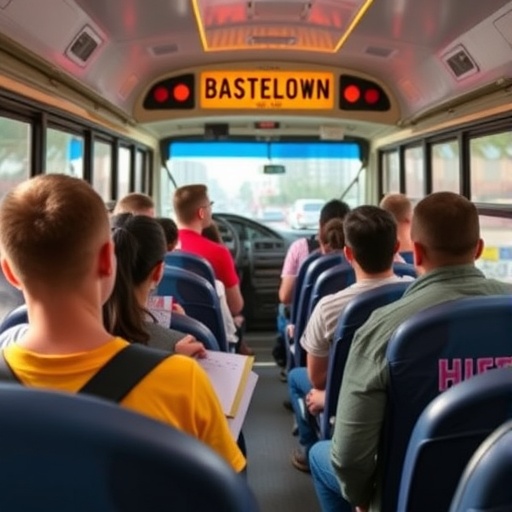
In Spain, the daily routine of millions of students involves long school bus journeys that may be silently undermining their academic engagement. A recent rigorous study conducted by a team of researchers at Universitat Jaume I of Castelló highlights a concerning pattern: the length of time students spend commuting to school directly impacts their psychological and emotional connection to their education, as well as their behavioral participation. This revelation sheds light on a nuanced and overlooked factor influencing student success and well-being, especially within secondary and upper secondary education levels.
The research draws upon a significant sample of 470 students aged between 13 and 21, attending two secondary schools in the province of Castelló. The schools, located in La Vall d’Alba and Onda, present a diverse geographic backdrop, with multiple bus routes varying dramatically in both distance and duration. Notably, some routes extended beyond 50 kilometers one way, translating to commuting times exceeding an hour. This extensive coverage enabled the researchers to examine a wide spectrum of commuting experiences and their correlates with academic engagement.
Academic engagement, the focal construct of this study, is a complex and multifaceted phenomenon. It is conceptualized as the student’s holistic involvement and connection with their academic environment, blending affective-emotional, cognitive, and behavioral dimensions. The affective-emotional component captures feelings and interpersonal relationships tied to the school setting, encompassing student attitudes toward peers and educators. Cognitive engagement reflects mental investment, encompassing motivation, cognitive effort, and the willingness to grapple with challenging material. Behavioral engagement involves active participation, routine attendance, and persistence in academic tasks.
Data analysis uncovered a stark association between commuting duration and diminished academic engagement across all three dimensions. Students enduring longer bus rides reported weaker emotional bonds with their schools, reduced motivation, and less behavioral participation. This suggests that extended commuting times may disrupt students’ capacity to build positive school relationships, sustain cognitive effort, and consistently engage in academic activities. The cumulative effect implies a detrimental feedback loop where prolonged travel induces disengagement, which in turn hampers learning and socio-emotional development.
The implications of these findings are particularly potent for secondary and upper secondary students, who are navigating complex developmental challenges amid academic pressures. These students are at a critical stage for cultivating essential skills and competencies, and academic engagement serves as a vital lever for successful learning outcomes. The study highlights how the external factor of transportation logistics can impose hidden barriers that derail students from fully committing to their educational journey.
The research team, including Laura Abellán Roselló from the Learning Difficulties Research Group and Pablo Marco Dols alongside Javier Soriano Martí from the Interuniversity Institute of Geography, emphasize the intersections between geographic realities and educational psychology. Their interdisciplinary approach bridges spatial analysis with engagement theory, unveiling a novel dimension of educational inequality shaped by commuting environments. This fusion of geography and pedagogy situates the physical journey as a significant, yet underappreciated determinant of academic vitality.
Statistically, the sample revealed that roughly one-third of the students experienced commutes lasting under 15 minutes, whereas approximately 15% faced journeys exceeding an hour. The intensity of disengagement correlated positively with the increasing travel times, underscoring a dose-response relationship where longer exposure to commuting stressors compounds adverse academic and emotional effects. This quantitative evidence corroborates qualitative insights regarding the draining and isolating experiences tied to extended commutes.
Researchers propose that prolonged time spent on school buses might provoke anxiety, fatigue, and social isolation. These emotional and physical burdens could degrade students’ readiness for classroom participation and intellectual challenges. Furthermore, long commutes limit opportunities for leisure, homework, and family interactions, crucial components for balanced adolescent development. Consequently, travel duration emerges as a latent yet powerful factor mediating academic trajectories.
This study urges educators and policymakers to recognize transportation as a critical context factor influencing educational engagement. Targeted strategies and interventions are necessary to mitigate the negative impacts. For example, schools might develop flexible learning schedules, implement engagement-boosting programs for students with long commutes, or advocate for optimized bus routing to reduce travel time. Professional development for teachers to foster positive student relationships and create resilient learning environments is also essential.
In rural and geographically dispersed schooling contexts, such as those examined in Castelló, these findings highlight systemic challenges. The spatial distribution of student populations demands coordinated solutions that balance accessibility with engagement. Insights from this research can inform educational planning, transportation infrastructure, and community initiatives aiming to close engagement gaps and promote equitable learning experiences.
The publication of this study in the esteemed Revista de Educación adds to the growing discourse on social determinants of educational outcomes. By illuminating the nexus between geography and student psychology, it opens avenues for cross-sector collaboration spanning education, transportation, and public health domains. Interventions emerging from these insights hold promise for bolstering academic success and fostering well-being among vulnerable student populations.
Continued research is recommended to explore longitudinal effects of commuting on academic trajectories and to test intervention efficacy. Moreover, examination of individual differences, such as resilience and social support networks, may elucidate protective factors that buffer against commute-induced disengagement. Such knowledge will enhance tailored support systems to assist students in overcoming barriers related to their travel realities.
In sum, this pioneering study marks a critical step toward understanding how everyday logistics shape educational engagement, a foundational element of academic achievement and personal development. As educational institutions and communities strive to cultivate inclusivity and success, recognizing and addressing the hidden toll of long school commutes is imperative. This work offers both a scientific framework and a call to action for nurturing student potential in all dimensions of their lives.
News Publication Date: 30-Sep-2025
Web References: https://doi.org/10.4438/1988-592X-RE-2025-410-714
Cite Scienmag News
Courtney Benton. (November 3, 2025). Bus Ride Duration Influences Students’ Academic Engagement with School, Peers, and Teachers. Scienmag. https://scienmag.com/bus-ride-duration-influences-students-academic-engagement-with-school-peers-and-teachers/
Courtney Benton. "Bus Ride Duration Influences Students’ Academic Engagement with School, Peers, and Teachers." Scienmag, 3 November 2025, https://scienmag.com/bus-ride-duration-influences-students-academic-engagement-with-school-peers-and-teachers/. Accessed 4 September 2026.
Courtney Benton. "Bus Ride Duration Influences Students’ Academic Engagement with School, Peers, and Teachers." Scienmag. November 3, 2025. https://scienmag.com/bus-ride-duration-influences-students-academic-engagement-with-school-peers-and-teachers/


