


Mitigating the effects of climate change has become a major focus worldwide, with countries and international organizations developing various strategies to address the problem. Lowering CO₂ emissions is at the top, with carbon capture technologies being a promising way forward.

Credit: Charalambous et al. 2024. DOI: 10.1038/s41586-024-07683-8
Mitigating the effects of climate change has become a major focus worldwide, with countries and international organizations developing various strategies to address the problem. Lowering CO₂ emissions is at the top, with carbon capture technologies being a promising way forward.
Nonetheless, bridging the gap between research and practical implementation of carbon capture solutions has proven so difficult, it has an actual name: “Valley of Death”. The challenge is compounded by the need to take into account the perspectives and priorities of different stakeholders along the process.
Traditionally, carbon capture tech development begins with chemists designing materials and engineers developing processes, while economic and environmental impacts are assessed later. The results are often suboptimal and only delay the implementation of real-world solutions.
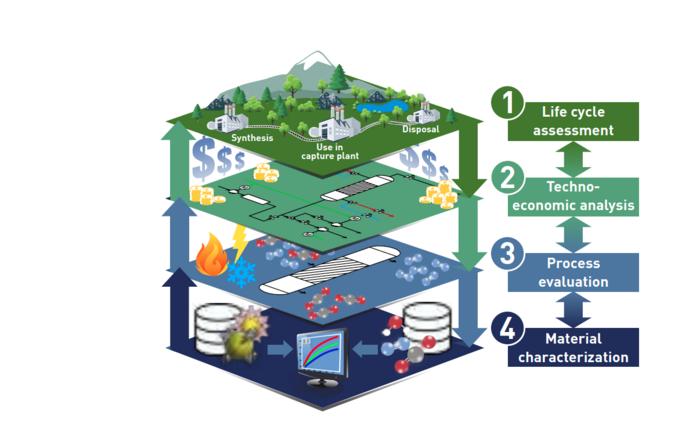
In response to this, scientists led by Berend Smit at EPFL and Susana Garcia at Heriot-Watt University have developed the PrISMa (Process-Informed design of tailormade Sorbent Materials) platform: an innovative tool that seamlessly connects materials science, process design, techno-economics, and life-cycle assessment by taking into account multiple stakeholder perspectives from the outset.
Using advanced simulations and machine learning, PrISMa can identify the most effective and sustainable solutions, and predict the performance of new materials, which sets it apart as a powerful tool in the fight against climate change.
Assessing KPIs
PrISMa evaluates four Key Performance Indicators (KPIs), or “layers,” to assess the viability of a carbon capture material from its initial development to its implementation into a complete carbon capturing plant.
- Materials Layer: Using experimental data and molecular simulations, the platform predicts the adsorption properties of potential sorbent materials.
- Process Layer: PrISMa computes process performance parameters, such as purity, recovery, and energy requirements.
- Techno-Economic Analysis Layer: PrISMa assesses the economic and technical viability of a carbon capture plant.
- Life-Cycle Assessment Layer: PrISMa evaluates the environmental impacts over the plant’s entire life cycle, ensuring comprehensive sustainability.
Testing PrISMa on case studies
The scientists used PrISMa to compare over sixty real-world case studies, in which CO2 is captured from different sources in five world regions with different technologies. By taking into account multiple stakeholder perspectives, PrISMa helped identify the most effective and sustainable solutions.
“One of the unique features of the PrISMa platform is its ability to predict the performance of new materials using advanced simulations and machine learning,” says Berend Smit. “This innovative approach accelerates the discovery of top-performing materials for carbon capture, surpassing traditional trial-and-error methods.”
Molecular simulations
The platform integrates density functional theory (DFT) and molecular simulation to predict material properties needed for process design. The team tested this approach on a CO2 capture plant looking at the indirect emissions over 30 years of the plant’s operation, and coupled this with a techno-economic assessment, which evaluated the cost of the process.
“We succeeded in connecting the movement of electrons at the DFT level to calculate the total amount of CO₂ captured over the 30-year lifetime of a capture plant, and at which costs,” says Berend Smit.
The stakeholders’ point of view
PrISMa provides invaluable insights for various stakeholders, offering engineers the tools to design the most efficient and cost-effective carbon capture processes, and guiding chemists on the molecular characteristics that enhance material performance.
Environmental managers gain access to comprehensive evaluations of environmental impacts, enabling more informed decision-making, while investors benefit from detailed economic analyses that reduce the risks and uncertainties associated with investing in new technologies.
Discovering new materials
PrISMa can accelerate the discovery of top-performing materials for carbon capture, surpassing traditional trial-and-error methods. Its interactive tools allow users to explore over 1,200 materials, understanding the trade-offs between cost, environmental impact, and technical performance.
This comprehensive approach ensures that chosen solutions capture CO₂ efficiently while minimizing overall environmental impacts.
One way that Smit envisions PrISMa being used is in the discovery of metal-organic frameworks (MOFs), porous materials with a wide range of applications, including carbon capture. “The idea is that chemists can upload the crystal structures of their MOFs, and the platform ranks these materials for all kinds of capture processes,” he says. “So, even chemists who do not have detailed knowledge of carbon capture technologies can get feedback on which MOF is the best performing and why.”
PrISMa can accelerate the development of carbon capture technologies, helping achieve net-zero emissions by uniting all relevant stakeholders early in the research process. By providing a comprehensive evaluation of materials and processes, PrISMa enables more informed decision-making, leading to the development of more effective and sustainable carbon capture solutions.
Other contributors
- ETH Zurich
- Solverlo Ltd.
- Institut des Matériaux Poreux de Paris, ENS-Paris
- Lawrence Berkeley National Laboratory
Reference
Charithea Charalambous, Elias Moubarak, Johannes Schilling, Eva Sanchez Fernandez, Jin-Yu Wang, Laura Herraiz, Fergus McIlwaine, Shing Bo Peh, Matthew Garvin, Kevin Maik Jablonka, Seyed Mohamad Moosavi, Joren Van Herck, Aysu Yurdusen Ozturk, Alireza Pourghaderi, Ah-Young Song, Georges Mouchaham, Christian Serre, Jeffrey A. Reimer, André Bardow, Berend Smit, & Susana Garcia. Shedding Light on Stakeholders’ Perspectives for Sorbent-Based Carbon Capture. Nature 17 July 2024. DOI: 10.1038/s41586-024-07683-8
Journal
Nature
Article Title
Shedding Light on Stakeholders’ Perspectives for Sorbent-Based Carbon Capture.
Article Publication Date
17-Jul-2024
Cite Scienmag News
Sloane Callahan. (July 17, 2024). Bridging the “Valley of Death” in carbon capture. Scienmag. https://scienmag.com/bridging-the-valley-of-death-in-carbon-capture/
Sloane Callahan. "Bridging the “Valley of Death” in carbon capture." Scienmag, 17 July 2024, https://scienmag.com/bridging-the-valley-of-death-in-carbon-capture/. Accessed 4 September 2026.
Sloane Callahan. "Bridging the “Valley of Death” in carbon capture." Scienmag. July 17, 2024. https://scienmag.com/bridging-the-valley-of-death-in-carbon-capture/

