


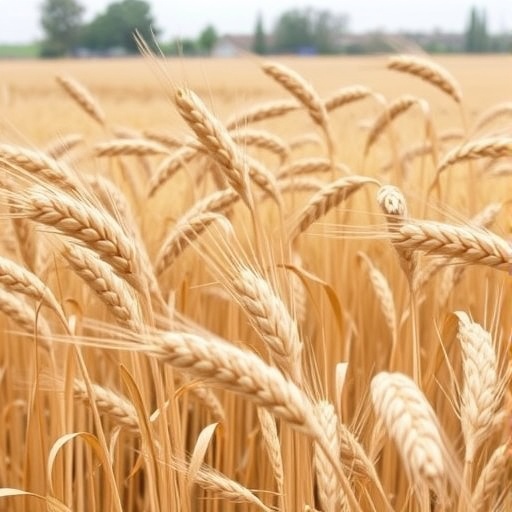
In a transformative stride toward sustainable agriculture, recent research has unveiled how centuries of selective breeding have remarkably altered the water use patterns of winter wheat across Europe. This groundbreaking study, conducted by Behrend et al. and published in npj Sustainable Agriculture, sheds light on the intricate relationship between plant breeding and water resource efficiency, revealing implications that ripple across environmental management, food security, and climate adaptation strategies.
Winter wheat, a staple cereal crop in Europe, has been cultivated and selectively bred for millennia, aiming to enhance yield, disease resistance, and adaptability. However, the subtle impacts of breeding on physiological traits tied to water usage remained largely unexplored until now. The research team embarked on a comprehensive analysis linking historical breeding practices with ecophysiological data to decode how winter wheat’s water consumption patterns have evolved alongside agronomic improvements.
Using an impressive dataset that spans genetic, phenotypic, and climatic variables, the researchers employed advanced modeling frameworks to dissect water use efficiency (WUE) and transpiration dynamics. WUE, fundamentally the ratio between biomass produced and water consumed, offers a pivotal metric for assessing drought resilience and sustainable yield. By quantifying shifts in WUE indicators over different breeding eras, the study captures a vivid narrative of how human intervention has unwittingly reshaped fundamental plant-water relations.
One of the study’s major revelations is the temporal trend illustrating that modern winter wheat varieties tend to use water more judiciously compared to their historical progenitors. Through selective breeding, traits favoring reduced stomatal conductance and altered root architectures have been increasingly favored. Consequently, these physiological modifications afford modern cultivars a distinct advantage under water-limited conditions by minimizing transpiration losses without compromising photosynthetic capacity.
Furthermore, the spatial dimension of the research highlights notable regional variability across Europe. For instance, varieties adapted to drier southern European climates exhibit more conservative water use patterns, whereas northern variants maintain higher transpiration rates aligned with their mesic environments. This heterogeneous adaptation underscores the complex interplay between genotype, environment, and human selection, emphasizing the necessity for region-specific breeding strategies geared toward climatic resilience.
In addressing climatic challenges, the research also emphasizes how the changing phenology of winter wheat affects water use efficiency. Genotypes with accelerated development cycles may escape late-season droughts, effectively reducing evaporative demands during critical growth phases. This phenological plasticity, coupled with morpho-physiological traits, orchestrates a multifaceted approach to optimizing water use under shifting environmental pressures.
The study further integrates remote sensing and field experimental data to validate modeled predictions, enhancing the robustness of their conclusions. Technologies such as thermal infrared imaging and soil moisture sensing provide empirical evidence linking canopy temperature dynamics and transpiration rates, reinforcing the theoretical framework of breeding-induced alterations in water use traits.
Importantly, this research transcends academic insight by informing practical agricultural policy and breeding programs. As water scarcity intensifies amidst global climate change, the capacity to breed crops that inherently economize water consumption without yield penalties represents a pivotal adaptive strategy. Policymakers and breeders are thereby urged to incorporate ecophysiological trait selection alongside conventional yield-based metrics.
Moreover, the findings call for renewed attention to the genetic corridors influencing water use, advocating for integrating genetic diversity from landraces and wild relatives. These genetic reservoirs might harbor untapped water-efficient traits that current high-yield cultivars lack, offering pathways to elevate resilience through genomic-assisted breeding.
The implications of these insights extend beyond Europe, resonating in agro-ecological zones worldwide where water availability increasingly dictates agricultural viability. By unraveling how breeding subtly, yet significantly, modulates plant hydration dynamics, this study lays the groundwork for global efforts emphasizing sustainable intensification and water stewardship.
In light of these discoveries, future research directions beckon toward molecular dissection of trait heritability and gene-environment interactions governing water use. Such knowledge could catalyze the development of precision-bred wheat varieties optimized for diverse climate scenarios, reinforcing food system resilience globally.
Finally, this research dovetails with broader sustainability goals by highlighting the interconnectedness of food production, water resources, and environmental stewardship. As agriculture grapples with the dual imperatives of feeding a growing population and conserving vital natural resources, innovations in crop water use represent a linchpin in harmonizing productivity with planetary boundaries.
Overall, the pioneering work by Behrend and colleagues underscores how evolutionary processes guided by human selection have reshaped water dynamics in a critical crop species. Their integrative approach combining physiology, genetics, and climate modeling offers a compelling template for future investigations aiming to address the grand challenges of sustainable agriculture under climate uncertainty.
Cite Scienmag News
Alan Morgan. (March 31, 2026). Breeding Alters Winter Wheat Water Use in Europe. Scienmag. https://scienmag.com/breeding-alters-winter-wheat-water-use-in-europe/
Alan Morgan. "Breeding Alters Winter Wheat Water Use in Europe." Scienmag, 31 March 2026, https://scienmag.com/breeding-alters-winter-wheat-water-use-in-europe/. Accessed 4 September 2026.
Alan Morgan. "Breeding Alters Winter Wheat Water Use in Europe." Scienmag. March 31, 2026. https://scienmag.com/breeding-alters-winter-wheat-water-use-in-europe/


