


Repetitive transcranial magnetic stimulation, or rTMS, has become one of the few non-drug options available to people whose depression refuses to lift under standard antidepressants. Magnetic coils placed against the scalp deliver rapid pulses that alter the excitability of the prefrontal cortex, and for roughly a third of patients with major depressive disorder who do not respond to first-line treatments, the technique can bring meaningful relief. Yet the neurobiology underneath the therapy remains stubbornly opaque. A new preclinical study published in Frontiers in Molecular Neuroscience now offers a striking explanation for why clinical responses to rTMS are so uneven: the same stimulation protocol produces fundamentally different biological effects depending on the depressive phenotype of the brain it is applied to.
The research team, led by Marta Boffa and Francesca Zoratto of the Istituto Superiore di Sanità in Rome together with Mauro Pettorruso of the G. d’Annunzio University of Chieti-Pescara, set out to answer a question that has long hovered over the neuromodulation field. Does rTMS push the brain along a single, common path of adaptation, or does it recruit distinct mechanisms depending on the baseline state of neural circuits? To find out, they compared three groups of male rats: a non-depressed control group of socially housed Wistar rats, a treatment-responsive depression model created by prolonged social isolation in otherwise ordinary Wistar rats, and a model of treatment-resistant depression built from Wistar-Kyoto rats exposed to both social isolation and a four-week chronic mild stress protocol involving rotating stressors such as cage tilting, food and water deprivation, soiled bedding, and stroboscopic illumination.
The treatment-resistant model is critical to the study’s design. Most preclinical rTMS research has relied on depression models that respond to standard antidepressants, which limits how well the findings translate to the treatment-resistant patients who actually receive the therapy in clinics. The Wistar-Kyoto strain under chronic mild stress, by contrast, is unresponsive to classic antidepressant drugs but has been shown in earlier work to react to esketamine, electroconvulsive therapy, and deep brain stimulation, making it a far better stand-in for the human condition the therapy targets.
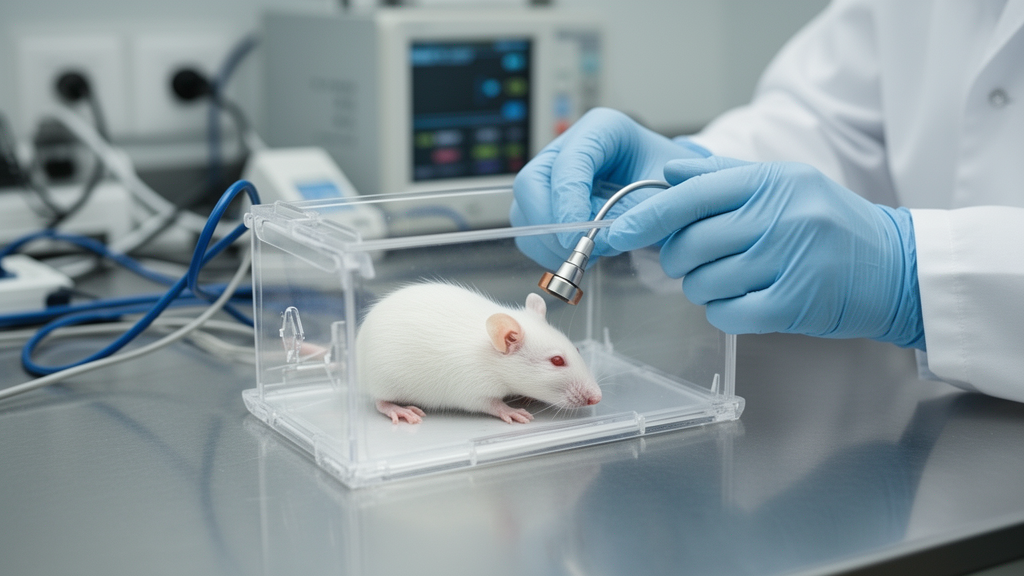
The stimulation protocol itself was engineered to mirror clinical practice as closely as rodent anatomy allows. Using a rat-specific cooled coil and a commercial stimulator, the team delivered high-frequency stimulation at 10 hertz, 110 percent of resting motor threshold, in trains of 40 pulses, amounting to 1,600 pulses per session across eight consecutive days and a total of 12,800 pulses aimed bilaterally at the frontal cortex. Notably, the animals were awake and unanesthetized during stimulation, gently held under the coil, with sham groups receiving identical handling and noise exposure. Behavioral testing began one day after the final session and again fourteen days later, spanning tests of anhedonia, motivation, helplessness, and anxiety-like behavior, including the sucrose consumption, novelty-suppressed feeding, splash, forced swim, open-field, and elevated plus maze tests.
The behavioral results split cleanly along phenotype lines. In the treatment-responsive isolation model, active rTMS improved multiple domains: the rats moved more in the forced swim test, froze less in the open field, and entered the open arms of the elevated plus maze earlier and spent more time there, indicating reduced anxiety. In the treatment-resistant model, the effects were narrower but still real. Treated rats approached food faster in the novelty-suppressed feeding test and, in the splash test, a significantly higher proportion of actively stimulated TRD animals engaged in self-grooming, a proxy for motivation and self-care that is often collapsed in severe depressive states. Neither model showed changes in sucrose consumption, and most behavioral gains faded by the two-week follow-up, suggesting the protocol produced adaptations that may need maintenance sessions to persist.
The neuroendocrine data added a second layer of divergence. Active stimulation lowered basal plasma corticosterone, the rodent equivalent of the human stress hormone cortisol, only in the treatment-responsive model. In the treatment-resistant rats, corticosterone stayed flat even though select behaviors improved. This dissociation matters because dysregulation of the hypothalamic-pituitary-adrenal axis is central to depression’s pathophysiology and has been linked in clinical work to whether patients respond to neuromodulation. The findings imply that behavioral recovery in treatment-resistant brains can proceed independently of stress-hormone normalization, possibly reflecting reduced neuroendocrine flexibility or altered stress-feedback regulation as features of the resistant state itself.
The most consequential results emerged at the molecular level, sixteen days after the final stimulation session, when detectable behavioral effects had largely subsided. In the prefrontal cortex of treatment-resistant rats, active rTMS significantly increased expression of both Bdnf, the gene encoding brain-derived neurotrophic factor, and Cnr1, the gene encoding the CB1 cannabinoid receptor, with large effect sizes. BDNF signaling is a cornerstone of activity-dependent synaptic remodeling and antidepressant action, while the endocannabinoid system regulates stress adaptation and synaptic plasticity through control of excitatory and inhibitory neurotransmission. Neither gene was significantly elevated in the treatment-responsive or control groups, and the hippocampus showed essentially no changes except a reduction of Bdnf in controls, pointing to a marked regional specificity for the stimulated cortical area.
Perhaps the most intriguing observation was a correlation. Across the treatment-resistant group, prefrontal Bdnf and Cnr1 expression were strongly and positively correlated, an association driven entirely by the actively stimulated animals and absent in sham-treated ones and in the other models. Because the endocannabinoid and BDNF systems are known to interact bidirectionally in regulating synaptic plasticity and stress responses, the authors interpret this pattern as coordinated engagement of plasticity-related pathways specifically in the treatment-resistant phenotype. Correlation cannot establish causation, and the absence of matched short-term molecular samples means the team cannot say whether these gene changes accompanied the behavioral improvements or emerged afterward. Still, the finding suggests that late, persistent cortical molecular adaptations outlasted the visible behavioral response rather than simply mirroring it.
Taken together, the study argues that rTMS does not switch on a single biological program across depressive conditions. In treatment-responsive brains, recovery tracked neuroendocrine normalization and broader behavioral improvement; in treatment-resistant brains, selective gains in motivation and self-care ran in parallel with a coordinated, prefrontal engagement of neurotrophic and endocannabinoid machinery. The authors acknowledge a key limitation: only male rats were studied, a significant gap given well-established sex differences in depressive phenotypes and HPA-axis regulation, and female subjects remain underrepresented in preclinical rTMS research broadly. Even so, the work lays groundwork for a more refined clinical vision, in which stimulation protocols are matched not just to symptoms but to the underlying neurobiological state of the patient’s brain. If phenotype-informed, mechanism-guided neuromodulation can be validated in humans, the heterogeneous and often frustrating response rates of rTMS in treatment-resistant depression may become less a mystery and more a matter of matching the right biological lever to the right brain.
Subject of Research: Phenotype-dependent behavioral, neuroendocrine, and molecular responses to repetitive transcranial magnetic stimulation in rat models of treatment-responsive and treatment-resistant depression
Article Title: Depressive phenotype shapes behavioral, neuroendocrine and molecular responses to repetitive transcranial magnetic stimulation in preclinical models of depression
Article References: Boffa, M., Spalletti, S., Martella, F., Cerri, C., Feliciani, B., Inserra, A., De Risio, L., Di Lorenzo, G., Martinotti, G., D’Addario, C., Pettorruso, M., & Zoratto, F. (2026). Depressive phenotype shapes behavioral, neuroendocrine and molecular responses to repetitive transcranial magnetic stimulation in preclinical models of depression. Frontiers in Molecular Neuroscience, 19, Article 1939025. https://doi.org/10.3389/fnmol.2026.1939025
Image Credits: AI Generated
DOI: 10.3389/fnmol.2026.1939025
Keywords: rTMS, treatment-resistant depression, BDNF, endocannabinoid system, neuroplasticity, prefrontal cortex, corticosterone, HPA axis, preclinical models, chronic mild stress, neuromodulation, Cnr1
Cite Scienmag News
Cassandra Pierce. (October 15, 2026). Brain Stimulation for Depression Works Differently Depending on the Brain It Hits, Rat Study Finds. Scienmag. https://scienmag.com/brain-stimulation-for-depression-works-differently-depending-on-the-brain-it-hits-rat-study-finds/
Cassandra Pierce. "Brain Stimulation for Depression Works Differently Depending on the Brain It Hits, Rat Study Finds." Scienmag, 15 October 2026, https://scienmag.com/brain-stimulation-for-depression-works-differently-depending-on-the-brain-it-hits-rat-study-finds/. Accessed 15 October 2026.
Cassandra Pierce. "Brain Stimulation for Depression Works Differently Depending on the Brain It Hits, Rat Study Finds." Scienmag. October 15, 2026. https://scienmag.com/brain-stimulation-for-depression-works-differently-depending-on-the-brain-it-hits-rat-study-finds/


