


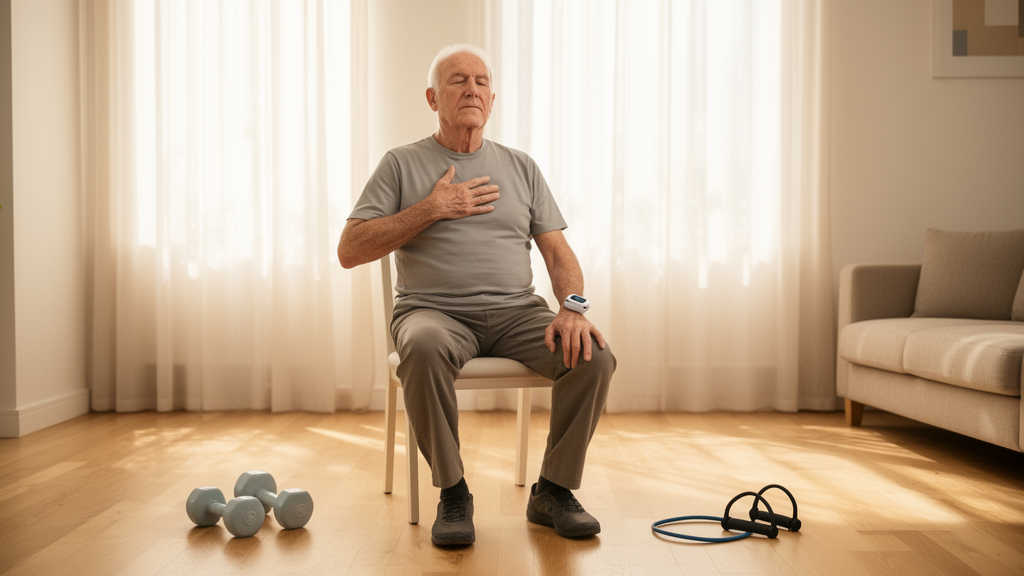
For millions of people living with chronic heart failure, the road to recovery has traditionally run through hospital gyms and supervised rehabilitation centers. But a new clinical study from Poland suggests that the living room may be just as powerful a training ground. Researchers at the Medical University of Bialystok report that a simple, low-cost, six-month home-based program combining physical exercise with respiratory muscle training significantly improved walking capacity, strengthened the muscles of breathing, and reduced debilitating fatigue in patients with a weakened heart. The findings, published in Frontiers in Rehabilitation Sciences, arrive at a moment when health systems worldwide are searching for scalable ways to deliver cardiac rehabilitation to patients who cannot easily access it.
Chronic heart failure is far more than a problem of a failing pump. The condition disrupts the delicate interplay between the heart and the lungs, producing pulmonary congestion, altered gas exchange, and impaired lung mechanics. As a result, the work and energy cost of every breath rises, and even modest physical effort becomes exhausting. This physiological burden explains why patients with heart failure often experience profound breathlessness and fatigue, and why rehabilitation programs that target only the legs and arms may miss a crucial piece of the therapeutic puzzle. The Bialystok team designed their intervention with this cardiopulmonary coupling in mind, pairing conventional endurance training with structured breathing exercises and inspiratory muscle training.
The evidence base for exercise training in heart failure is already strong. Large randomized trials and meta-analyses have shown that regular exercise improves physical endurance and quality of life, reduces all-cause and heart failure-related hospitalizations, and may even lower long-term mortality. The European Society of Cardiology currently recommends supervised exercise training and rehabilitation for all patients with chronic heart failure who are able to participate. Yet in practice, cardiac rehabilitation remains dramatically underused, with participation rates estimated at only 10 to 30 percent. Distance, cost, frailty, and simple logistics keep many patients from ever setting foot in a center-based program, creating an urgent need for models that work beyond the clinic walls.
To test whether rehabilitation could be safely and effectively moved into patients’ homes, the researchers enrolled 63 patients with stable heart failure with reduced ejection fraction, meaning their hearts pumped at less than 40 percent of normal capacity. Participants were randomized in a 3:2 ratio to an intervention or control group. The intervention group received detailed instruction in a tailored home program: physical training performed once daily, at least five times per week, at an intensity of 4 to 5 points on a 10-point Borg scale of perceived exertion, building toward sessions of 45 to 60 minutes. Each patient also received a Pulmogain RespiTrain device for resistance training of the respiratory muscles, along with an illustrated booklet, a pedometer, and a self-monitoring diary to record heart rate, blood pressure, breathlessness, and step counts.
Crucially, the program did not abandon patients to their own devices. Scheduled clinic visits at one and three months allowed the team to verify exercise technique and adjust the training plan, while weekly telephone support reinforced adherence. Family members or caregivers were trained to supervise sessions at home. This hybrid of autonomy and remote oversight proved remarkably effective: adherence to the recommended protocol, defined as completing at least 120 sessions over 24 weeks, averaged an impressive 91.5 percent, and 82.8 percent of patients who started the program completed the full six-month assessment. Patients logged an average of more than 9,000 steps per day, including roughly 3,300 steps within each dedicated training session.
The physiological results were striking. After six months, the distance patients could walk in six minutes, a standard measure of functional capacity, increased by an average of 37.86 meters, a change the authors describe as clinically meaningful. Maximal inspiratory pressure, the force the diaphragm and other inspiratory muscles can generate, rose by 20.21 centimeters of water, while maximal expiratory pressure climbed by 20.75 centimeters of water, both highly statistically significant gains. Fatigue, measured with the validated Fatigue Severity Scale, fell by an average of 0.68 points. Notably, the magnitude of the inspiratory pressure improvement closely matches results from meta-analyses of supervised inspiratory muscle training, which reported gains of roughly 16 to 25 centimeters of water, suggesting that home-based delivery can achieve comparable physiological effects.
The respiratory component of the program deserves particular attention. Heart failure impairs ventilation and the matching of airflow to blood perfusion in the lungs, and previous research has shown that breathing exercises and inspiratory muscle training can improve not only respiratory mechanics but also exercise tolerance and quality of life. Meta-analytic data indicate that patients with inspiratory muscle weakness benefit most from this form of training, and the baseline inspiratory pressure of the Bialystok cohort, around 63 centimeters of water, was consistent with substantial respiratory muscle impairment. The study’s combined approach, pairing endurance walking with targeted respiratory resistance training, produced gains consistent with the best results reported in the supervised literature.
Safety, often the central concern when prescribing unsupervised exercise to cardiac patients, was reassuring. No serious adverse events related to training were reported, and no deaths occurred in the heart failure group. The few exercise-related complaints were minor: one case each of excessive fatigue, breathlessness, and calf cramps, and two episodes of chest pain. The researchers attribute this safety profile to careful patient selection, thorough instruction in contraindications and safe exercise principles, and the structured self-monitoring system that kept the study team informed of each patient’s status week by week.
The study was not without limitations, and the authors are candid about them. The COVID-19 pandemic disrupted the original design, and the control group could not be assessed after six months because most participants were unwilling to attend hospital visits during lockdowns. This means the analysis effectively became a single-arm before-and-after comparison, so some of the observed improvement could reflect natural variability, regression to the mean, or the motivating effect of increased attention. The sample was also small, dominated by men, and enrolled before newer heart failure drugs such as SGLT2 inhibitors became standard. These caveats temper the strength of the conclusions, though they do not erase the consistency of the physiological gains with the broader supervised-rehabilitation literature.
Even with those qualifications, the implications are considerable. Prior systematic reviews have found home-based cardiac rehabilitation to be non-inferior to center-based programs in clinical outcomes, with marginally higher completion rates, and the landmark HF-ACTION trial struggled to keep long-term adherence above 30 percent even with intensive support. Against that benchmark, an adherence rate above 90 percent in an unsupervised, home-delivered program is remarkable, and the authors suggest that simple tools such as pedometers, diaries, and weekly phone calls may offer a viable, cost-effective alternative to high-tech telemonitoring, especially in low-resource settings. For the vast majority of heart failure patients who never receive rehabilitation today, a program that requires little more than a pair of legs, a breathing device, a booklet, and a telephone line could bring the benefits of the clinic directly into the home.
Subject of Research: Home-based exercise and respiratory rehabilitation for chronic heart failure
Article Title: Beyond the clinic: a six-month home-based exercise and respiratory rehabilitation program improves functional capacity, respiratory muscle strength, and fatigue in chronic heart failure
Article References: Ciołkiewicz, M., Wojciuk, M., Kuryliszyn-Moskal, A., Dakowicz, A., Sawicka-Śmiarowska, E., & Kamiński, K. (2026). Beyond the clinic: a six-month home-based exercise and respiratory rehabilitation program improves functional capacity, respiratory muscle strength, and fatigue in chronic heart failure. Frontiers in Rehabilitation Sciences, 7, Article 1958027. https://doi.org/10.3389/fresc.2026.1958027
Image Credits: AI Generated
DOI: 10.3389/fresc.2026.1958027
Keywords: heart failure, cardiac rehabilitation, home-based exercise, respiratory muscle training, inspiratory muscle training, six-minute walk test, fatigue, functional capacity, HFrEF, adherence, telemonitoring, pilot study
Cite Scienmag News
Beatrice Stafford. (October 15, 2026). Six Months of Home-Based Exercise and Breathing Training Transforms Heart Failure Recovery. Scienmag. https://scienmag.com/six-months-of-home-based-exercise-and-breathing-training-transforms-heart-failure-recovery/
Beatrice Stafford. "Six Months of Home-Based Exercise and Breathing Training Transforms Heart Failure Recovery." Scienmag, 15 October 2026, https://scienmag.com/six-months-of-home-based-exercise-and-breathing-training-transforms-heart-failure-recovery/. Accessed 15 October 2026.
Beatrice Stafford. "Six Months of Home-Based Exercise and Breathing Training Transforms Heart Failure Recovery." Scienmag. October 15, 2026. https://scienmag.com/six-months-of-home-based-exercise-and-breathing-training-transforms-heart-failure-recovery/


