


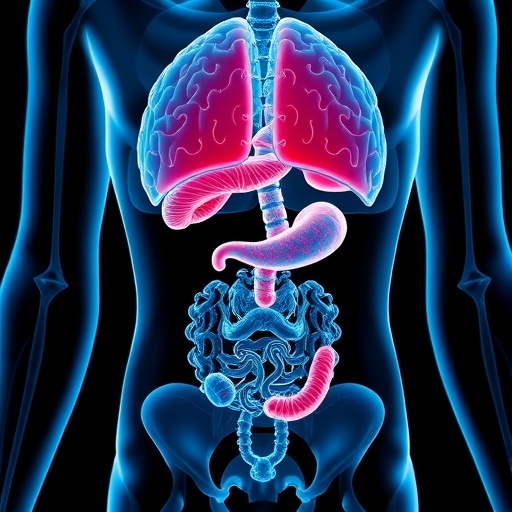
In a groundbreaking study poised to redefine our understanding of brain physiology, researchers have uncovered the intricate mechanical interplay between the brain and abdomen, revealing that brain motion is significantly influenced by abdominal activity. This discovery challenges long-held assumptions that brain movements are predominantly governed by intracranial processes alone, opening new vistas into how systemic bodily functions coordinate with neural physiology, with profound implications for neurological research and clinical practice.
For decades, neuroscientists have observed subtle but consistent shifts and oscillations within the brain’s structure, but the driving forces behind these movements remained elusive. Traditional models primarily attributed these to cardiac pulsation, cerebrospinal fluid dynamics, and respiratory-induced variations within the cranial cavity. However, the recent study, conducted by Garborg et al. and published in Nature Neuroscience, uses cutting-edge imaging and biomechanical analysis to demonstrate that the abdomen’s mechanical motion plays an essential role in influencing brain displacement.
The brain, suspended within the skull and cushioned by cerebrospinal fluid, is mechanically coupled to the rest of the body through various connective tissues and fluidic channels. This coupling, it turns out, extends beyond the confines of the cranial vault and is dynamically modulated by abdominal mechanics. By harnessing advanced MRI techniques and computational modeling, the research team meticulously mapped the temporal and spatial characteristics of brain movement, correlating them directly with simultaneous measurements of abdominal pressure and motion.
One of the pivotal insights from the study is the recognition that abdominal organ motion, primarily driven by respiratory cycles and visceral pulsations, generates mechanical forces that propagate upward, creating coupling effects that influence intracranial dynamics. The coupling integrates complex biomechanical signals that converge on the brain’s structural matrix, showing a previously underestimated organ-to-organ mechanical communication axis. These findings provide a fresh perspective on the systemic integration of mechanical forces across distant bodily compartments.
Furthermore, this abdominal-brain coupling appears to be mediated through the connective tissue sheaths, the dura mater, and the meningeal layers, which act as conduits for these mechanical forces. The researchers observed that abdominal motion impacts the venous return and cerebrospinal fluid flow, thereby modulating intracranial pressure and volume dynamics, which in turn contribute to subtle neural tissue displacement. Such mechanobiological feedback loops might underlie both physiological brain function and vulnerability to certain neuropathologies.
The implications of this research ripple beyond fundamental neuroscience. Since brain motion has a measurable effect on neuronal activity and metabolic processes, understanding its drivers can illuminate mechanisms underpinning diseases characterized by disrupted intracranial dynamics, such as hydrocephalus, traumatic brain injury, and neurodegenerative disorders. The abdominal-brain mechanical axis might become a novel target for therapeutic interventions that focus on modulating systemic biomechanical environments.
In an era where neuroimaging is rapidly evolving, the ability to detect and quantify these interorgan mechanical linkages ushers in new diagnostic potentials. The study’s approach, combining real-time functional imaging with biomechanical modeling, sets a precedent for future explorations of how bodily rhythms synchronize with brain physiology. This systemic perspective challenges the paradigm of studying the brain in isolation, advocating for a holistic body-brain framework.
Moreover, the research underscores the importance of considering respiratory and visceral factors during neurological examinations and interventions. Surgical procedures, anesthesia management, and rehabilitation protocols might be optimized by factoring in this brain-abdomen mechanical coupling. The rhythmic forces emanating from the abdomen could be harnessed or mitigated to influence cerebral perfusion, intracranial pressure regulation, and even neuroplasticity.
From a methodological standpoint, the study ingeniously integrated multi-modal imaging technologies, including phase-contrast MRI and elastography, supplemented by computational finite element models that simulate tissue mechanical properties under physiological loading. These robust techniques enabled the precise capture of micrometer-scale brain movements synchronized with abdominal organ motions, delineating a vivid mechanical portrait of this interorgan interaction.
Physiologically, the coupling phenomenon aligns with known autonomic nervous system controls that regulate visceral functions, suggesting a complex reciprocal relationship between neural commands and mechanical feedback. This bidirectional communication might serve as a regulatory mechanism to synchronize brain activity with visceral states, contributing to homeostasis and adaptive behavioral responses.
As scientific understanding progresses, the researchers envision the integration of wearable sensors that monitor abdominal mechanics in conjunction with neuroimaging data, enabling dynamic assessments of brain health in various contexts — from sleep and exercise to disease progression. Such innovations could revolutionize personalized medicine approaches focused on brain disorders.
In sum, this pioneering research challenges the neuroscientific community to reconsider brain biomechanics within the broader anatomical and physiological matrix. By revealing the profound influence of abdominal mechanical forces on brain movement, it sets the stage for new interdisciplinary explorations that bridge neurology, gastroenterology, biomechanics, and systems biology. The brain is not an isolated organ but a biomechanical node intimately tied to the rhythms of the body.
This discovery is likely to ignite a surge of research exploring how other organ systems contribute mechanically and functionally to cerebral physiology. Understanding the brain’s motion in the context of systemic dynamics expands the frontier of neuroscience, presenting opportunities to reimagine how the brain’s health and disease states are evaluated and treated.
As the science community assimilates this knowledge, clinical protocols may evolve to incorporate assessments of abdominal mechanics when diagnosing neurological conditions. Such integrative approaches promise to enhance patient outcomes by unveiling hidden biomechanical factors that influence brain function.
The full significance of brain-abdomen mechanical coupling extends into conceptualizing cognition and consciousness through a biomechanical lens. The intertwined rhythms between the gut and the brain not only modulate neural movement but could also influence neural signaling patterns, opening new theoretical paradigms on brain-body communication.
Ultimately, Garborg et al.’s study is a clarion call to embrace a holistic, dynamic view of brain physiology. It emphasizes that the brain’s motion and function are a symphony orchestrated by the entire body, where mechanical forces transcend localized confines to choreograph the intricate dance of life’s fundamental organ.
Cite Scienmag News
Cassandra Pierce. (April 27, 2026). Brain Movement Linked to Abdominal Mechanical Coupling. Scienmag. https://scienmag.com/brain-movement-linked-to-abdominal-mechanical-coupling/
Cassandra Pierce. "Brain Movement Linked to Abdominal Mechanical Coupling." Scienmag, 27 April 2026, https://scienmag.com/brain-movement-linked-to-abdominal-mechanical-coupling/. Accessed 4 September 2026.
Cassandra Pierce. "Brain Movement Linked to Abdominal Mechanical Coupling." Scienmag. April 27, 2026. https://scienmag.com/brain-movement-linked-to-abdominal-mechanical-coupling/


