


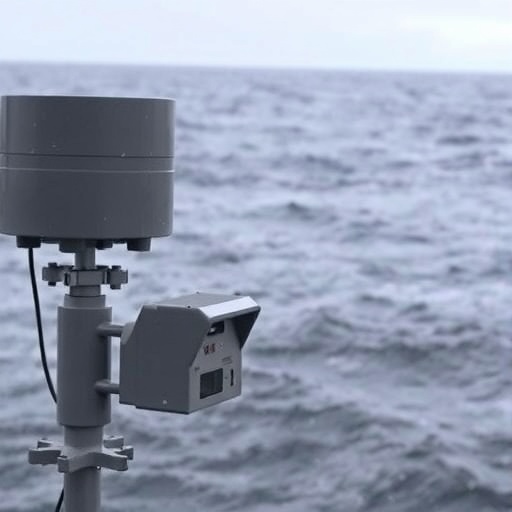
Satellite scatterometers have become indispensable tools in the realm of meteorology and oceanography, serving as critical instruments for measuring ocean surface winds on a global scale. These measurements underpin weather forecasting models and climate studies, providing invaluable data for understanding atmospheric dynamics and improving predictive accuracy. However, the measurement accuracy of scatterometers, particularly those operating in the Ku-band frequency range, has long been hampered by interference caused by rain. Rainfall introduces complex scattering effects that distort radar signals, leading to errors in wind speed and direction retrievals that pose significant challenges for data reliability.
In a major scientific advance, a collaborative team of researchers from the China Meteorological Administration, the Chinese Academy of Sciences, and the Royal Netherlands Meteorological Institute have pioneered a novel methodological approach to address these longstanding challenges. Utilizing dual-frequency radar measurements from the innovative WindRAD instrument installed on China’s FengYun-3E (FY-3E) satellite, the researchers devised a conceptual rain model aimed at precisely characterizing and correcting the rain-induced biases in Ku-band scatterometer wind observations. Their groundbreaking findings have been rigorously documented in the peer-reviewed publication titled “A rain effect elimination approach using FengYun-3E WindRAD dual-frequency measurements,” recently published in Atmospheric and Oceanic Science Letters.
At the core of this breakthrough lies the exploitation of WindRAD’s dual-frequency capability, which simultaneously captures Ku-band and C-band backscatter signals. The dual-frequency data allow the disentanglement of rain-related scattering processes from wind-driven ocean surface signals, thereby enabling a more accurate quantification of the rain-induced errors. The team’s proposed rain conceptual model leverages this capability to estimate and subsequently correct the Ku-band normalized radar cross-section (NRCS) biases attributed to precipitation. This comprehensive model accounts for the complex interactions between radar waves, raindrops, and wind-generated sea surface roughness, marking a significant technical milestone in satellite remote sensing.
The practical implications of the improved correction methodology are profound. Validation results demonstrate that under moderate rainfall conditions, the corrected Ku-band wind measurements show strikingly enhanced agreement with the more rain-resilient C-band readings. Statistically, the root-mean-square error (RMSE) for wind speed decreases by approximately 0.2 meters per second, while wind direction errors reduce by an average of 1.6 degrees. Such improvements not only enhance measurement fidelity but also reduce systematic bias, particularly notable at rain rates below 10 millimeters per hour, where the average wind speed bias is nearly eliminated.
Dr. Xu Na, corresponding author of the study, emphasizes the broader significance of this research, stating, “Our method substantially improves the accuracy of Ku-band scatterometer wind retrievals during rainy conditions, which historically have been a major source of measurement uncertainty. While further refinement is necessary for extreme rainfall scenarios and low wind speeds, this work lays a solid foundation for extending the reliability of scatterometer data worldwide.” These sentiments underscore the importance of the study as a stepping stone towards enhancing the utility of satellite wind observations in diverse meteorological and climatological applications.
Beyond the immediate performance gains, the dual-frequency rain correction framework proposed by this research offers a versatile and technically robust approach that can be adapted to other international Ku-band scatterometers. This adaptability is crucial for advancing global ocean wind monitoring infrastructure. By integrating such advanced correction algorithms, future satellite scatterometers can achieve higher accuracy in data products, thereby improving the quality of weather forecasts, ocean circulation models, and climate monitoring programs on a planetary scale.
The scientific rigor behind this achievement involved a meticulous analysis of dual-frequency scatterometer data, extensive algorithm development, and validation against in situ wind observations. Key to the success was the ability to exploit differences in the attenuation and scattering behavior of Ku- and C-band radar signals in the presence of rain. The methodology hinges on conceptualizing NRCS biases as functions of rain rate and wind speed, a technical innovation that reconciles atmospheric precipitation effects with ocean surface measurements, offering new perspectives in radar remote sensing.
Significantly, this advancement addresses one of the most persistent sources of error in satellite scatterometer wind retrievals—rain contamination of Ku-band radar signals. Previously, rainfall-induced biases led to systematic underestimation or overestimation of wind speeds, especially in tropical and mid-latitude storm systems, critically undermining forecast accuracy and hindering climate data record consistency. By mitigating these errors, the new correction approach enables higher confidence in real-time and retrospective scatterometer data, facilitating improved response strategies for weather-related hazards.
The improved rainfall correction technique also has important implications for the interpretation of long-term scatterometer datasets. Rain contamination has complicated the exploitation of historical Ku-band scatterometer records for climate trend detection and variability studies. With the ability to retrospectively apply such sophisticated rain correction algorithms, scientists can revisit legacy datasets to extract more reliable ocean wind information, thereby enhancing understanding of climatic changes and extreme weather patterns over multiple decades.
Furthermore, the study exemplifies the growing importance of international collaboration and technological innovation in Earth observation science. Combining expertise from Chinese and Dutch atmospheric and remote sensing researchers enabled the effective integration of advanced radar technology with atmospheric science to tackle a problem of global significance. The FY-3E WindRAD instrument itself stands as a testament to cutting-edge satellite sensor engineering, uniquely equipped to support transformative research in ocean-atmosphere interactions under adverse weather conditions.
In summary, the development of this innovative rain conceptual model utilizing FengYun-3E’s dual-frequency WindRAD measurements represents a pivotal step toward overcoming the limitations posed by precipitation on Ku-band scatterometer wind retrievals. This work enhances the accuracy, reliability, and operational utility of satellite-derived ocean surface winds, advancing the scientific capability to monitor and understand the Earth’s atmospheric and oceanic systems. As global climate patterns evolve and extreme weather events become more frequent, such advancements offer essential tools for improving resilience and preparedness worldwide.
Web References:
Cite Scienmag News
Violet Maxwell. (November 7, 2025). Boosting Ocean Wind Measurement Precision: Innovative Rain Correction Method for FY-3E WindRAD. Scienmag. https://scienmag.com/boosting-ocean-wind-measurement-precision-innovative-rain-correction-method-for-fy-3e-windrad/
Violet Maxwell. "Boosting Ocean Wind Measurement Precision: Innovative Rain Correction Method for FY-3E WindRAD." Scienmag, 7 November 2025, https://scienmag.com/boosting-ocean-wind-measurement-precision-innovative-rain-correction-method-for-fy-3e-windrad/. Accessed 6 September 2026.
Violet Maxwell. "Boosting Ocean Wind Measurement Precision: Innovative Rain Correction Method for FY-3E WindRAD." Scienmag. November 7, 2025. https://scienmag.com/boosting-ocean-wind-measurement-precision-innovative-rain-correction-method-for-fy-3e-windrad/


