


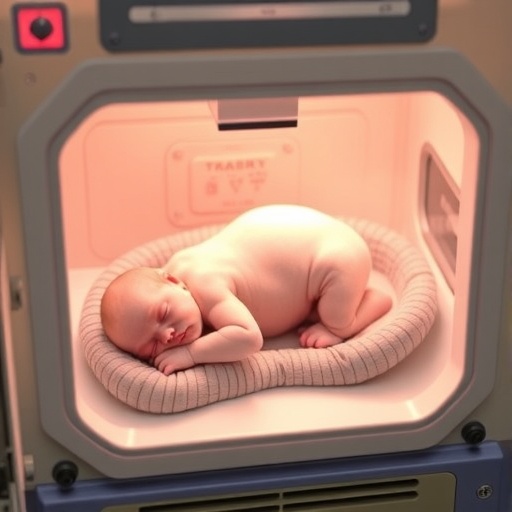
In the delicate and critical environment of neonatal care, maintaining optimal thermal conditions during transport poses a significant challenge to healthcare professionals worldwide. Neonates, particularly preterm infants, are exceptionally vulnerable to hypothermia, which can lead to severe complications. Recent advancements in neonatal transport incubator technology have focused on innovative methods to regulate and preserve internal temperatures, ensuring these infants receive the most stable thermal environment possible. A groundbreaking study published by Kobayashi, Tanaka, and Arimitsu delves deeply into the physics of thermoregulation with a focus on the impact of covering access ports in neonatal transport incubators.
This research sheds new light on how simple modifications to incubator design can influence the intricate temperature dynamics within the enclosed space. Transport incubators typically feature several access ports that allow clinicians to monitor and care for neonates during transfer. However, these ports can also inadvertently become points of thermal compromise, allowing warm air to escape and cold air to infiltrate. While previous studies have confirmed that covering these ports helps prevent drops in central temperature, the broader implications for overall temperature distribution within the incubator were less clear—until now.
Employing state-of-the-art computational fluid dynamics (CFD), Kobayashi and colleagues offer a comprehensive simulation-based analysis of airflow and heat transfer within transport incubators. Their work moves beyond surface-level understanding by modeling how covering access ports alters convection patterns and temperature gradients inside the incubator. The CFD approach allows the visualization of subtle thermal imbalances, revealing complex interactions between warm air currents and cooler zones that are not easily detected in clinical settings.
The study’s findings indicate that covering access ports effectively maintains the central zone’s warmth, which is crucial for neonatal health, yet it simultaneously introduces regional variances in temperature. Specifically, areas near the walls of the incubator experience less heat circulation, generating colder microenvironments. This phenomenon creates a thermal imbalance, meaning that while the infant’s core remains protected, peripheral zones might be subject to potentially harmful temperature differentials. This nuanced understanding is vital for optimizing the incubator’s design and operation during neonatal transport.
Thermoregulation in neonatal care is not merely about keeping a constant global temperature but involves ensuring a uniform thermal environment that minimizes stress on the tiny patient. Infants, especially those born prematurely, have limited ability to regulate their body temperature naturally. Therefore, even minor temperature fluctuations can trigger deleterious physiological responses. The insights provided by this study prompt a reevaluation of standard transport incubator configurations, pushing for design enhancements that simultaneously guard central temperatures while evening out internal temperature disparities.
Kobayashi’s team employed CFD simulations under real-world thermal loading conditions experienced during neonatal transport. The analysis included variable factors such as ambient temperature, incubator set points, and heat loss through different surfaces. This methodological rigor allows the results to be highly relevant to actual clinical scenarios. Furthermore, the research underscores the limitations of intuition-based design changes, highlighting how advanced computational modeling can uncover unintended consequences that simple thermal measurements may overlook.
A critical takeaway from this work is the importance of balancing access and insulation within the incubator framework. Access ports are indispensable for clinical tasks—ranging from feeding and medication delivery to monitoring vital signs—but they also represent vulnerabilities in the incubator’s thermal envelope. Covering these ports might seem an intuitive solution but comes with trade-offs. By effectively sealing off these points, the designers might inadvertently reduce convective heat distribution necessary to maintain a uniformly warm interior.
This research suggests that future improvements should consider integrating dynamic thermal management systems that compensate for localized cooling effects. Potential strategies may involve introducing secondary heating elements or optimizing airflow through strategically placed vents. The study’s findings open the door to innovations such as smart incubators equipped with internal sensors capable of real-time thermal mapping and adaptive temperature control based on detected imbalances.
Moreover, the implications extend beyond neonatal transport to other clinical devices requiring precise thermal conditions. Insights into the interplay between access convenience and thermal uniformity could revolutionize the design of medical enclosures used in surgical settings, intensive care units, and even in space medicine where thermal control is critical.
The study by Kobayashi and colleagues also highlights the growing role of computational simulations in medical device innovation. Rather than relying solely on experimental prototypes, CFD offers a powerful and cost-effective means to iterate design improvements rapidly. This approach accelerates the translation of scientific understanding into practical solutions that enhance patient care.
Interdisciplinary collaboration played a pivotal role in this success, combining expertise in neonatal medicine, fluid mechanics, and thermal engineering. The synergy of these fields produced a nuanced perspective on neonatal thermoregulation, which may have otherwise been overlooked by specialists working in isolation.
While the article focuses on the physical and engineering aspects, it subtly underscores the clinical importance of ensuring neonatal patients’ safety during the vulnerable transport phase. Preservation of normothermia is a cornerstone of neonatal survival and long-term health outcomes. As neonatal intensive care units aim to push survival boundaries increasingly earlier in gestation, such technological refinements gain amplified significance.
In conclusion, covering access ports in neonatal transport incubators emerges as a double-edged sword: a beneficial practice for maintaining central temperature, yet simultaneously a cause for thermal imbalances within the device’s interior. The intricate temperature distribution unveiled through computational fluid analysis demands rethinking of current incubator designs and operational protocols. Future innovation must strive to harmonize the need for access with the imperative of maintaining uniform thermal environments that prioritize neonatal welfare during the precarious transport window.
As neonatal transport technology evolves, this research marks a significant milestone, providing precise quantitative insight where only qualitative assumptions existed before. It paves the way for an era of “intelligent” incubators where thermal management is not a one-size-fits-all endeavor but a carefully coordinated, dynamic process tuned to the individual infant’s needs.
Such advancements, grounded in rigorous, multidisciplinary science, have the potential to save countless newborn lives globally by reducing hypothermia-related complications. This study serves as a compelling example of how the intersection of medicine and engineering can yield transformative improvements in neonatal care even during the earliest and most fragile moments of life.
Cite Scienmag News
Harold Sullivan. (August 19, 2025). Boosting Neonatal Warmth: Incubator Port Covers Analyzed. Scienmag. https://scienmag.com/boosting-neonatal-warmth-incubator-port-covers-analyzed/
Harold Sullivan. "Boosting Neonatal Warmth: Incubator Port Covers Analyzed." Scienmag, 19 August 2025, https://scienmag.com/boosting-neonatal-warmth-incubator-port-covers-analyzed/. Accessed 7 September 2026.
Harold Sullivan. "Boosting Neonatal Warmth: Incubator Port Covers Analyzed." Scienmag. August 19, 2025. https://scienmag.com/boosting-neonatal-warmth-incubator-port-covers-analyzed/


