


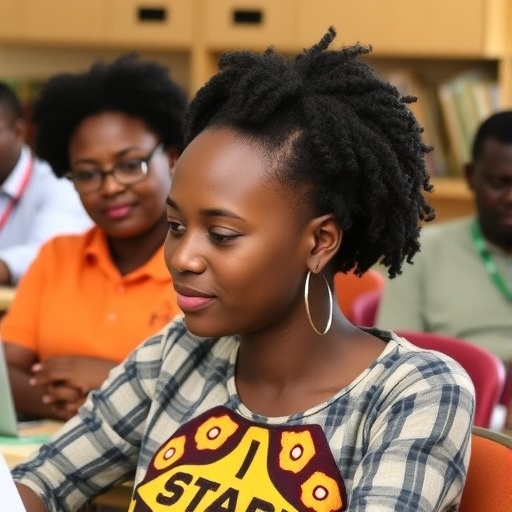
Recent studies have illuminated a critical aspect of higher education in Ghana, focusing on the intricate dynamics of cognitive engagement among students. The research conducted by Hansen, Heeralal, and Ndwandwe provides not just a window into the academic lives of Ghanaian students, but dives deeper to explore how teacher support and individual personality traits collectively influence learning outcomes. This pivotal inquiry sheds light on the importance of pedagogical strategies in fostering an environment where students are not only passive recipients of information but active participants in the educational process.
Cognitive engagement refers to the depth of students’ attention, curiosity, and willingness to learn. It is essential for academic success and personal development. The study highlights that in Ghanaian higher education, many students struggle with cognitive engagement due to a combination of traditional teaching methods and a lack of individualized support from educators. The authors argue that rethinking these approaches could enhance students’ overall academic experience, leading to better outcomes not only academically but also in personal and professional life skills.
Teacher support emerges as a crucial factor in this equation. The research indicates that when teachers are accessible and willing to provide guidance, students feel more valued and driven to engage with the material. This level of support is not mere encouragement; it represents a foundational element of a supportive learning environment. By fostering strong teacher-student relationships, educators can significantly boost cognitive engagement levels amongst students, ensuring that they are not just memorizing facts, but are encouraged to think critically, analyze information, and effectively participate in discussions.
Additionally, the role of student personality traits cannot be overlooked. The research identifies specific traits that correlate with higher levels of engagement, such as openness to experience, conscientiousness, and resilience. These characteristics empower students to navigate the complexities of academic life with a proactive mindset. For instance, students who exhibit higher levels of conscientiousness are likely to be more organized and motivated, while those who are open to new experiences are often more willing to explore diverse perspectives in their studies.
As we delve deeper into educational strategies, one must consider the types of interventions that could be implemented to enhance cognitive engagement. The findings suggest that teaching practices should be adaptable, embracing techniques that cater to diverse personality types and learning styles. This could mean integrating more collaborative projects, fostering group discussion formats, or allowing for student choice in assignments that align with their interests and strengths.
Furthermore, the implications of this research extend beyond the classroom walls. Higher education institutions can leverage these insights to redesign curricula and develop more comprehensive support systems for both students and faculty. By investing in training teachers to recognize and respond to diverse student needs and personalities, colleges can create an ecosystem that prioritizes engagement and interaction, thereby enriching the educational journey.
Another significant theme presented by the researchers is the necessity for a culturally responsive framework within the context of Ghanaian higher education. Understanding the local cultural dynamics, values, and expectations can enhance the effectiveness of teacher interactions with students. This is pivotal in creating environments where students feel respected and understood, leading to increased participation and cognitive involvement.
In light of these findings, there is an urgent need for educational stakeholders—administrators, policymakers, and educators—to consider the enactment of policies that emphasize cognitive engagement. Initiatives that blend teacher training with student support mechanisms hold the potential to transform the learning landscape. Curbing the passive learning model, which is prevalent in many educational systems, and promoting active engagement through innovative teaching strategies is essential.
Moreover, technology can serve as a powerful ally in promoting cognitive engagement. The integration of digital tools and resources within the Ghanaian higher education framework can provide students with avenues to engage with content more interactively. Whether through online discussion forums, virtual reality learning experiences, or gamified assessments, technology offers limitless potential for enriching the learning environment.
The study’s findings present a compelling case for continuous research efforts in this field. While the current focus has been on the interplay of teacher support and personality traits, future studies could expand this scope to include external factors such as socio-economic status, cultural background, and family dynamics. Furthermore, longitudinal studies would provide deeper insights into how cognitive engagement evolves throughout a student’s academic career.
Ultimately, the goal of enhancing cognitive engagement transcends mere academic improvement. It aims to nurture holistic individuals capable of critical thinking, problem-solving, and collaborative work in a globalized world. The insights provided by Hansen, Heeralal, and Ndwandwe serve as a timely reminder of the transformational power of education—a reminder that ideally, every student should feel engaged, inspired, and prepared for the challenges that lie ahead.
In conclusion, the research conducted on enhancing cognitive engagement in Ghanaian higher education underscores the need for a collaborative effort among educators and institutions. By understanding the importance of teacher support combined with a keen awareness of student personality traits, stakeholders can co-create learning experiences that are not only beneficial but transformative. A renewed focus on these areas could usher in a new era for education in Ghana, one where students thrive academically and personally, better preparing them for future endeavors.
Hansen, AB., Heeralal, J.P. & Ndwandwe, D.N. Correction: Enhancing students’ cognitive engagement in Ghanaian higher education: insights into the role of teacher support and student personality traits. Discov Educ 4, 460 (2025). https://doi.org/10.1007/s44217-025-00941-5
Cite Scienmag News
Courtney Benton. (October 28, 2025). Boosting Cognitive Engagement in Ghanaian Universities: Insights. Scienmag. https://scienmag.com/boosting-cognitive-engagement-in-ghanaian-universities-insights/
Courtney Benton. "Boosting Cognitive Engagement in Ghanaian Universities: Insights." Scienmag, 28 October 2025, https://scienmag.com/boosting-cognitive-engagement-in-ghanaian-universities-insights/. Accessed 8 September 2026.
Courtney Benton. "Boosting Cognitive Engagement in Ghanaian Universities: Insights." Scienmag. October 28, 2025. https://scienmag.com/boosting-cognitive-engagement-in-ghanaian-universities-insights/


