


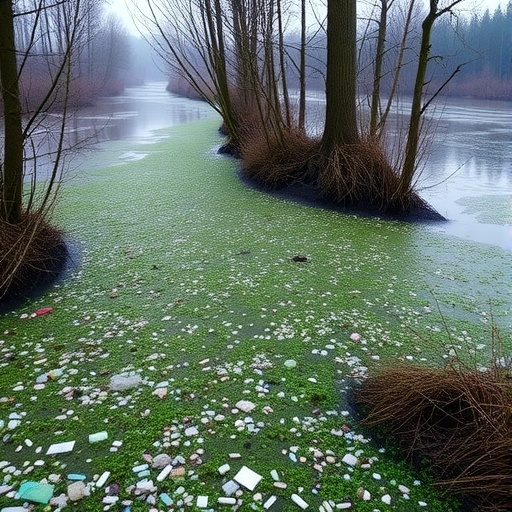
In the summer of 2021, catastrophic rainfall over western Germany pushed the Rhine to heights not seen in generations, submerging floodplain meadows near Cologne under meters of churning river water. When the flood receded, researchers from the University of Cologne and the University of Bayreuth rushed to a grassland nature reserve called Langel-Merkenich to harvest the grass before rain or wind could disturb what the water had left behind. Their findings, now published in the journal Microplastics and Nanoplastics, reveal that ordinary grassland vegetation acted as a natural filter, trapping substantial quantities of microplastic particles and river sediments during the flood — and that plants can distinguish, in effect, between plastic arriving with the river and plastic falling from the sky.
The team, led by Markus Rolf, Hannes Laermanns and Christina Bogner, together with Christian Laforsch and Martin G. J. Löder, seized on a rare scientific opportunity. The July 2021 flood was triggered by extreme precipitation, including 153.5 millimeters of rain recorded within 24 hours at a weather station just seven kilometers from the sampling site. Rhine water levels rose to eight meters, inundating the floodplain between 14 and 21 July. Crucially, the meadow had been mowed roughly three weeks before the flood and had experienced no inundation since the previous winter, meaning everything found on the plants could be confidently attributed to that single flood event and to routine atmospheric deposition.
The researchers established four sampling transects across the grassland, each containing three plots. Three transects sat at elevations between 38.9 and 39.8 meters above sea level and were flooded; a fourth, at 40.2 meters, remained dry and therefore collected only airborne microplastics. Because all flooded transects lay along the same contour lines, the comparison isolated the effects of vegetation and distance from the river rather than differences in topography. The dominant grass species, Lolium perenne, or perennial ryegrass, blanketed the entire site.
Back in the laboratory, the team faced a formidable analytical challenge: extracting and identifying microplastics from grass coated in river mud. They first rinsed the deposits off the vegetation, dried the material, and subjected it to density separation in a concentrated zinc chloride brine with a density of 1.7 to 1.8 grams per cubic centimeter. Because most common plastics are less dense than this solution, plastic particles floated while mineral grains sank. Organic matter — which would otherwise swamp the signal — was digested using an enzymatic-oxidative protocol, a multi-step purification that breaks down biological material without destroying plastics. The remaining particles were filtered onto aluminum oxide filters and analyzed with focal plane array micro-Fourier transform infrared spectroscopy, or μ-FPA-FTIR, a technique that records an infrared spectrum for every pixel of an image, allowing researchers to chemically identify particles as small as six micrometers. A machine-learning-based particle finder pre-screened the spectra, but every identification was verified manually by two experienced analysts. Rigorous contamination control, including plastic-free clothing, laminar-flow sample preparation, and blank containers opened alongside every sample, ensured the results reflected the environment rather than the laboratory.
The results were striking. Microplastic abundance per square meter of vegetation reached as high as 44,054 particles in the transect closest to the river, compared with only 574 to 1,247 particles per square meter in the unflooded, atmosphere-only transect. Vegetation biomass ranged from about 13 to 462 grams per square meter, and the mass of material deposited on the plants climbed steeply with biomass — the densest grass retained up to 378 grams of sediment per square meter. Statistical analysis confirmed the pattern: the correlation between vegetation biomass and deposited sediment mass was strong and significant (Spearman’s ρ = 0.88, p = 0.0031), and smaller microplastics tracked vegetation closely as well. The correlation strengthened as particle size decreased, peaking at ρ = 0.82 for the smallest class, particles between 6 and 50 micrometers. In other words, the thicker the grass, the more effectively it filtered fine sediment and fine plastic from the floodwater.
Yet the story is not simply that plastic follows sediment. When the researchers related microplastic numbers to sediment mass, the correlation was not statistically significant. Sediment deposition varied across the site by a factor of roughly 700, while microplastic concentrations within that sediment varied by only about a factor of 70, and one transect at the flood line showed conspicuously enriched microplastic concentrations. This decoupling matters because it suggests microplastics and mineral grains do not settle in lockstep. Plastics differ from natural sediments in density, shape, elasticity and surface chemistry, and environmental weathering, biofilm formation and aggregation with iron minerals can further alter how they move through water. The authors caution that transport models built for mineral particles may not straightforwardly apply to microplastics — a point of growing concern in river science.
The chemistry of the trapped particles provided a fingerprint of their origin. Flood-deposited material was dominated by polypropylene, followed by polyethylene and polystyrene, and contained a notable fraction of spherical microbeads — between 10.5 and 21.6 percent of particles in the flooded transects. Polystyrene microbeads are known contaminants of the lower Rhine, where they have been traced to ion-exchange resins used in industrial water treatment. By contrast, the unflooded transect received almost no microbeads (0 to 1.3 percent), was dominated instead by polyethylene, and consisted overwhelmingly of tiny fragments: 88 to 92.5 percent of its particles were smaller than 100 micrometers, and no particle exceeded one millimeter. Fibres were surprisingly rare everywhere, never exceeding about six percent of the total.
These contrasts allowed the team to separate fluvial from atmospheric plastic deposition with unusual clarity. Material arriving with the floodwater was larger, more diverse in polymer type, and peppered with microbeads; material arriving from the air was finer, more polyethylene-rich, and essentially bead-free. The finding implies that vegetation acts as a passive sampling device, recording the signature of whatever deposition pathway dominates — and that microbead content in floodplain vegetation could serve as a simple indicator of riverine plastic input.
The study also reframes floodplains themselves. Rather than serving as uniform sinks, these landscapes impose spatial structure on plastic pollution through the interplay of topography and plant cover. Earlier work by the same group showed that flood frequency and local depressions shape microplastic accumulation in floodplain soils; the new results add vegetation density and, by extension, leaf area as key controls. The authors note that laboratory flume experiments have sometimes found the opposite pattern — larger particles preferentially retained by vegetation — but that such studies typically use pristine, unweathered plastics under simplified flow conditions, which behave differently from the biofouled, fragmented particles circulating in real rivers.
The broader implications extend to flood management and nature-based solutions. If grasslands can strip microplastics from floodwater in a single event, then maintaining or restoring vegetated floodplains along regulated rivers could measurably reduce the downstream delivery of plastic to estuaries and seas, while simultaneously buffering communities against flood peaks. Conversely, the accumulated plastic is not eliminated but relocated — stored temporarily in floodplain soils and vegetation, subject to remobilization in future floods. Understanding how much plastic floodplain vegetation captures, and what happens to it afterward, will be essential for closing the budget of riverine plastic pollution.
The authors acknowledge limitations, including a modest sample size imposed by the labor-intensive FTIR workflow, and they recommend that future studies measure leaf area index alongside biomass to better capture the interception capacity of plants. Still, the message is vivid: a summer flood, a quiet meadow by the Rhine, and the discovery that something as ordinary as grass can stand between a major European river and the sea, one microscopic plastic particle at a time.
Cite Scienmag News
Violet Maxwell. (September 8, 2026). Rhine floodplains trap microplastics during major flood event. Scienmag. https://scienmag.com/rhine-floodplains-trap-microplastics-during-major-flood-event/
Violet Maxwell. "Rhine floodplains trap microplastics during major flood event." Scienmag, 8 September 2026, https://scienmag.com/rhine-floodplains-trap-microplastics-during-major-flood-event/. Accessed 8 September 2026.
Violet Maxwell. "Rhine floodplains trap microplastics during major flood event." Scienmag. September 8, 2026. https://scienmag.com/rhine-floodplains-trap-microplastics-during-major-flood-event/


