


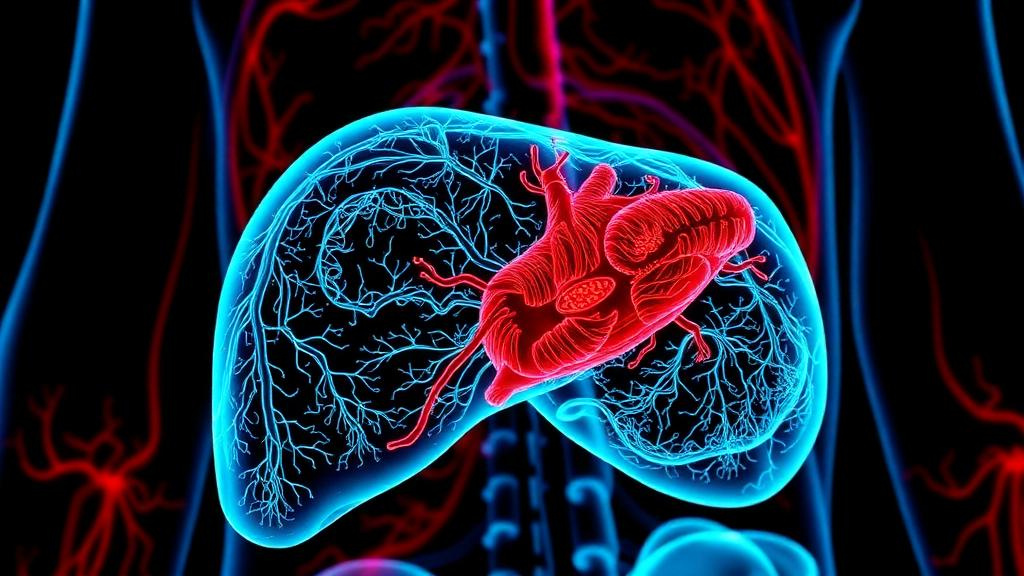
Radiofrequency ablation, one of the most widely used treatments for early liver cancer, runs into serious trouble when tumors grow large and hug major blood vessels. A comprehensive narrative review published in Holistic Integrative Oncology by researchers at Peking University Cancer Hospital and Texas A&M University lays out why this subgroup of hepatocellular carcinoma patients fares so poorly with ablation alone, and maps out a path forward built on multimodal therapy, advanced navigation, artificial intelligence, and computational modeling. The authors searched PubMed, Web of Science, CNKI, and Wanfang through September 2024, drawing on clinical trials, observational cohorts, meta-analyses, translational experiments, and modeling studies to build their case.
The central villain is a phenomenon called the heat-sink effect. Radiofrequency ablation works by delivering alternating current at 375 to 500 kilohertz through an electrode tip, causing ions in tissue to agitate and generate frictional heat. When tissue reaches 50 to 60 degrees Celsius for four to six minutes, key proteins denature and cell membranes collapse, producing irreversible cell death. Above 60 degrees, coagulation necrosis accelerates almost instantly. But when a tumor sits within a few millimeters of a hepatic vessel at least 3 millimeters in diameter, continuous blood flow whisks that heat away, lowering local tissue temperature and shrinking the zone of necrosis. Experiments in pigs first confirmed the effect, and subsequent computational studies showed the cooling scales with vessel diameter and flow rate, producing asymmetrical thermal deficits along the direction of blood flow.
Tumor size compounds the problem. For lesions of 3 centimeters or smaller away from major vessels, ablation achieves complete coagulation with five-year survival rates of 60 to 70 percent, comparable to surgical resection. Beyond 3 centimeters, a single electrode cannot cover the tumor plus the required 5-to-10-millimeter safety margin, forcing multi-electrode overlapping ablations that raise technical difficulty, procedural duration, and complication risk. When a large tumor also abuts a major vessel, the two limitations interact. One cited study found that when an adjacent vessel measured 5 millimeters or more in diameter, the odds of incomplete ablation more than doubled, with local progression-free survival correspondingly shortened.
Perhaps the most striking insight of the review is that incomplete ablation is not merely a technical shortfall but a biological trigger. Cells surviving in the sublethal zone, where temperatures hover around 50 to 55 degrees, upregulate heat shock proteins such as HSP70 and HSP90, enhancing resistance to apoptosis. A recent meta-analysis linked elevated heat shock protein expression to poorer overall survival in hepatocellular carcinoma, with a pooled hazard ratio of 1.61. Sublethal heating also induces epithelial-mesenchymal transition, downregulating E-cadherin and upregulating Vimentin and N-cadherin through TGF-beta/Smad signaling. In perivascular locations, these newly migratory cells sit right next to the vascular bed, potentially increasing the risk of intravasation and blood-borne metastasis.
The biological cascade continues. Sublethal heat can enrich tumor stem-like cells; in one study, heat-exposed hepatocellular carcinoma cells adopted a progenitor-like, highly proliferative phenotype, with CD133 and CK19 markers rising significantly by day five, and produced larger, more aggressive tumors when implanted in mice. Meanwhile, necrotic tissue releases damage-associated molecular patterns that briefly activate immunity but then trigger compensatory anti-inflammatory pathways. Residual cells show increased M2 macrophage and regulatory T cell infiltration and upregulated PD-L1, creating what the authors describe as a post-ablation immune escape effect that transforms the initial clearance reaction into a pro-repair environment hospitable to regenerating tumor clones.
Against this backdrop, the review catalogs a decade of technical refinements. Internally cooled and perfusion electrodes slow carbonization and expand the coagulation zone. Bipolar and multipolar configurations concentrate current between closely spaced electrodes, and switching-mode systems reallocate energy at millisecond intervals toward lower-impedance paths, producing more homogeneous ablation. A multicenter study found multi-applicator radiofrequency ablation cut the cumulative four-year local tumor progression rate to 16.3 percent versus 50.5 percent for monopolar treatment in vessels-adjacent lesions, suggesting that geometry, not energy type, is the key to countering blood flow. A no-touch strategy, deploying three or four electrodes in normal parenchyma around the tumor, achieved local tumor progression rates of just 0.7 percent at one year and 1.6 percent at two years in a multicenter trial of small tumors, though it remains hard to encircle large lesions completely.
Vascular occlusion offers another route. The surgical Pringle maneuver, clamping hepatic inflow, increased mean ablation volume from 3.2 to 8.7 cubic centimeters in animal work, but brought portal vein thrombosis, bile duct dilatation, and worsened systemic inflammatory responses. Endovascular balloon occlusion is less invasive: in one series, ablation zones averaged 5.1 centimeters for tumors averaging 4.2 centimeters, with 100 percent technical success. Yet a follow-up prospective study showed that while balloon occlusion reduced local tumor progression to 11 percent for perivascular tumors of 3.5 centimeters or smaller, larger lesions still recurred locally in 40 percent of cases despite occlusion. Overcoming the heat sink alone, the authors conclude, is not enough for big tumors.
The evidence therefore points toward multimodal frameworks in which non-ablative therapies form the backbone. Transarterial chemoembolization combined with ablation improved one-year overall survival to 92.6 percent versus 85.3 percent for ablation alone in a randomized trial of tumors of 3 centimeters or larger, and a meta-analysis of 2,236 patients found roughly a 15 percent improvement in five-year survival for tumors over 3 centimeters. Stereotactic body radiation therapy, whose dose delivery is entirely unaffected by blood flow, outperformed ablation for local control in a randomized trial of recurrent tumors, with two-year local progression-free survival of 92.7 percent versus 75.8 percent. On the systemic front, the IMbrave050 phase III trial showed adjuvant atezolizumab plus bevacizumab after ablation or resection significantly improved recurrence-free survival in high-risk patients, while combinations of ablation with lenvatinib and the PD-1 inhibitor sintilimab nearly doubled objective response rates in unresectable disease.
Emerging technologies may eventually close the remaining gap. Fusion imaging that co-registers CT or MRI with live ultrasound cut twelve-month local recurrence from 46.2 percent to 21.7 percent for lesions invisible on conventional ultrasound, and electromagnetic tracking can reduce needle-tip error from roughly 17.8 millimeters to 3.3 millimeters. Artificial intelligence planning systems now recommend electrode number, spacing, and power settings, allowing less-experienced operators to match expert outcomes. Patient-specific bioheat models using finite element and computational fluid dynamics methods can simulate the heat-sink effect before the procedure, with one multi-physics model predicting ablation volume within a 4.9 percent mean error. The authors caution, however, that most AI tools rest on retrospective single-center data and that no computational framework is yet ready for routine clinical use. Their bottom line: for large perivascular hepatocellular carcinoma, radiofrequency ablation should no longer be the default, but a selectively deployed adjunct within an individualized, multidisciplinary strategy that addresses both the physics of heat and the biology of survival.
Subject of Research: Radiofrequency ablation of large perivascular hepatocellular carcinoma and multimodal treatment strategies
Article Title: Radiofrequency ablation for large perivascular hepatocellular carcinoma: from biophysical limitations to holistic integrative strategies
Article References: Wang, S., Shen, Y.-H., Wang, B., Wu, H., Zhang, Z.-Y., Yan, K., Wu, J., Yang, W., & Wu, W. (2026). Radiofrequency ablation for large perivascular hepatocellular carcinoma: from biophysical limitations to holistic integrative strategies. Holistic Integrative Oncology, 5(1), Article 40. https://doi.org/10.1007/s44178-026-00244-1
Image Credits: AI Generated
DOI: 10.1007/s44178-026-00244-1
Keywords: hepatocellular carcinoma, radiofrequency ablation, heat-sink effect, perivascular tumor, TACE, SBRT, immunotherapy, artificial intelligence, computational modeling, thermal ablation, liver cancer, multimodal therapy
Cite Scienmag News
Nathaniel Bowman. (October 3, 2026). Blood Vessels Sabotage Liver Tumor Ablation, Review Finds Smarter Combined Strategies Are the Answer. Scienmag. https://scienmag.com/blood-vessels-sabotage-liver-tumor-ablation-review-finds-smarter-combined-strategies-are-the-answer/
Nathaniel Bowman. "Blood Vessels Sabotage Liver Tumor Ablation, Review Finds Smarter Combined Strategies Are the Answer." Scienmag, 3 October 2026, https://scienmag.com/blood-vessels-sabotage-liver-tumor-ablation-review-finds-smarter-combined-strategies-are-the-answer/. Accessed 4 October 2026.
Nathaniel Bowman. "Blood Vessels Sabotage Liver Tumor Ablation, Review Finds Smarter Combined Strategies Are the Answer." Scienmag. October 3, 2026. https://scienmag.com/blood-vessels-sabotage-liver-tumor-ablation-review-finds-smarter-combined-strategies-are-the-answer/


