


Strongyloidiasis has long been one of the most overlooked infections in global health. Caused by the soil-transmitted helminth Strongyloides stercoralis, the parasite can persist silently in the human body for decades, and in people whose immune systems become suppressed it can trigger a life-threatening condition known as hyperinfection. Yet for years the World Health Organization had no formal guidance on how to control the disease at the population level. That changed when WHO published its first guidelines for the public health control of S. stercoralis in endemic areas, opening the door for national programs to confront a parasite that has largely escaped the attention of mass drug administration campaigns.
A new study published in the journal Parasites & Vectors offers one of the first real-world tests of those guidelines. An international team of researchers, led by Sara Roose of IRCCS Sacro Cuore Don Calabria Hospital in Verona, Italy, together with colleagues from the Ethiopian Public Health Institute and Ghent University, set out to determine whether the WHO framework could be applied in practice using serological diagnostics. Their findings, drawn from nearly seven thousand blood samples collected across Ethiopia, suggest that the country’s burden of strongyloidiasis is highly uneven, and that a nationwide treatment campaign may be unnecessary while targeted interventions in specific districts could deliver substantial benefit.
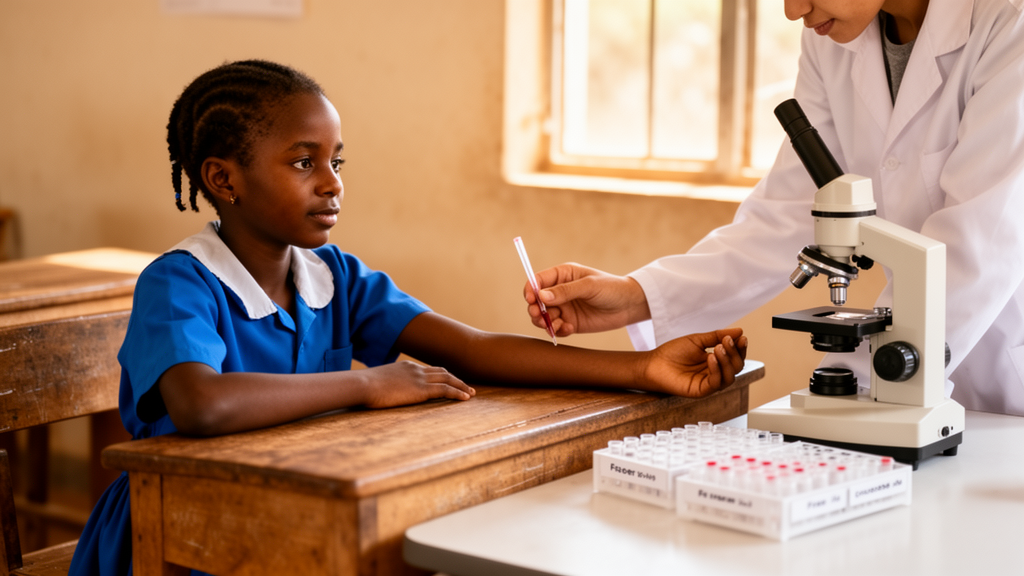
The technical foundation of the study rests on banked serum samples originally collected in 2019 during a large epidemiological survey of soil-transmitted helminths. Rather than recruiting new participants, the researchers exploited this existing biobank, analyzing 6,693 samples from 63 schools spread across 33 woredas, the administrative districts that serve as implementation units for neglected tropical disease control in Ethiopia. This design allowed the team to generate district-level estimates of infection without the cost and logistics of a new national field campaign, demonstrating a pragmatic pathway that other endemic countries could follow.
Detecting S. stercoralis is notoriously difficult. Unlike other soil-transmitted worms, the parasite sheds larvae in feces only intermittently, so conventional stool microscopy such as the Kato-Katz thick smear, the workhorse of helminth mapping, misses most infections. The researchers instead turned to serology, using the commercially available InBios Strongy Detect IgG ELISA. This assay detects antibodies against two recombinant antigens, NIE and SsIR, which are specific to S. stercoralis. Because antibodies persist after infection, a positive result indicates exposure at some point, which makes serology well suited for mapping the geographic distribution of transmission even if it cannot distinguish current from past infection with perfect precision.
The results revealed an overall seroprevalence of 10.4 percent, with a 95 percent confidence interval of 9.7 to 11.1 percent. More striking than the national average was the heterogeneity between districts. Woreda-level seroprevalence ranged from a low of 2.7 percent to a high of 41.0 percent, a fifteen-fold difference that underscores how locally variable transmission can be. Under the WHO guidelines, mass drug administration with ivermectin should be considered in implementation units where observed seroprevalence among school-aged children exceeds 15 percent. Applying that threshold to the Ethiopian data, only seven of the 33 woredas qualified for targeted treatment.
The study also examined a second question with important programmatic implications: whether existing mass drug administration campaigns targeting other diseases had already suppressed strongyloidiasis as a collateral benefit. Ivermectin, the drug of choice for S. stercoralis, is widely distributed in Ethiopia through programs aimed at lymphatic filariasis and other filarial diseases. The researchers compared seroprevalence in woredas that had received ivermectin mass drug administration in the five years preceding sample collection, from 2014 to 2018, with those that had not. The pattern was striking: none of the woredas where ivermectin had been administered during that window exceeded the WHO threshold for initiating treatment.
These findings carry two major messages for policy. First, they suggest that Ethiopia does not require a dedicated nationwide mass drug administration program for strongyloidiasis. Instead, treatment could be confined to a selected number of woredas where seroprevalence is high, conserving resources and reducing the risk of unnecessary drug exposure. Second, the data provide evidence that existing ivermectin-based programs targeting filarial infections are already delivering hidden dividends against S. stercoralis, a benefit that has not historically been counted when the value of those campaigns is assessed. For ministries of health weighing the costs of neglected tropical disease programs, such collateral effects strengthen the economic case for sustained investment.
The authors are careful to acknowledge the limits inherent in their design. The samples were collected for a different purpose in 2019, so the estimates reflect the situation at that time rather than the present day. Seroprevalence measured in school-aged children serves as a proxy for community transmission, and antibody persistence means the assay may overestimate current infection in areas where transmission has recently declined. The study’s cross-sectional design also means the apparent protective association with prior ivermectin administration, while consistent with the biology of the drug, cannot be interpreted as definitive proof of causation. These caveats do not undermine the central conclusion, but they highlight the need for confirmation through prospective surveys.
Beyond the Ethiopian findings, the study exposes practical gaps that must be closed before serology-based mapping can be scaled up globally. The researchers emphasize that national health institutes need technical manuals that define survey designs accounting for the sensitivity and specificity of the diagnostic test used. Without such corrections, raw seroprevalence figures can mislead program managers about whether a district truly crosses the WHO treatment threshold. The team also calls on manufacturers of commercial serological assays to provide validated cutoffs, transparent performance characteristics, and clear statements of the target condition and target population for which those characteristics were derived. Meeting these requirements, the authors argue, will be essential for the reliable application of the new WHO guidelines using antibody-based diagnostics.
The Ethiopian experience offers a template for other endemic countries now confronting the question of how to implement WHO’s first strongyloidiasis guidelines. By leveraging banked samples, a commercially available ELISA, and the existing administrative structure of neglected tropical disease implementation units, the researchers showed that a credible national picture of S. stercoralis distribution can be assembled quickly and affordably. The image that emerges is not one of uniform national burden but of scattered hotspots coexisting with districts where transmission appears already controlled, partly through the unintended generosity of campaigns aimed at other parasites. For a disease that has spent decades in the shadows of global health, that level of geographic resolution is a significant step forward, and it transforms the abstract language of guidelines into a concrete map of where treatment is needed most.
Subject of Research: Seroprevalence of Strongyloides stercoralis infection and application of WHO public health control guidelines in Ethiopia
Article Title: Exploring the application of the WHO guidelines for the public health control of strongyloidiasis through a seroprevalence study in Ethiopia
Article References: Exploring the application of the WHO guidelines for the public health control of strongyloidiasis through a seroprevalence study in Ethiopia. (n.d.). https://doi.org/10.1186/s13071-026-07736-z
Image Credits: AI Generated
DOI: 10.1186/s13071-026-07736-z
Keywords: Strongyloides stercoralis, strongyloidiasis, seroprevalence, WHO guidelines, Ethiopia, ELISA, ivermectin, mass drug administration, neglected tropical diseases, soil-transmitted helminths, public health control, serology
Cite Scienmag News
Drew Townsend. (October 8, 2026). Blood Tests Reveal Hidden Burden of a Neglected Parasite Across Ethiopian Schools. Scienmag. https://scienmag.com/blood-tests-reveal-hidden-burden-of-a-neglected-parasite-across-ethiopian-schools/
Drew Townsend. "Blood Tests Reveal Hidden Burden of a Neglected Parasite Across Ethiopian Schools." Scienmag, 8 October 2026, https://scienmag.com/blood-tests-reveal-hidden-burden-of-a-neglected-parasite-across-ethiopian-schools/. Accessed 8 October 2026.
Drew Townsend. "Blood Tests Reveal Hidden Burden of a Neglected Parasite Across Ethiopian Schools." Scienmag. October 8, 2026. https://scienmag.com/blood-tests-reveal-hidden-burden-of-a-neglected-parasite-across-ethiopian-schools/


