


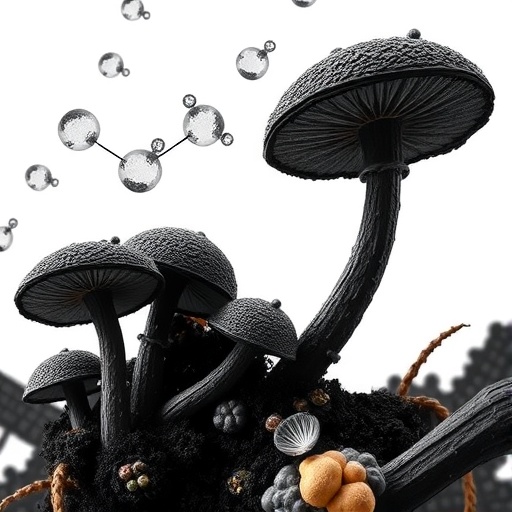
Fungi have spent millions of years assembling molecular tools that can attack competitors, communicate with their surroundings and survive extreme environmental stress. Many of these tools are polyketides, a chemically diverse family of natural products that includes antibiotics, pigments, cholesterol-lowering drugs and potent toxins. Yet discovering new fungal polyketides has remained difficult because the genes responsible for making them are often switched on only under conditions that are challenging to recreate in the laboratory. A new study now identifies an unconventional group of fungi that could make this search faster, broader and more predictable.
Researchers have established black yeasts from the genera Exophiala and Knufia as hosts for the heterologous production of fungal polyketides. In heterologous expression, genes from one organism are transferred into another organism, which then acts as a biological manufacturing platform. Instead of trying to persuade a native fungus to activate a silent biosynthetic pathway, scientists can isolate the relevant genes and install them in a host engineered to produce the desired molecule under controlled conditions.
The strategy addresses a central problem in natural-product research. Fungal polyketides are generally assembled by large enzymes known as polyketide synthases, or PKSs. These molecular machines use building blocks derived from primary metabolism, commonly acetyl-CoA and malonyl-CoA, and join them through repeated condensation reactions. Different PKS domains control chain extension, reduction, dehydration, methylation and the final release of the product. By varying these enzymatic modules, fungi can create remarkably different chemical structures from similar starting materials.
Saccharomycotina yeasts, including the widely used laboratory species Saccharomyces cerevisiae, have become popular platforms for expressing fungal biosynthetic pathways because they grow rapidly and are comparatively easy to modify genetically. However, their metabolic capabilities can limit the range of products they generate. Filamentous fungi in the Eurotiomycete group can support more demanding biosynthetic pathways, but they are often slower, more difficult to engineer and less convenient for systematic experiments. Exophiala and Knufia appear to occupy a useful middle ground, combining the robustness associated with filamentous fungi with the practical advantages of yeast-like growth.
The researchers tested whether these black yeasts could accommodate PKSs with different architectural designs. Their experiments produced a diverse set of fungal polyketides, including 6-methylsalicylic acid, YWA1, monocillin II, farinosone B and monacolin J. These compounds represent distinct chemical outcomes and require different enzymatic activities. The study therefore goes beyond demonstrating that a single pathway can function in an unfamiliar host; it suggests that the black yeasts can support a broader collection of biosynthetic systems.
One important product was 6-methylsalicylic acid, a relatively simple aromatic polyketide that is frequently used as a model for studying fungal PKS activity. Other products, such as YWA1, are associated with pigment biosynthesis, while monacolin J belongs to the family of complex polyketides related to commercially important cholesterol-lowering compounds. Monocillin II and farinosone B further expand the chemical range represented in the experiments. Producing such structurally different molecules in the same host type indicates that the platform may be compatible with both compact and highly elaborate PKS systems.
The technical significance lies in the host’s ability to connect foreign enzymes with its own cellular resources. A heterologous PKS needs access to sufficient precursor molecules, cofactors and energy, while its product must be tolerated and transported or released without disrupting the host. The enzyme may also require correct expression levels and compatible cellular conditions for folding and activity. A host that grows reliably while maintaining these resources can make it easier to compare pathways, optimize production and identify the genetic features that determine product yield.
Black yeasts may also offer advantages for pathways that fail in conventional laboratory yeast. Their natural resilience could help them withstand unusual metabolic burdens or the accumulation of bioactive compounds. At the same time, their genetic tractability may allow researchers to insert biosynthetic genes, adjust promoters, alter precursor supply and delete competing pathways. These capabilities are essential for turning a proof-of-concept expression system into a platform for discovery and manufacturing.
The findings could be particularly valuable for exploring fungal genomes that contain large numbers of apparently silent biosynthetic gene clusters. Genome sequencing has revealed that many fungi possess far more polyketide and nonribosomal peptide pathways than are visible under standard laboratory conditions. Rather than waiting for the right environmental trigger, researchers could reconstruct selected clusters in Exophiala or Knufia and screen the resulting cultures for new molecules. This approach may reveal compounds with antibacterial, antifungal, anticancer, immunomodulatory or other pharmacological properties.
The study does not eliminate the challenges of fungal natural-product discovery. Large PKS genes can be difficult to clone and express, pathways may require accessory enzymes, and some products may be unstable or toxic to the host. Production levels will also need to be optimized before the system becomes commercially practical. Nevertheless, the work expands the available toolkit at a critical moment. By demonstrating that black yeasts can efficiently produce a wide range of fungal polyketides, the researchers provide a new bridge between genome mining and chemical discovery, potentially accelerating the search for the next generation of bioactive molecules.
Cite Scienmag News
Juliet Wilcox. (August 3, 2026). Black yeasts efficiently produce diverse fungal polyketides as heterologous hosts. Scienmag. https://scienmag.com/black-yeasts-efficiently-produce-diverse-fungal-polyketides-as-heterologous-hosts/
Juliet Wilcox. "Black yeasts efficiently produce diverse fungal polyketides as heterologous hosts." Scienmag, 3 August 2026, https://scienmag.com/black-yeasts-efficiently-produce-diverse-fungal-polyketides-as-heterologous-hosts/. Accessed 3 September 2026.
Juliet Wilcox. "Black yeasts efficiently produce diverse fungal polyketides as heterologous hosts." Scienmag. August 3, 2026. https://scienmag.com/black-yeasts-efficiently-produce-diverse-fungal-polyketides-as-heterologous-hosts/


