


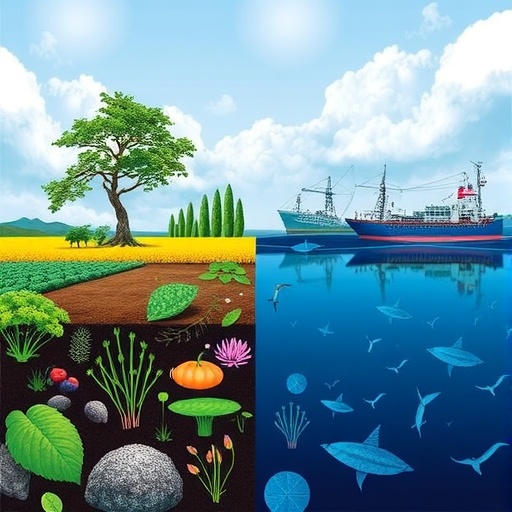
In the ever-evolving narrative of Earth’s climate system, one aspect remains critically vital yet persistently complex: the primary productivity of terrestrial and marine ecosystems. Photosynthesis, the biochemical keystone that fuels the planet’s biosphere, has conventionally been examined in separated silos of land and ocean. However, this segmented perspective obscures the reality of a tightly coupled Earth system where interdependent biospheric processes jointly shape global carbon dynamics. A groundbreaking study published in Nature Climate Change by Zhang et al. (2025) shatters these disciplinary boundaries by integrating satellite-derived data streams to comparatively analyze net primary production (NPP) trends across terrestrial and marine biomes from 2003 to 2021. The resulting revelations challenge long-held assumptions and cast new light on the biosphere’s resilience and vulnerabilities amid escalating climate warming.
At the heart of this novel research lies the integrated quantification of planetary NPP, a measure of the net carbon fixed by ecosystems through photosynthesis after accounting for plant respiration. This synthesis leverages a variety of satellite platforms, combining outputs of heterogeneous vegetation indices, ocean color, and chlorophyll fluorescence data. These products enable unprecedented cross-ecosystem comparisons, illuminating divergent trajectories in biological productivity that reflect underlying differences in ecosystem sensitivities, particularly to temperature increases in tropical latitudes—a hotspot for climate impacts.
From 2003 to 2021, the global biosphere’s net primary production exhibited a modest but statistically meaningful overall increase of approximately 0.11 petagrams of carbon per year (PgC yr⁻¹), with a confidence interval spanning ±0.13 PgC yr⁻¹ (P = 0.05). This trend belies the contrasting contributions from the land and ocean realms. On land, a robust and statistically significant upward trend was identified, amounting to an enhancement of roughly 0.20 ± 0.07 PgC yr⁻¹ (P < 0.001). Terrestrial ecosystems thus emerge as the primary drivers of global NPP increase, likely benefiting from CO₂ fertilization effects, longer growing seasons in some regions, and varied responses to regional climate anomalies.
Conversely, oceanic primary productivity exhibited a discernible, though not yet statistically significant, downward trend of approximately −0.12 ± 0.12 PgC yr⁻¹ (P = 0.07). Though the decline is less pronounced and accompanied by greater uncertainty than the terrestrial increase, the downward path warrants attention. Ocean ecosystems, particularly phytoplankton communities, are highly sensitive to environmental factors such as sea surface temperatures, nutrient availability, and stratification changes—each influenced by climate variability and warming. The contrast between land and sea NPP trends thus possibly underscores differential ecosystem responses rooted in distinct physiological and biogeochemical constraints.
One of the most intriguing and consequential findings of the study is the contrasting role of terrestrial and marine NPP in interannual variability. While the land biosphere steadily pushes the planetary carbon uptake upwards, its year-to-year fluctuations are comparatively muted. In contrast, ocean productivity exhibits large swings tightly coupled to climatic oscillations, especially driven by the El Niño–Southern Oscillation (ENSO). ENSO phenomena trigger profound shifts in sea surface temperatures and nutrient dynamics, directly modulating phytoplankton blooms and carbon fixation in vast oceanic regions. Hence, the oceans act as the biosphere’s pulse, driving the global carbon uptake rhythm on annual to multi-year scales.
This complex interplay between terrestrial persistence and oceanic volatility has far-reaching implications. It suggests that predicting future biosphere behavior under climate change requires holistic, integrative approaches that reconcile land–ocean processes rather than isolated examination. The study’s satellite-enabled planetary-scale perspective is a clarion call to the scientific community to break down traditional ecosystem compartmentalization and embrace joint monitoring schemes. Such integration will sharpen the accuracy of carbon budget assessments critical for climate mitigation policies and ecosystem management.
The terrestrial enhancement of NPP aligns well with prior findings suggesting a fertilization effect of rising atmospheric CO₂, potentially boosted by warming-induced increased photosynthetic activity and extended phenological seasons in temperate and boreal forests. However, this boost is not uniform geographically or taxonomically; tropical forests and arid regions may experience diminished growth due to heat and water stress. Therefore, continued monitoring and sophisticated regional analyses remain imperative to capture dynamic spatial heterogeneity and emergent thresholds beyond which productivity may crash.
Marine declines, on the other hand, are likely influenced by warming-driven stratification that limits nutrient upwelling into surface waters, suppressing phytoplankton growth in key oceanic zones. Additionally, ocean acidification and shifts in marine food webs may exacerbate primary production losses. These perturbations not only curb carbon sequestration but also threaten marine biodiversity and fisheries vital for human livelihoods. Understanding the mechanistic underpinnings of ocean productivity decline is essential for evaluating potential feedback loops and transboundary climate impacts.
Crucially, these findings underscore that while terrestrial ecosystems currently compensate for oceanic productivity drops, their capacity to do so indefinitely is uncertain. Prolonged terrestrial warming, drought stress, pest outbreaks, and land-use change may weaken land’s carbon sink function, risking a tipping point beyond which global NPP could stall or decline. Similarly, ocean productivity trajectories will be shaped by future climate forcings that might amplify negative trends or instigate recovery under certain scenarios.
The study also emphasizes the value of satellite remote sensing as a transformative tool for biosphere science. Satellite platforms provide synoptic, repeated, and standardized observations critical for detecting subtle trends and anomalies invisible to ground-based networks alone. Advanced algorithms integrating multispectral data capture leaf porosity, chlorophyll fluorescence, and ocean color complexities, translating spectral signatures into robust NPP estimates across terrestrial and marine realms. This technological fusion empowers continuous planetary-scale biosphere surveillance indispensable for climate action.
Moreover, Zhang et al.’s research highlights the need to couple these remote observations with in situ measurements and ecosystem models. This integrative approach will refine understanding of causal mechanisms and feedbacks, enabling predictive modeling under multiple emission and climate scenarios. As climate policies increasingly hinge on reliable carbon flux quantifications and nature-based solutions, robust and harmonized land–ocean NPP datasets become ever more critical.
Looking forward, this study invites renewed scientific and policy focus on developing integrated biosphere monitoring frameworks. Coordinated efforts among satellite agencies, oceanographic institutions, terrestrial ecologists, and climate modelers will be foundational for fully deciphering Earth system responses. Improved spatiotemporal resolution, sensor fusion, and real-time data assimilation can reveal early warning signals of biospheric stress, facilitating adaptive management and mitigation strategies.
In summary, the landmark analysis by Zhang and colleagues provides a holistic and nuanced portrait of the Earth’s living carbon engine amid a changing climate. It reveals that while terrestrial nature currently breathes life into the planet’s CO₂ uptake, the ocean’s biological heart fluctuates with climatic rhythms and edges toward decline. Such divergence signals both resilience and vulnerability, emphasizing an urgent need for globally integrated biosphere science to safeguard the planetary life-support system. This study marks a pivotal advance in our quest to understand the biosphere’s role in modulating climate and securing a sustainable future.
As humanity intensifies efforts to confront global warming, appreciating the intertwined fates of land and ocean mechanisms of carbon fixation becomes paramount. The emerging evidence from satellite observations implores not only scientists but also policy leaders and the public to value and invest in comprehensive biospheric stewardship. Only by embracing the intricate connectivity of terrestrial and marine life can effective climate solutions be designed and implemented, preserving Earth’s vitality for generations to come.
Cite Scienmag News
Sloane Callahan. (August 2, 2025). Biological Production Trends: Land vs. Ocean Contrasts. Scienmag. https://scienmag.com/biological-production-trends-land-vs-ocean-contrasts/
Sloane Callahan. "Biological Production Trends: Land vs. Ocean Contrasts." Scienmag, 2 August 2025, https://scienmag.com/biological-production-trends-land-vs-ocean-contrasts/. Accessed 3 September 2026.
Sloane Callahan. "Biological Production Trends: Land vs. Ocean Contrasts." Scienmag. August 2, 2025. https://scienmag.com/biological-production-trends-land-vs-ocean-contrasts/


