


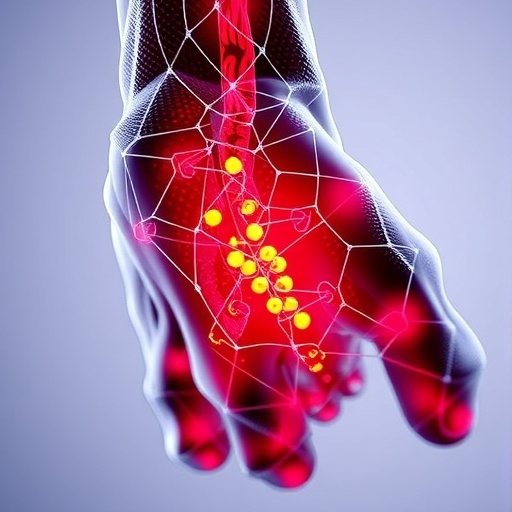
A groundbreaking study published in the latest issue of Cyborg and Bionic Systems reveals an innovative biomimetic nanocomposite hydrogel designed to revolutionize tendon repair and regeneration. This advanced system, named KGN@PB@CM, integrates nanotechnology, immunomodulation, and tissue engineering to address persistent challenges in tendon healing, especially the chronic inflammatory environment and poor tenocyte regeneration that have long hindered effective recovery.
At its core, the KGN@PB@CM platform leverages the catalytic and antioxidant properties of Prussian blue (PB) nanozymes, which serve as potent scavengers of reactive oxygen species (ROS). Excessive ROS generation following tendon injury exacerbates inflammation and damages resident stem cells, impeding repair. The PB nanozyme core efficiently mitigates oxidative stress, creating a more hospitable microenvironment for tissue regeneration.
Complementing the PB core is kartogenin (KGN), a small molecule known to induce stem cell migration and tenogenic differentiation. By loading KGN onto the PB nanozyme, the system ensures targeted delivery of a bioactive agent that directly promotes the differentiation of tendon-derived stem cells (TDSCs) into tenocytes—the specialized cells responsible for producing and maintaining tendon extracellular matrix.
To achieve precise targeting and immune evasion, the nanoparticles are cloaked with macrophage cell membranes (CM). This biomimetic coating endows the nanocomposite with homologous targeting ability toward inflamed tendon sites, capitalizing on the natural homing tendencies of macrophages to areas of tissue damage and infection. This strategic coating also reduces immune clearance, prolonging nanoparticle retention and therapeutic action at the injury site.
Embedded within a thermosensitive Pluronic F127/hyaluronic acid (HA-F127) hydrogel, the nanoparticles maintain a sol state at room temperature, facilitating easy administration. Upon exposure to physiological temperatures, the hydrogel rapidly transitions into a gel, ensuring sustained local release of the therapeutic agents and stable retention at the site of tendon injury. This functional matrix further mimics the natural extracellular environment, providing mechanical support conducive to cell proliferation and matrix remodeling.
In vitro assays decisively demonstrated the efficacy of KGN@PB@CM. The nanozyme displayed remarkable ROS scavenging ability in DPPH assays, directly protecting TDSCs from hydrogen peroxide-induced oxidative damage, as evidenced by significantly reduced fluorescence in DCFH-DA staining. Cell viability assays—including live/dead staining and CCK-8 tests—confirmed that the nanocomposite exhibited excellent cytocompatibility, while EdU incorporation assays revealed enhanced proliferation rates among treated TDSCs compared to controls.
Crucially, the nanoplatform reprogrammed macrophage polarization dynamics. RAW 264.7 macrophages stimulated with lipopolysaccharide (LPS) to mimic a pro-inflammatory phenotype (M1) experienced a marked downregulation of classical M1 markers such as inducible nitric oxide synthase (iNOS) and CD86 following treatment. Concurrently, markers characteristic of the anti-inflammatory M2 phenotype—including CD206, arginase-1 (Arg-1), and interleukin-10 (IL-10)—were significantly upregulated. This polarization shift was corroborated at both the gene expression and protein secretion levels, with enzyme-linked immunosorbent assays (ELISA) showing decreased pro-inflammatory cytokines (IL-1β, IL-6, TNF-α) and increased anti-inflammatory mediators (IL-10, TGF-β1). Understanding this immune modulation is fundamental, as transitioning macrophages from M1 to M2 states orchestrates the resolution of inflammation and facilitates tissue repair.
On the TDSC front, the nanocomposite exerted a powerful influence on tenogenic differentiation. Immunofluorescence staining and quantitative real-time PCR analyses revealed substantial upregulation of tendon-specific markers—including collagen type I (COL1), tenomodulin (TNMD), scleraxis (SCX), and mohawk (MKX)—following treatment with the full KGN@PB@CM construct compared to PB or KGN@PB alone. These findings confirm that the released KGN successfully recruits endogenous stem cells and promotes their programmed differentiation into tendon-forming cells, while the PB core simultaneously ensures that oxidative stress does not sabotage this regenerative trajectory.
In vivo validation employed a rat Achilles tendon injury model, divided into four groups: sham-operated controls, untreated injury models, a negative control hydrogel vehicle (NC-gel), and the therapeutic KGN@PB@CM-loaded hydrogel (NPs@gel). Histological analysis at two and four weeks post-surgery using H&E and Masson’s trichrome staining demonstrated superior tissue architecture in the NPs@gel group, characterized by densely packed, well-aligned collagen fibers and a robust extracellular matrix. Quantitative Bonar scoring reflected significantly improved histological outcomes compared to control groups, emphasizing the hydrogel’s regenerative impact.
Immunofluorescent characterization of the tendon microenvironment revealed a favorable macrophage distribution within treated tissues. The KGN@PB@CM group showed a marked decrease in CD86-positive M1 macrophages and an increase in CD206-positive M2 macrophages, corroborating the in vitro polarization findings. Parallel increases in COL1 and TNMD expression, combined with reduced α-smooth muscle actin (α-SMA)—commonly associated with pathological fibrosis—indicated not only enhanced tendon regeneration but also diminished scar tissue formation, a notorious impediment to functional recovery.
Functionally, the therapeutic efficacy was reflected in comprehensive gait analysis using the CatWalk system. Rats treated with KGN@PB@CM exhibited significant improvements in paw print area, stride length, and paw pressure, approaching the gait parameters of sham-operated animals by four weeks post-intervention. Additionally, reduced swing duration suggested restored motor coordination and pain alleviation. Biomechanical assessment further validated these functional gains, with treated tendons demonstrating significantly higher failure load, tensile strength, stiffness, and Young’s modulus—all index parameters of restored and durable mechanical integrity.
Long-term biosafety was also rigorously assessed. Histological examinations of major organs including heart, lung, spleen, liver, and kidney at eight weeks post-treatment showed no signs of inflammation, necrosis, fibrosis, or other pathological alterations. This comprehensive safety profile underscores the translational potential of KGN@PB@CM, mitigating concerns regarding systemic toxicity or off-target effects.
This dual-modulation strategy, combining ROS scavenging and targeted delivery of a tendon-inductive agent within an immune-modulating nanoplatform, presents a paradigm shift for the treatment of tendon injuries. It not only resolves the inflammatory milieu that often disrupts healing but also directly enhances stem cell-driven regeneration, offering a holistic solution. As the lead investigators note, while further validation in larger animal models and longitudinal studies remains, their biomimetic hydrogel system opens new vistas for regenerative medicine beyond tendons—potentially applicable to a spectrum of musculoskeletal and inflammatory diseases requiring both immune reprogramming and tissue engineering.
In summary, KGN@PB@CM represents an elegant convergence of nanotechnology, biomaterials science, and immunology, delivering a sophisticated, multifunctional platform for tendon regeneration. With its demonstrated efficacy, favorable safety profile, and robust mechanistic foundation, this innovation could soon translate into effective clinical therapies, fulfilling a crucial unmet need in orthopedics and regenerative medicine.
News Publication Date: April 23, 2026.
Web References: DOI: 10.34133/cbsystems.0503.
Cite Scienmag News
Ophelia Keating. (May 19, 2026). Bioinspired Nanocomposite Advances Targeted Immunoengineering and Enhances Tendon Regeneration. Scienmag. https://scienmag.com/bioinspired-nanocomposite-advances-targeted-immunoengineering-and-enhances-tendon-regeneration/
Ophelia Keating. "Bioinspired Nanocomposite Advances Targeted Immunoengineering and Enhances Tendon Regeneration." Scienmag, 19 May 2026, https://scienmag.com/bioinspired-nanocomposite-advances-targeted-immunoengineering-and-enhances-tendon-regeneration/. Accessed 3 September 2026.
Ophelia Keating. "Bioinspired Nanocomposite Advances Targeted Immunoengineering and Enhances Tendon Regeneration." Scienmag. May 19, 2026. https://scienmag.com/bioinspired-nanocomposite-advances-targeted-immunoengineering-and-enhances-tendon-regeneration/


