


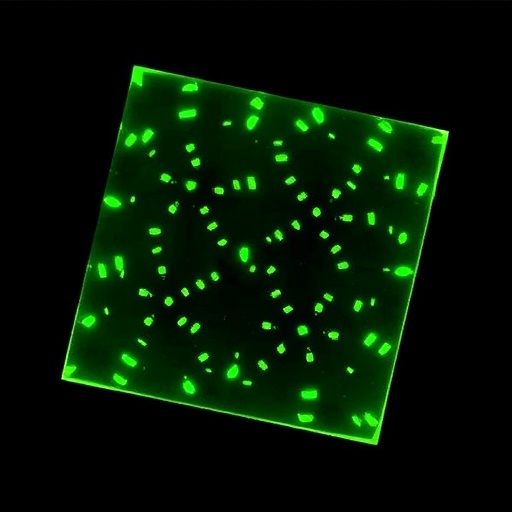
In the ever-evolving landscape of flexible electronics, a groundbreaking advancement has emerged from the intersection of sustainable materials science and nanoscale engineering. Researchers Antonaci, de Marzo, Blasi, and their colleagues have unveiled a novel piezoelectric thin film composed of biodegradable chitosan-cellulose and sub-spherical nanocrystals. This pioneering composite not only challenges current paradigms of piezoelectric materials but also opens new horizons for eco-friendly, flexible devices with enhanced electromechanical functionalities.
The development of flexible electronics has traditionally relied on synthetic polymers and inorganic ceramics, which, despite their impressive electrical properties, pose significant environmental concerns due to their non-biodegradable nature and potential toxicity. This latest study marks a pivotal shift towards integrating natural biopolymers with nanoengineered components to forge materials that harmonize performance with sustainability. Chitosan, derived from chitin found in crustacean shells, and cellulose, the most abundant organic polymer on Earth, serve as the biopolymeric backbone of this thin film.
What sets this composite apart is the innovative incorporation of sub-spherical nanocrystals, whose morphological characteristics significantly influence the piezoelectric response. Unlike traditional rod-shaped or plate-like nanoparticles, these nearly spherical nanocrystals induce unique polarization effects within the polymer matrix. The precise synthesis and dispersion techniques employed ensure a homogenous distribution, critical for achieving consistent electrical output and mechanical flexibility across the thin film.
Piezoelectric materials generate electric charge in response to mechanical stress, a property central to applications ranging from sensors and energy harvesters to actuators and bioelectronic interfaces. The research team’s approach harnesses the inherent piezoelectric capabilities of cellulose, enhanced by the structural reinforcement and electrical modulation provided by chitosan and the embedded nanocrystals. This synergy results in a composite that exhibits remarkable piezoelectric coefficients while maintaining biodegradability and mechanical robustness.
The fabrication process of these biodegradable piezoelectric thin films entails precise control over the polymer blend ratios, nanoparticle concentration, and film casting parameters. Through solution casting and subsequent thermal treatment, the researchers optimize the crystallinity and phase alignment of the cellulose chains, a decisive factor in amplifying piezoelectric phenomena. Moreover, the chitosan component provides complementary adhesion and mechanical integrity, elevating the film’s durability under repeated flexing.
Characterization techniques, including scanning electron microscopy and X-ray diffraction, reveal the morphology and crystallographic orientation of the composite. These analyses confirm the successful integration of the sub-spherical nanocrystals within the chitosan-cellulose matrix and the development of an interconnected network facilitating effective electromechanical transduction. Additionally, dielectric and piezo-response force microscopy studies quantify the electrical behavior at the nanoscale, correlating structural attributes with macroscopic performance.
One of the critical achievements of this research lies in balancing the competing demands of piezoelectric sensitivity and environmental compatibility. While inorganic piezoelectric materials like lead zirconate titanate (PZT) offer high efficiency, their toxicity limits practical applications, especially in biomedical or wearable electronics. The biodegradable composite addresses these issues by providing a non-toxic, eco-conscious alternative without compromising the essential piezoelectric functions.
The potential applications of such biodegradable piezoelectric films are vast and transformative. In the sphere of wearable health monitors, these materials could enable self-powered sensors that conform seamlessly to the skin, reducing electronic waste by naturally decomposing after use. Furthermore, in environmental sensing networks, deployment of transient devices built from this composite could minimize long-term ecological impact, aligning technological advancement with sustainability mandates.
Moreover, energy harvesting stands to benefit greatly from this innovation. The ability of these thin films to convert ambient mechanical vibrations into electrical energy could power low-consumption devices autonomously. By integrating this composite into textiles or flexible substrates, it becomes feasible to create garments or surfaces that generate electricity from everyday movements, marking a significant stride toward self-sustaining electronics.
The interplay between mechanical flexibility and electrical functionality is a hallmark of next-generation flexible electronics. The chitosan-cellulose-nanocrystal film demonstrates exceptional strain tolerance, maintaining piezoelectric output under bending, twisting, and stretching. This resilience is crucial for practical deployment in dynamic, real-world environments where rigid materials fail. The biodegradable nature further ensures that the lifecycle of devices crafted from this film is environmentally benign.
Challenges remain in scaling production and ensuring long-term stability in variable conditions such as humidity and temperature fluctuations. However, the team’s preliminary assessments of environmental degradation show controlled biodegradability without premature loss of performance. This balance hints at the potential for customized device lifespans tailored to specific applications, a novel feature in material design.
Innovation in materials science often hinges on manipulating structures at micro- and nano-scales. The choice of sub-spherical nanocrystals in this work is a testament to the nuanced understanding of how shape, size, and orientation of nanoscale inclusions dictate macroscopic properties. Such precision engineering paves the way for further exploration into tailored composites, optimizing piezoelectric output while preserving biocompatibility and flexibility.
The collaboration exemplifies multidisciplinary research, combining expertise in polymer chemistry, nanotechnology, materials engineering, and device physics. This convergence is instrumental in pushing the boundaries of what biodegradable materials can achieve, moving beyond passive packaging into active electronic components that blend seamlessly into the natural world.
Looking forward, integrating this composite into complex devices such as flexible displays, implantable medical sensors, and transient robotics could revolutionize how electronics interact with biological systems and the environment. The biodegradable piezoelectric thin films could serve as the foundation for devices that perform critical functions and then safely return to the earth, mitigating electronic waste accumulation.
Furthermore, the environmental implications of widespread adoption are profound. Reducing reliance on hazardous materials and enabling a circular approach to electronic materials aligns with global sustainability goals. The research highlights the feasibility of replacing traditional inorganic piezoelectrics without sacrificing performance, setting a benchmark for future innovations.
The study encapsulates the vision of sustainable technology that is functional, reliable, and responsible. By merging the oldest natural polymers with cutting-edge nanomaterials, it redefines the possibilities in flexible electronics. This biodegradable chitosan-cellulose and sub-spherical nanocrystals composite piezoelectric thin film stands at the frontier of eco-conscious innovation, promising a future where technology and nature coexist harmoniously.
In summary, the work by Antonaci and colleagues represents a monumental leap toward green electronics with practical piezoelectric applications. Its potential impact ranges from personal health devices to expansive environmental monitoring systems. As research progresses, this biodegradable composite could redefine industry standards, catalyzing a shift towards electronics that are as transient as the functions they perform yet as enduring as the values they embody.
Cite Scienmag News
Denise Maddox. (March 2, 2026). Biodegradable Chitosan-Cellulose Nanocrystal Piezoelectric Film. Scienmag. https://scienmag.com/biodegradable-chitosan-cellulose-nanocrystal-piezoelectric-film/
Denise Maddox. "Biodegradable Chitosan-Cellulose Nanocrystal Piezoelectric Film." Scienmag, 2 March 2026, https://scienmag.com/biodegradable-chitosan-cellulose-nanocrystal-piezoelectric-film/. Accessed 4 September 2026.
Denise Maddox. "Biodegradable Chitosan-Cellulose Nanocrystal Piezoelectric Film." Scienmag. March 2, 2026. https://scienmag.com/biodegradable-chitosan-cellulose-nanocrystal-piezoelectric-film/


