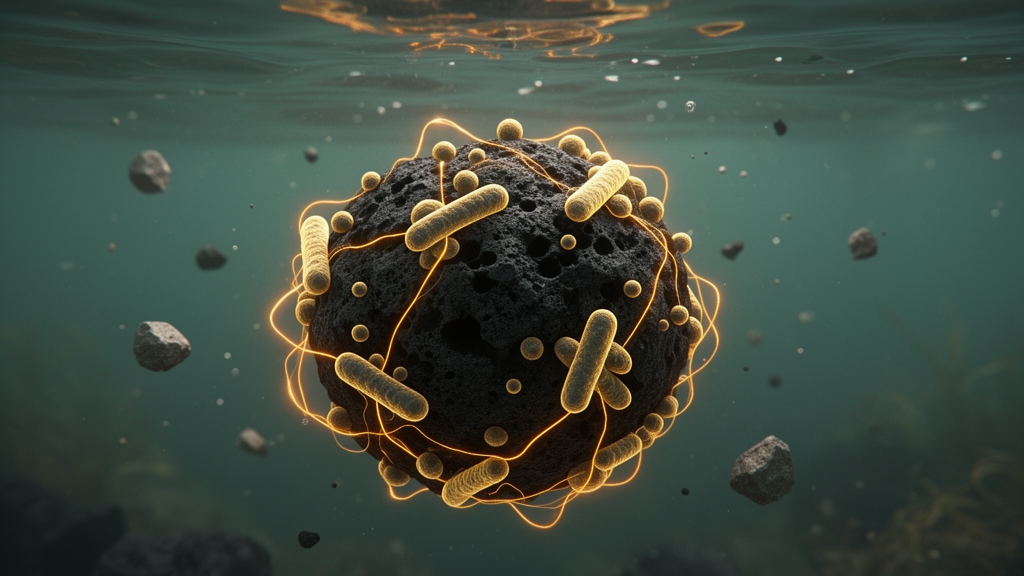
Anammox bacteria, the anaerobic microbes that convert ammonium and nitrite directly into nitrogen gas, already offer wastewater engineers one of the most energy-efficient nitrogen removal pathways known. Compared with conventional nitrification and denitrification, the anammox process cuts aeration energy demand by 50 to 60 percent, eliminates the need for exogenous organic carbon, and can lower operational costs by up to 90 percent. Yet the bacteria responsible grow extraordinarily slowly, with a maximum specific growth rate of 0.0027 per hour and doubling times of 10 to 12 days, which has long hampered efforts to scale the process industrially. A new open-access review published on 19 August 2026 examines how biochar, a carbon-rich material made by heating biomass under oxygen-limited conditions, may help overcome this bottleneck by acting as an electron bridge in these microbial communities.
The review, authored by Wenya Zhao, Wenqi Li, Yuheng Zhu, Yidi Li, Mabruk Adams, Hanbo Chen and Chongjun Chen in the journal Biochar, synthesizes current understanding of biochar-induced electron transfer mechanisms during anammox processes. Its central argument is that biochar supports extracellular electron transfer in anammox systems through three non-exclusive proposed mechanisms: enrichment of redox-active compounds within the extracellular polymeric substance matrix that surrounds the bacteria, direct interspecies electron transfer through conductive biochar networks, and mediated interspecies electron transfer via redox-active functional groups on biochar surfaces. The authors stress that these mechanisms may coexist within the same reactor and that the relative contribution of each pathway remains uncertain.
The mechanistic foundation rests on the unusual biology of anammox bacteria themselves. These planctomycete bacteria possess a three-compartment cellular architecture, with the anammoxosome serving as the exclusive intracellular site of the anammox metabolism. Inside this compartment, nitrite reductase and hydrazine synthase generate hydrazine, which hydrazine dehydrogenase then oxidizes to nitrogen gas, releasing electrons that must traverse the insulating cell membrane to reach external acceptors. Multiple c-type cytochromes distributed across the cell membrane, periplasm and outer membrane form transmembrane conduits that bridge these electrically insulating barriers. Experimental work has confirmed the intrinsic electroactivity of anammox bacteria: within microbial electrolysis cells, they generate anodic currents by transferring electrons to graphene oxide electrodes while oxidizing ammonium, and isotope-labeling experiments have shown they can interact with solid carbon to completely oxidize ammonium to nitrogen gas.
Biochar enters this picture as a particulate solid with demonstrable electron exchange capacity, the combined electron-donating and electron-accepting capability of the material. Produced typically at pyrolysis temperatures between 300 and 700 degrees Celsius, biochar contains redox-active moieties including poly-condensed aromatic structures and quinone functional groups. The review emphasizes that feedstock type and pyrolysis temperature govern its electronic properties. Biochar produced at 300 to 400 degrees Celsius carries abundant electron-donating groups such as phenolic and hydroquinone moieties, conferring high electron exchange capacity but limited electron-accepting capability, a redox profile that may enhance anammox metabolism by augmenting the electron-accepting function of anammox biomass. Conversely, biochar pyrolyzed above 500 degrees Celsius shows stronger electron-accepting characteristics, which the authors note could potentially impede anammox metabolism through electron competition.
The first proposed mechanism involves the extracellular polymeric substances, or EPS, the hydrogel-like matrix of proteins, polysaccharides and other compounds that surrounds anammox bacteria. This matrix contains c-type cytochromes homologous to those involved in hydrazine oxidation, and the ratio of proteins to polysaccharides within it fundamentally shapes its electrochemical behavior. According to studies cited in the review, biochar amendment has been associated with increased EPS secretion of 30 to 40 percent compared with controls, a 73.8 percent increase in the electron transfer capability of EPS, reduced charge transfer resistance, and a 44.1 percent increase in extracellular electron-donating capacity. At a dosage of 10 grams per liter, one study recorded a 51 percent increase in anammox activity, hypothesized to relate to the EPS increase. The authors caution, however, that biochar does not consistently stimulate EPS production: under long-term operation and nitrogen loading shocks, biochars made at different temperatures failed to sustain increased total EPS yield.
The second mechanism, direct interspecies electron transfer, relies on the electrical conductivity of biochar to establish conductive networks connecting microorganisms through c-type cytochromes or microbial nanowires. Biochar may also indirectly support this pathway simply by providing attachment sites that increase microbial proximity. Reported electron-donating and electron-accepting capacities of 2.64 and 0.79 millimoles per gram suggest balanced redox capacities suited to a mediating role, and biochar has been reported to function as an electron donor in redox reactions and as a mediator for nitrate reduction during anammox. Recent studies cited in the review report that biochar amendment enhanced the electron transfer capability of anammox bacteria and improved nitrogen removal efficiency by 4.0 to 11.6 percent, with biochar potentially acting as a bidirectional redox mediator that donates electrons for nitrite reduction while accepting electrons during hydrazine oxidation.
The third mechanism, mediated interspecies electron transfer, involves biochar adsorbing or releasing soluble redox mediators such as quinones and flavins and shuttling electrons between microorganisms and minerals, in a manner analogous to humic substances. The electron-shuttling capacity of low-temperature biochar may facilitate ammonium oxidation by coupling intracellular hydrazine synthesis with nitrite reduction. In one cited study, biochar addition enhanced anammox electron flux, accompanied by a 29.7 to 36.4 percent reduction in UASB reactor startup duration and a 9.3 to 14.7 percent increase in nitrogen removal compared with unamended controls. Unlike dissolved shuttles such as AQDS and flavins, which wash out with the effluent and require continuous replenishment, particulate biochar resists washout and may provide a more persistent electron-transfer platform while simultaneously serving as a microbial carrier.
The performance evidence spans a range of operating conditions. In an anammox system with a nitrogen concentration of 100 milligrams per liter, biochar addition at 10 grams per liter promoted nitrate reduction and raised electron transfer capacity to 0.89 milliequivalents per gram, roughly three times the control value, alongside a significant increase in the abundance of Candidatus Kuenenia. Another study found that biochar allowed operation at total nitrogen concentrations of 300 milligrams per liter after activity declined above 250, an effect attributed to enrichment of Candidatus Brocadia and Candidatus Kuenenia, increased EPS production, and a 2.6-fold increase in hzsB gene copy number. Earlier work also recorded gene copy numbers for hydrazine synthase, hydrazine dehydrogenase, cd1-type nitrite reductase and periplasmic nitrate reductase that were 5.6-, 8.7-, 9.4- and 4.2-fold higher, respectively, in biochar-amended reactors than in controls, and a fixed-bed column reactor integrating biochar achieved a maximum total nitrogen removal efficiency of 90.5 percent.
The review is notably candid about the limits of the evidence. Most mechanistic inferences have been drawn from electrochemical measurements, spectroscopic characterization and microbial community analysis rather than pathway-specific quantitative assays, and such observations, while consistent with enhanced electron transfer, are not pathway-specific. Direct confirmation of direct or mediated interspecies transfer would require electron-flux measurements, inhibitor-based experiments, isotopic tracing or spatially resolved electrochemical analyses. It also remains unclear whether EPS enrichment precedes enhanced electron transfer or occurs as a consequence of it, and the temporal sequence of biochar’s effects is unresolved. Comparisons across studies are further complicated by inconsistent units, incomplete reporting and differing experimental conditions, so the dominance of any particular electron transfer pathway cannot be universally asserted.
Practical risks also temper the enthusiasm. Improper feedstock selection or preparation can generate harmful constituents including heavy metals, polycyclic aromatic hydrocarbons, environmentally persistent free radicals, dioxins and perfluorinated chemicals, and biochar aging may block pores, alter surface chemistry, and leach toxins that directly inhibit anammox bacteria. Excessive dosage risks impaired mass transfer and altered sludge structure. Looking forward, the authors propose strategic feedstock selection, pyrolysis optimization, metal and heteroatom doping, machine-learning-assisted prediction of biochar properties, and life-cycle and techno-economic assessment to balance production energy and emissions against the energy savings of anammox operation. If future validation in scalable systems confirms the proposed electron-bridging roles, biochar could offer a low-cost, tunable route to faster and more stable anammox-based wastewater treatment.
Subject of Research: Proposed mechanisms by which biochar enhances electron transfer and nitrogen removal in anammox wastewater treatment systems
Article Title: Biochar as an electron bridge: mechanistic insights into enhanced anammox performance in wastewater treatment
Article References: Zhao, W., Li, W., Zhu, Y., Li, Y., Adams, M., Chen, H., & Chen, C. (2026). Biochar as an electron bridge: mechanistic insights into enhanced anammox performance in wastewater treatment. Biochar, 8(1), Article 131. https://doi.org/10.1007/s42773-026-00650-8
Image Credits: AI Generated
DOI: 10.1007/s42773-026-00650-8
Keywords: biochar, anammox, wastewater treatment, electron transfer, extracellular polymeric substances, nitrogen removal, direct interspecies electron transfer, mediated interspecies electron transfer, pyrolysis, c-type cytochromes, machine learning, life-cycle assessment
Cite Scienmag News
Morgan Morrow. (October 29, 2026). Biochar May Boost Wastewater Nitrogen Removal by Bridging Microbial Electron Transfer. Scienmag. https://scienmag.com/biochar-may-boost-wastewater-nitrogen-removal-by-bridging-microbial-electron-transfer/
Morgan Morrow. "Biochar May Boost Wastewater Nitrogen Removal by Bridging Microbial Electron Transfer." Scienmag, 29 October 2026, https://scienmag.com/biochar-may-boost-wastewater-nitrogen-removal-by-bridging-microbial-electron-transfer/. Accessed 29 October 2026.
Morgan Morrow. "Biochar May Boost Wastewater Nitrogen Removal by Bridging Microbial Electron Transfer." Scienmag. October 29, 2026. https://scienmag.com/biochar-may-boost-wastewater-nitrogen-removal-by-bridging-microbial-electron-transfer/