


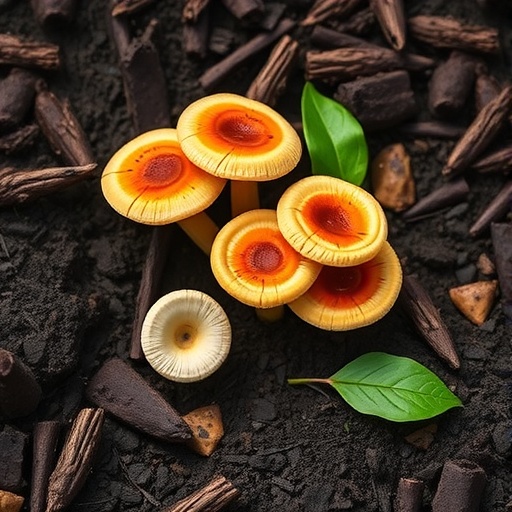
A groundbreaking study published in the journal Biochar unveils an innovative, nature-based approach to tackling the persistent environmental threat posed by red mud—an alkaline industrial waste notorious for its toxicity and challenging remediation. This pioneering research presents a novel remediation strategy that harnesses the synergistic power of biochar and beneficial soil fungi to specifically target and immobilize hazardous metals, thereby accelerating soil restoration and detoxification processes in severely contaminated landscapes.
Red mud is a byproduct generated in vast quantities during aluminum production, characterized by its extremely high alkalinity and laden with hazardous heavy metals, including arsenic and lead. Its harsh chemical environment not only presents a substantial ecological risk but also severely impairs plant growth and soil microbial activity, which are essential for natural recovery. Traditional remediation techniques often struggle to effectively neutralize or remove such pollutants, leaving large tracts of land degraded and inhospitable.
The researchers’ innovative solution leverages biochar, a porous, carbon-rich substance derived from biomass pyrolysis, combined with arbuscular mycorrhizal (AM) fungi known for their symbiotic associations with plant roots. Through careful experimentation, this study tested the efficacy of two distinct fungal species, Funneliformis mosseae and Rhizophagus intraradices, each paired with biochar and the resilient plant Arundo donax, commonly referred to as giant reed. This combination aimed to harness the complementary abilities of fungi in metal stabilization and soil amelioration, tailored to different metal contaminants.
Intriguingly, the study found that each fungal species exhibited unique and specialized interactions with specific metals in the red mud. The combination of biochar and Funneliformis mosseae notably enhanced the photosynthetic performance and antioxidant mechanisms within Arundo donax, enabling it to thrive amid arsenic contamination. This treatment significantly reduced the mobility of arsenic, immobilizing the toxic metalloid and thereby mitigating its bioavailability and environmental risk. Such an approach demonstrates increased plant resilience even in highly alkaline and toxic substrates.
Conversely, Rhizophagus intraradices paired with biochar showed a remarkable capacity to stimulate plant biomass and vigor while simultaneously immobilizing lead—a positively charged metal ion commonly found in red mud. This combination also contributed to the reduction of soil salinity, a frequent secondary stressor in contaminated sites, and enhanced the diversity and activity of soil microbial communities. Particularly impressive was the activation of phosphorus cycling enzymes, which improved nutrient availability vital for ecosystem recovery.
This research highlights the concept of “fungal species–metal valency matching,” wherein the chemical nature of contaminants—specifically their valency or charge state—determines the optimal fungal species for effective detoxification. Arsenic primarily exists in negatively charged ionic forms, which Funneliformis mosseae adeptly stabilizes through interactions within the rhizosphere. Lead, bearing a positive charge, is more efficiently immobilized by Rhizophagus intraradices, highlighting how fungi exhibit selective affinities and mechanisms attuned to metal speciation.
Beyond metal immobilization, the symbiotic relationship fostered between fungi, biochar, and Arundo donax initiated profound improvements in soil quality. Soil alkalinity was lowered significantly, and salt concentrations reduced, facilitating a more hospitable soil environment. Soil nutrient dynamics were positively influenced, with noticeable increases in organic carbon, nitrogen content, and bioavailable phosphorus contributing to enhanced fertility. These changes subsequently supported microbial diversity and activity, underscoring the holistic benefits of this tailored bioremediation strategy.
Advanced microbial community analyses provided deeper insights into the ecological mechanisms driving soil recovery. Specific bacterial taxa enriched by fungal and biochar treatments played pivotal roles in carbon sequestration and enzymatic processes central to nutrient cycling, particularly those involved in phosphorus mobilization. These findings emphasize the critical function of intricate plant–microbe–biochar networks in rehabilitating severely degraded soils, elucidating microbial synergies previously overlooked in remediation science.
The study’s findings also translate into actionable, location-specific remediation guidance. Areas burdened predominantly by arsenic contamination are best remediated using biochar plus Funneliformis mosseae, optimizing arsenic stabilization and plant survival. In contrast, sites where lead contamination and soil salinity are predominant benefit more from the Rhizophagus intraradices and biochar combination, which better supports biomass growth and metal immobilization. This highlights a paradigm shift from generic remediation protocols to precision, science-driven environmental management.
This species–metal valency matching strategy opens new frontiers in sustainable remediation, demonstrating that biotechnological innovation can effectively convert industrial toxicants into manageable ecological challenges. By leveraging the natural capabilities of fungi and the physicochemical properties of biochar, the proposed system offers a scalable, environmentally sound method to remediate some of the most recalcitrant industrial wastes on Earth. This method holds promise for reversing land degradation trends and restoring biological productivity to contaminated sites.
Furthermore, the employment of Arundo donax, a robust perennial grass capable of colonizing hostile environments, adds a critical phytoremediation dimension to the strategy. Its ability to establish in contaminated soils is markedly enhanced through fungal symbiosis and biochar amendment, thus promoting ecosystem stabilization and facilitating long-term recovery of soil function. This multifaceted approach exemplifies the integration of plant, microbe, and material sciences to remediate complex industrial residues.
Ultimately, this breakthrough study charts a hopeful path forward in managing the ever-growing threat of industrial pollution. Where previous remediation efforts have often faltered due to chemical complexity and ecological intolerance, the biochar-fungi-plant nexus offers targeted, adaptable solutions. As global industrial activity continues to produce hazardous residues, such innovative strategies could revolutionize how humanity rehabilitates contaminated land, turning liabilities into opportunities for environmental regeneration.
News Publication Date: 13-Feb-2026
Web References: http://dx.doi.org/10.1007/s42773-025-00568-7
References: Wang, X., Sun, Y., Zeng, D. et al. Biochar-loaded AM fungi coupled with Arundo donax enable targeted red mud remediation via valency—specific metal detoxification and soil function recovery. Biochar 8, 52 (2026).
Cite Scienmag News
Roger Howard. (March 26, 2026). Biochar and Beneficial Fungi Collaborate to Detoxify Toxic Red Mud and Revitalize Soil Health. Scienmag. https://scienmag.com/biochar-and-beneficial-fungi-collaborate-to-detoxify-toxic-red-mud-and-revitalize-soil-health/
Roger Howard. "Biochar and Beneficial Fungi Collaborate to Detoxify Toxic Red Mud and Revitalize Soil Health." Scienmag, 26 March 2026, https://scienmag.com/biochar-and-beneficial-fungi-collaborate-to-detoxify-toxic-red-mud-and-revitalize-soil-health/. Accessed 4 September 2026.
Roger Howard. "Biochar and Beneficial Fungi Collaborate to Detoxify Toxic Red Mud and Revitalize Soil Health." Scienmag. March 26, 2026. https://scienmag.com/biochar-and-beneficial-fungi-collaborate-to-detoxify-toxic-red-mud-and-revitalize-soil-health/


