


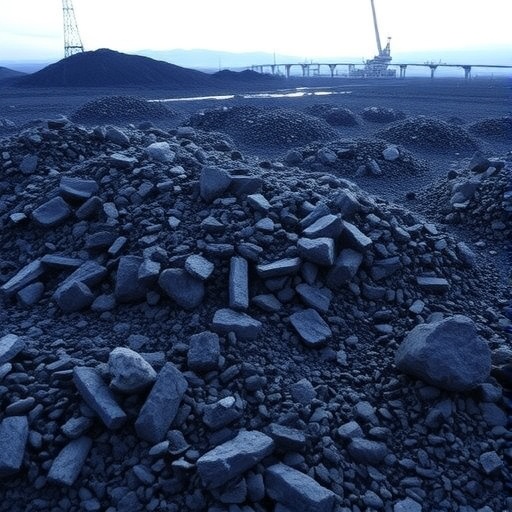
In an era marked by critical shortages and geopolitical tensions surrounding rare earth elements, researchers at The University of Texas at Austin have unveiled compelling new insights into the presence of these valuable elements within the coal and coal ash reserves of the U.S. Gulf Coast. Their findings collectively suggest that the coal basins along this coastal region harbor rare earth elements with an aggregate estimated value surpassing $187 billion, sparking renewed interest in unconventional mineral extraction methods intertwined with traditional coal industry operations.
Despite the striking total valuation, the economic feasibility of extracting rare earth elements from this coal and its byproduct, coal ash, reveals a complex picture. When evaluated per ton, the rare earth element content translates to values below $5 for both raw coal and coal ash. This relatively low unit price disqualifies the prospect of establishing standalone mining ventures solely dedicated to rare earth element recovery. Instead, industry experts advocate a synergistic approach where rare earth extraction functions as a supplementary revenue stream integrated into existing coal mining and processing workflows.
Brent Elliott, a research associate professor at the Bureau of Economic Geology, emphasizes the importance of leveraging byproducts to sustain profitability. “If you’re already mining the coal, the rare earth elements could be a side hustle,” he states, signaling a paradigm shift where traditional coal operations might essentially host a parallel rare earth recovery enterprise without incurring prohibitive additional costs.
Published in the International Journal of Coal Science & Technology, this investigation builds upon prior national assessments, including a 2024 study that evaluated rare earth quantity in coal ash landfills, estimating the U.S. nationwide extractable value at approximately $8.4 billion. Both projects enjoy support from the U.S. Department of Energy within a broader strategic push to secure domestic sources of critical minerals and lessen dependence on import-heavy supply chains, currently dominated by China, which supplies roughly 70% of the rare earth demand in the United States.
The research team conducted comprehensive geochemical analyses on 118 samples sourced primarily from the U.S. Geological Survey archives. These encompassed lignite, a relatively immature brown coal, harvested from 13 mines scattered across Texas, Louisiana, Mississippi, and including an abandoned mine in Arkansas alongside clay pits in Tennessee and Kentucky. Lignite’s geological profile offers unique advantages in terms of the accessibility and extractability of embedded rare earth elements compared to other coal types.
Quantitative calculations indicate that approximately 58 billion metric tons of coal in the Gulf Coast region incorporate roughly $186 billion worth of rare earth elements, assuming a 70% extraction efficiency through environmentally benign chemical processes. Additionally, coal ash stockpiled in landfills and detention basins within the region contains an estimated $1.2 billion worth of rare earth elements, with about 30% recoverability. Intriguingly, these estimates highlight a rare earth concentration translating to around $3.20 per ton for coal and approximately $4.40 per ton for coal ash.
A noteworthy aspect pertains to the mineralogical nature of the rare earth elements found in these materials: they predominantly belong to categories critical for producing high-performance magnets. Such magnets are indispensable components within advanced technologies, ranging from electric vehicles and wind turbines to electronic devices and advanced weaponry. This high-tech link greatly enhances the strategic importance of tapping into domestic reserves.
Geochemical assessments revealed that the rare earth element content in the studied lignite samples averages around 60% of the abundance present in the Earth’s upper crust. This underscores a fundamental issue in rare earth mining: the elements themselves are not extraordinarily scarce, but economically viable extraction depends heavily on identifying geologic repositories with suitably concentrated deposits. Extraction viability often hinges on both concentration and the complexity of chemical accessibility.
The distinct appeal of Gulf Coast lignite lies in the relative ease with which rare earth elements can be leached out using mild chemical agents. Approximately 70% of rare earths embedded in coal can be recovered via treatments involving weak acids that are environmentally compatible, minimizing ecological disruption. The discovery of localized anomalies, such as the Gibbons Creek mine in Central Texas exhibiting rare earth levels 17 times greater than average upper crust concentrations, offers intriguing possibilities linked perhaps to the region’s volcanic history and unique geochemical milieu.
Coal ash presents a markedly concentrated reservoir of rare earths, containing fourfold the median values of raw coal. This concentration arises naturally because burning coal expels carbon and other volatiles, concentrating residual elements into ash matrices. Still, extracting rare earths from coal ash poses distinct challenges. The elements are tightly bound within mineral phases, and while weak acids yield minimal recovery rates (around 5%), stronger acids can improve yields up to 30%, but introduce higher costs, operational challenges, and environmental concerns related to chemical handling and waste disposal.
The overarching implication of this research is that rare earth elements represent a valuable byproduct that could enhance the economic viability of coal-related activities if integrated thoughtfully. Energy generation facilities, for example, might implement pre-combustion extraction processes to recover rare earths prior to fuel consumption. Similarly, coal ash’s existing applications in infrastructure materials, such as road asphalt and construction bricks, could potentially be expanded to encompass rare earth element extraction modules.
Bridget Scanlon, the study’s lead author and a research professor at the Bureau of Economic Geology, highlights the multivariate possibilities: “There are all sorts of repurposing and recycling possibilities,” reflecting a circular economy approach aspiring to maximize resource utilization while minimizing waste. This interdisciplinary perspective aligns with broader sustainability objectives and critical mineral independence strategies.
In pursuit of such innovations, ongoing initiatives spearheaded by researchers like Brent Elliott focus on creating industrial partnerships that couple waste streams with novel extraction technologies. James Hower from the University of Kentucky notes that embracing a comprehensive “whole hog” approach is paramount, where the entirety of the coal product and its derivative materials undergo multifaceted utilization, thereby amplifying value recovery beyond simplistic extraction attempts.
This strategic vision echoes centuries-old industrial practices from the meatpacking sector, where complete utilization of raw material optimizes profitability. Analogously, coal product chains infused with rare earth element recovery can transform traditional mining landscapes, bridging energy production with advanced material supply chains critical for national security and green technology transitions.
As global demand for rare earth elements intensifies amidst emerging technologies and geopolitical realignments, tapping into domestic coal and coal ash resources could emerge as a crucial component of a resilient mineral supply strategy. While economic and technical hurdles remain, this multidisciplinary research portends innovative convergence—melding geosciences, chemical engineering, and sustainable resource management to harness hidden value beneath familiar terrain.
News Publication Date: 25-Mar-2026
Web References:
- International Journal of Coal Science & Technology Article
- Earlier 2024 Study on Coal Ash Rare Earth Elements
References:
- Elliott, B., Scanlon, B., Hower, J. et al. Rare earth element potential in coal and coal ash in the U.S. Gulf Coast. Int. J. Coal Sci. Technol. (2026). https://doi.org/10.1007/s40789-026-00872-y
Cite Scienmag News
Courtney Benton. (June 15, 2026). Billions in Critical Minerals Lurking in Gulf Coast Coal: Unraveling the Economic Challenges. Scienmag. https://scienmag.com/billions-in-critical-minerals-lurking-in-gulf-coast-coal-unraveling-the-economic-challenges/
Courtney Benton. "Billions in Critical Minerals Lurking in Gulf Coast Coal: Unraveling the Economic Challenges." Scienmag, 15 June 2026, https://scienmag.com/billions-in-critical-minerals-lurking-in-gulf-coast-coal-unraveling-the-economic-challenges/. Accessed 3 September 2026.
Courtney Benton. "Billions in Critical Minerals Lurking in Gulf Coast Coal: Unraveling the Economic Challenges." Scienmag. June 15, 2026. https://scienmag.com/billions-in-critical-minerals-lurking-in-gulf-coast-coal-unraveling-the-economic-challenges/


