


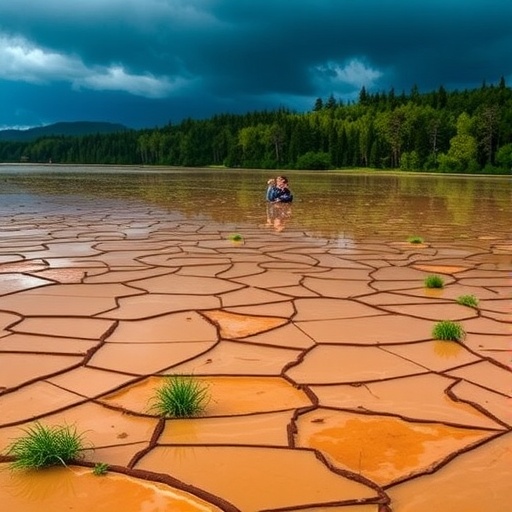
Researchers have identified why some natural disasters become international headlines while others remain largely invisible beyond the countries where they occur. An analysis of more than 2,600 officially recorded disasters suggests that cross-border media attention is shaped less by geographic distance than by three powerful forces: the availability of dramatic images, the number of people killed and the strength of personal connections between the affected country and the countries receiving the news. The findings, produced by researchers at the University of Bonn, the University of Warwick and Imperial College London, indicate that the global news system does not distribute attention evenly across climate-related disasters. Events such as earthquakes, volcanic eruptions, avalanches and forest fires are far more likely to attract foreign coverage than droughts and floods, even though the latter are among the most widespread and consequential effects of climate change.
The study draws on data from the Europe Media Monitor, a database supported by the European Commission that tracks news stories from approximately 20,000 media sources in 190 countries. The researchers examined disasters recorded from 2016 onward and compared how frequently each event was reported outside the country where it occurred. Their analysis treated international media coverage as an observable outcome influenced by characteristics of the disaster and relationships between nations. This approach enabled the team to distinguish between factors that make an event inherently newsworthy and factors that make audiences in another country feel connected to it. Instead of focusing only on whether a disaster was severe, the researchers asked why two events with similar death tolls could receive radically different levels of global attention.
The first major predictor was visual drama. Sudden catastrophes that produce striking, easily transmitted images were consistently more likely to cross national media borders. A collapsing building after an earthquake, a river of lava, a wall of snow or a forest engulfed by flames can communicate danger immediately, even to audiences unfamiliar with the location. Such images reduce the amount of explanation needed for a story to generate an emotional response, making them especially valuable in competitive digital news environments. By contrast, droughts often develop over months or years and may lack a single defining image. Their effects—depleted reservoirs, damaged crops, livestock losses and water shortages—can be severe but visually diffuse. This difference may help explain why disasters with a clear visual climax dominate international news while slower emergencies struggle to gain sustained attention.
The second factor was the death toll. As the number of fatalities increased, the probability that a disaster would receive coverage in foreign media generally rose as well. Fatalities provide a simple, widely understood measure of human impact and often become a central element of headlines, alerts and broadcast reports. Yet the relationship was not simply a matter of counting deaths. The study found that the same number of fatalities could generate different levels of international attention depending on the type of disaster and the relationship between the affected and observing countries. A sudden event with dramatic footage could receive extensive coverage even before the final death toll was known, while a slower-moving crisis might remain underreported despite causing substantial cumulative harm. The result is a news hierarchy in which immediacy and emotional visibility interact with mortality.
The most unexpected influence was social connectedness. Countries with strong personal ties were more likely to report one another’s disasters, even when they were far apart geographically and did not share a common language. To estimate these connections, the researchers used the Social Connectedness Index, which is based on patterns of Facebook friendships between countries relative to their populations. The measure is intended to capture the density of interpersonal relationships that link societies through migration, family, education, work and social networks. When people in one country have relatives, friends or established communities in another, a disaster there may feel less remote. Editors may also anticipate greater interest among readers who have direct or indirect connections to the affected population.
The researchers found that genetic similarity between populations was associated with higher levels of cross-border reporting as well. They do not interpret shared genetic material as a direct cause of media attention. Instead, they argue that it functions as a statistical proxy for historical migration and long-standing personal relationships that may be difficult to measure directly. The example of Ireland and the United States illustrates this logic. During the Great Famine in the nineteenth century, approximately 1.5 million people emigrated from Ireland to the United States. The resulting family and community ties have persisted across generations, helping create a social relationship between the two countries that is not explained by geography alone. In the study’s framework, genetic similarity may therefore reflect the historical pathways through which empathy and audience interest are formed.
The practical effect of these connections can be substantial. Based on the relationships identified in the data, the researchers estimate that German media might respond to a storm in Mexico that killed 62 people in a manner comparable to a disaster in Bangladesh that killed 100, despite Bangladesh being geographically closer to Germany. This comparison does not mean that distance has no influence at all, but it suggests that personal networks can outweigh physical proximity when editors decide which foreign events deserve attention. The finding challenges the assumption that international news operates primarily according to a simple radius around the audience. In a globally connected media environment, cultural familiarity, migration histories and online relationships can make a distant disaster appear more relevant than a geographically nearer one.
The study’s most consequential finding concerns droughts and floods, both of which are closely linked to a changing climate. These hazards were found to be less likely than many sudden disasters to receive international coverage, particularly when they occurred outside countries with strong social ties to the observing audience. Floods can produce spectacular scenes, but coverage may still be limited compared with earthquakes, fires or avalanches, especially when flooding is recurrent or spread across a large region. Droughts face an even greater visibility problem because their physical effects accumulate gradually and may be difficult to attribute to a single moment. This creates a potential mismatch between media attention and climate risk: the hazards most responsible for long-term disruption may be the least likely to become global news.
That mismatch could influence how the public understands climate change. People often encounter distant crises through news reports, and repeated exposure can shape perceptions of both urgency and probability. If international coverage favors sudden, cinematic disasters while underrepresenting drought, flooding and other gradual climate impacts, audiences may underestimate the scale of the greenhouse effect until the consequences reach their own communities. The researchers argue that personal connections could also become an important resource in addressing this problem. Stronger links between societies can increase empathy and public engagement, helping people recognize that climate-related disasters affecting distant populations are part of a shared global challenge. The study, published in Nature Human Behaviour, therefore reveals not only how news priorities are formed but also how those priorities may influence the world’s ability to respond collectively to climate change.
News Publication Date: 14-Aug-2026
Web References: https://doi.org/10.1038/s41562-026-02512-6
References: Nature Human Behaviour; “Uneven Patterns of Cross-Border Media Coverage Following Natural Disasters”; DOI: 10.1038/s41562-026-02512-6
Cite Scienmag News
Courtney Benton. (August 14, 2026). Media overlook droughts and floods despite their growing risks. Scienmag. https://scienmag.com/media-overlook-droughts-and-floods-despite-their-growing-risks/
Courtney Benton. "Media overlook droughts and floods despite their growing risks." Scienmag, 14 August 2026, https://scienmag.com/media-overlook-droughts-and-floods-despite-their-growing-risks/. Accessed 4 September 2026.
Courtney Benton. "Media overlook droughts and floods despite their growing risks." Scienmag. August 14, 2026. https://scienmag.com/media-overlook-droughts-and-floods-despite-their-growing-risks/


