


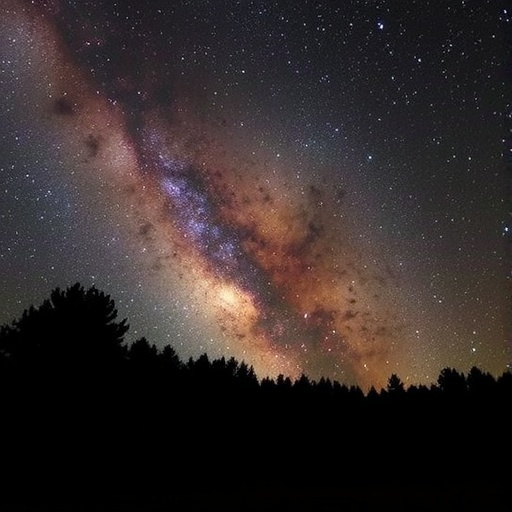
A groundbreaking study conducted by the European Southern Observatory (ESO) reveals alarming prospects for ground-based astronomy should the current trajectory of satellite deployments continue unabated. With proposals to launch over 1.7 million new satellites into Earth’s orbit, a figure that dwarfs the present count of around 14,000 operational satellites, the night sky risks being irrevocably transformed. This astronomical surge includes plans for extremely bright satellites, which could severely compromise the ability of modern observatories to detect faint celestial phenomena, fundamentally altering humanity’s view of the cosmos.
Since 2019, the proliferation of satellites has been accelerated, led predominantly by SpaceX’s Starlink constellation. While Starlink has already contributed tens of thousands of satellites to Earth’s orbital environment, the scale of upcoming launches promises to multiply this number exponentially. Olivier Hainaut, a senior astronomer at ESO with over three decades of experience, underscores the gravity of the problem: “Until now we have managed, but it’s getting worse.” His latest peer-reviewed study in Astronomy & Astrophysics quantifies the impact of these consortia on night sky brightness and astronomical observations, concluding that a threshold exists beyond which the capacity for optical astronomy could be severely hindered.
One particularly concerning proposal comes from Reflect Orbital, a US-based startup planning to deploy a fleet of 50,000 large, mirror-like satellites intended to beam sunlight onto Earth during night hours. These satellites would create beams spanning at least five kilometers across the Earth’s surface and would be exceptionally bright. Hainaut’s simulations indicate that these satellites would outshine nearly all other celestial objects visible to the naked eye. Viewed from within their reflected light beams, these satellites could appear up to four times as luminous as the full Moon. Even from urban areas affected by light pollution, where stars fade in visibility, these satellites alone could be the only ‘stars’ blazing in the sky, eclipsing natural night-time darkness.
Satellite constellations induce two primary forms of interference with astronomical observations: direct observations are marred by bright streaks or trails caused by satellite movements during exposure, and the overall sky brightness is elevated by scattering and diffuse light resulting from these objects. When satellites cross the field of view during imaging, they produce dazzling streaks that obscure or contaminate the faint celestial targets behind them. This effect is especially disruptive for high-precision instruments. For example, ESO’s Very Large Telescope (VLT) at Paranal Observatory in Chile would witness losses of up to 28% in field of view due to such satellite trails just two hours after sunset, assuming these satellites remain just below naked-eye visibility thresholds.
The problem intensifies with next-generation telescopes requiring longer exposure times and higher sensitivity, such as the Vera C. Rubin Observatory in the United States. This facility’s cameras, equipped with dense and complex electronics sensitive to even faint light pollution, could find their images rendered unusable for hours nightly due to saturated detectors from satellite trails. Hainaut’s modeling assumes Reflect Orbital’s satellites do not aim their beams toward observatories; however, even a single mirror-satellite within the fleet could spoil science data dramatically. The cumulative effect of 50,000 such satellites would devastate the observatory’s ability to conduct quality observations during periods when satellites are sunlit.
Beyond the discrete trails, the increased background sky brightness caused by satellite illumination represents a more insidious form of light pollution. Satellites too faint to be distinguished as individual points of light collectively contribute a veil of diffuse glow, while brighter satellites scatter light more intensively through the atmosphere, elevating overall night sky luminance. Such effects compromise the detection of faint cosmic sources like distant galaxies, Earth-like exoplanets, and potentially hazardous near-Earth objects. The new ESO analysis is the first to integrate these diffuse contributions comprehensively, demonstrating an up to three- to fourfold increase in night sky brightness with the full deployment of Reflect Orbital’s constellation.
The implications extend far beyond astronomy, touching upon ecological and human health concerns. Bright satellite constellations disrupt nocturnal environments, interfering with biological circadian rhythms across a range of species, including humans. The environmental cost of rocket launches sustaining these constellations adds another layer of concern, contributing to atmospheric pollution and climate impact. Moreover, the criação and re-entry of satellites generate debris and further atmospheric contamination. Olivier Hainaut emphasizes that while his work centers on astronomy, interdisciplinary efforts are essential to fully grasp the broad consequences of these space-faring endeavors.
A critical takeaway from the study is the establishment of a practical upper limit on satellite population to preserve dark skies for astronomical research. The analysis suggests that a maximum of approximately 100,000 satellites, all dim enough to remain below the naked-eye visibility threshold—visual magnitude 7 or fainter—is required. Surpassing this number or allowing satellites to be brighter than this threshold would exponentially exacerbate observation losses. “This is not a hard number, like 99,999 is good and 100,001 is bad,” says Hainaut, “but 100,000 causes losses at about the level of other technical losses, such as equipment failure.” More importantly, maintaining brightness below this level is essential; brighter satellites would necessitate even stricter population limits to mitigate damage.
Regulatory frameworks are currently grappling with these challenges. Both SpaceX and Reflect Orbital have filed applications with the US Federal Communications Commission (FCC) for permission to proceed with their planned launches. The ESO, alongside the UK’s Royal Astronomical Society and the International Astronomical Union, has submitted coordinated responses to these filings, emphasizing the existential threat posed to optical astronomy. The FCC received thousands of comments on these proposals, highlighting the widespread concern among scientists, policymakers, and the public. “The ball is now in the FCC’s court,” remarks ESO Institutional Affairs Officer Betty Kioko, “and we hope that the regulators appreciate the gravity of the threat.”
The evolving satellite landscape necessitates collaborative mitigations between astronomers, satellite engineers, policymakers, and industry stakeholders. ESO’s Director General, Xavier Barcons, stresses the multifaceted value of astronomy to humanity—scientific knowledge, technological innovation, education, and cultural enrichment. Protecting our view of the universe requires not only restricting satellite numbers and brightness but also developing advanced satellite designs optimized for minimal observational interference. The principles of responsible space stewardship must guide the future to ensure low Earth orbit remains a valuable, pristine resource for generations to come.
In summary, the relentless expansion of satellite mega-constellations poses profound challenges to traditional astronomy and the broader environment. The new ESO study quantifies these impacts with unprecedented detail, highlighting the urgent need to limit satellite numbers and ensure their brightness is carefully controlled. Without such measures, the cumulative effect will be to significantly brighten the night sky, reduce data quality, and jeopardize humanity’s intrinsic connection to the cosmos. As Hainaut eloquently concludes, “Low Earth orbit is a celestial seashore that provides immense value to modern life… We must manage the footprint of mega-constellations to ensure this resource remains pristine and accessible for future generations.”
News Publication Date: June 2026
Web References:
- https://www.eso.org/public/news/eso2607/
- https://elt.eso.org/
- https://www.eso.org/public/teles-instr/paranal-observatory/vlt/
- https://www.eso.org/public/images/eso2607c/
- https://www.theguardian.com/science/2026/apr/05/satellite-mirror-plans-could-disrupt-sleep-and-ecosystems-worldwide-scientists-say
- https://www.nature.com/articles/s41598-021-89909-7
References:
- Hainaut, O. “Impacts of satellite constellations on astronomical observations,” Astronomy & Astrophysics (forthcoming).
- ESO Public Release: https://www.eso.org/public/news/eso2607/
Cite Scienmag News
Grant Pearson. (July 1, 2026). Beyond the Limit: One Million Satellites and Mirrors in Space Threaten the Night Sky. Scienmag. https://scienmag.com/beyond-the-limit-one-million-satellites-and-mirrors-in-space-threaten-the-night-sky/
Grant Pearson. "Beyond the Limit: One Million Satellites and Mirrors in Space Threaten the Night Sky." Scienmag, 1 July 2026, https://scienmag.com/beyond-the-limit-one-million-satellites-and-mirrors-in-space-threaten-the-night-sky/. Accessed 4 September 2026.
Grant Pearson. "Beyond the Limit: One Million Satellites and Mirrors in Space Threaten the Night Sky." Scienmag. July 1, 2026. https://scienmag.com/beyond-the-limit-one-million-satellites-and-mirrors-in-space-threaten-the-night-sky/


