


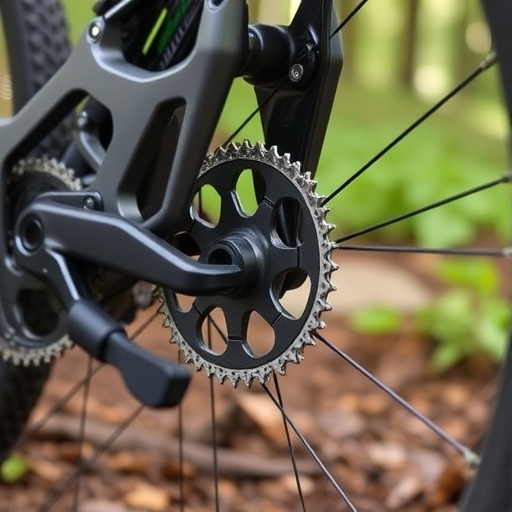
A new study is challenging one of mountain biking’s most persistent explanations for uncomfortable pedal feedback: the idea that pedal kickback is usually responsible. Researchers from Pforzheim University and the Technical University of Munich have analyzed the crank torque generated during downhill riding and identified three additional mechanical mechanisms that can transmit disruptive forces through a bicycle’s drivetrain. Their findings suggest that riders may often be feeling effects caused by braking, chain motion, derailleur behavior, or drivetrain inertia rather than classical pedal kickback. The research, published in Sports Engineering, offers a new framework for understanding how suspension movement and drivetrain dynamics interact on rough, steep trails.
Pedal kickback is traditionally described as a backward rotation of the cranks when a rear suspension compresses. In many full-suspension mountain bikes, the rear wheel axle does not move directly toward the bottom bracket. Instead, suspension compression changes the distance between the rear axle and the crankset. Because the chain connects the front chainring to the rear cassette, this changing distance can lengthen the upper, tensioned section of the chain. In a simplified mechanical model, the chain compensates for this extension by rotating the crank backward. A rider standing on the pedals may then experience the movement as resistance or a sudden force beneath the feet.
The researchers point out that this standard explanation depends strongly on speed and freewheel behavior. During fast downhill riding, the rear wheel may rotate quickly enough that the freewheel remains disengaged while the suspension compresses. Under these circumstances, chain growth does not necessarily produce continuous backward crank rotation. Earlier research by the same group found that pedal kickback becomes negligible above a critical wheel speed, while typical downhill runs frequently exceed that speed. This creates a practical contradiction: anti-kickback systems are widely marketed and used, yet the classical mechanism may rarely occur during real-world high-speed descents.
To investigate the issue, the team equipped a 2016 Canyon Sender downhill bike with sensors measuring crank torque, crank rotation, cassette rotation, rear-wheel rotation, and front and rear suspension movement. Cameras mounted on the rider and bicycle recorded the riding situations that produced the torque signals. The system sampled cassette and rear-wheel rotation at 800 hertz and crank torque at 400 hertz, allowing the researchers to compare mechanical events in detail. Two experienced riders completed approximately 45 minutes of downhill riding across three demanding tracks in Germany, including rough stone fields, fast sections, steep terrain, and wet conditions. A second bicycle, a modern high-pivot Norco Shore, was also tested in additional trials.
The researchers treated crank torque between the chainring and crank as the central measurement. This quantity provides a way to assess forces transmitted through the drivetrain without depending directly on how a rider distributes body weight between the two pedals. Torque signals below approximately plus or minus 15 newton-metres were classified as noise for this particular test setup. Such smaller fluctuations could be produced by chain oscillation, measurement inaccuracies, or ordinary rider movement on rough ground. The threshold was not intended to represent the level at which a rider necessarily perceives discomfort, and the authors stress that the value applies only to the bicycle and sensors used in the study.
The first of the three newly identified mechanisms is a blocked rear wheel. During braking on steep terrain, the rear wheel can lose load and lock temporarily. At the same time, a standing rider may shift forward or backward to maintain balance, causing an attempted rotation of the cranks. If the cassette begins to rotate through this rider input, the freewheel can engage with the stationary rear wheel. The drivetrain then abruptly resists the rider’s balancing movement, generating torque at the crank. In this case, the force is not primarily caused by suspension-induced chain growth. It results from the interaction between braking, wheel lock-up, freewheel engagement, and the rider’s effort to stabilize the bicycle.
The second mechanism, called cassette forwards, occurs when suspension compression pulls the cassette into forward rotation without producing continuous pedal kickback. Impacts from landings or obstacles can increase the distance between the chainring and cassette, extending the chain line. At downhill speeds, the freewheel may remain disengaged, allowing the cassette to rotate independently of the rear wheel. The cassette’s rotational inertia resists the acceleration, while the spring and damper inside the rear derailleur oppose the movement required to take chain from the slack side. These opposing forces appear as torque at the crank. The freewheel may briefly engage if the cassette accelerates beyond the rear-wheel speed, but the study identifies the initial torque required to accelerate the cassette as the defining event.
The third mechanism, cassette backwards, is linked to the chain’s return toward its normal tension after suspension movement or impact. When the chain becomes temporarily slack or oscillates, the derailleur’s torsion spring pulls it back into position. The cassette may rotate backward as the system restores chain tension. Because the cassette has rotating mass, it cannot stop instantly when the chain becomes fully tensioned. Its abrupt deceleration creates a torque peak that can be transmitted through the chainring and crank. Repeated chain oscillations can produce several peaks in succession, helping explain why riders sometimes describe a sensation resembling a loose component or repeated drivetrain tapping while crossing rough ground.
One especially intense situation appeared when cassette backwards and cassette forwards occurred consecutively. In the researchers’ observations, this combination could produce torque values of approximately 30 to 40 newton-metres. The cassette first rotates backward as the derailleur retensions the chain, then is forced to accelerate forward again as suspension movement extends the chain line. Instead of merely speeding up or slowing down, the rotating mass must change direction. That reversal demands a larger torque and may create a sharper sensation at the pedals. The result could be mistaken for severe pedal kickback, even though the underlying process involves chain slack, derailleur spring action, cassette inertia, and a subsequent suspension-driven acceleration.
During the actual downhill track measurements, the researchers did not record a clear instance of classical pedal kickback, even after lowering the torque threshold. They reproduced the mechanism only during a controlled pilot test in which a rider jumped from an approximately 0.8-metre edge into flat terrain at less than about 15 kilometres per hour. At the lower speed, the freewheel could remain engaged as the rear suspension compressed, allowing the chain-line extension to generate backward crank rotation. The result supports the study’s central argument: pedal kickback is a real mechanical phenomenon, but it may not be the dominant source of pedal forces during fast downhill riding.
The findings could influence how bicycle manufacturers evaluate suspension designs and anti-kickback technologies. A system designed to allow freewheel movement or reduce chain-line extension may address classical pedal kickback, but it may not eliminate torque generated by a locked rear wheel or by chain oscillations controlled by the derailleur. Similarly, changing suspension kinematics could reduce cassette-forwards events while leaving braking-related feedback untouched. The proposed classification gives engineers a way to distinguish these mechanisms during testing rather than treating every force at the pedals as the same problem. It may also help riders interpret feedback more accurately: resistance during braking on steep, rough terrain may indicate a blocked wheel, while frequent lighter impacts may arise from chain movement and drivetrain inertia.
The study remains exploratory. It is based primarily on one bicycle, two riders, and a limited amount of riding data, and the measurements were not accompanied by synchronized high-speed video. The authors also emphasize that the 15-newton-metre threshold and observed frequencies should not be generalized to every bicycle, drivetrain, rider, or trail. Future research will need to examine different suspension kinematics, chainstay protections, chain lengths, gear combinations, derailleur spring and damper settings, drivetrain masses, anti-kickback systems, and belt-drive designs. Even with these limitations, the work offers a potentially important shift in mountain-bike engineering: instead of asking only how much pedal kickback a bicycle has, designers and riders may need to ask which of several distinct torque mechanisms is actually operating at a given moment.
Cite Scienmag News
Denise Maddox. (August 25, 2026). Beyond Pedal Kickback: Classifying Crank Torque in Downhill Mountain Biking. Scienmag. https://scienmag.com/beyond-pedal-kickback-classifying-crank-torque-in-downhill-mountain-biking/
Denise Maddox. "Beyond Pedal Kickback: Classifying Crank Torque in Downhill Mountain Biking." Scienmag, 25 August 2026, https://scienmag.com/beyond-pedal-kickback-classifying-crank-torque-in-downhill-mountain-biking/. Accessed 3 September 2026.
Denise Maddox. "Beyond Pedal Kickback: Classifying Crank Torque in Downhill Mountain Biking." Scienmag. August 25, 2026. https://scienmag.com/beyond-pedal-kickback-classifying-crank-torque-in-downhill-mountain-biking/


