


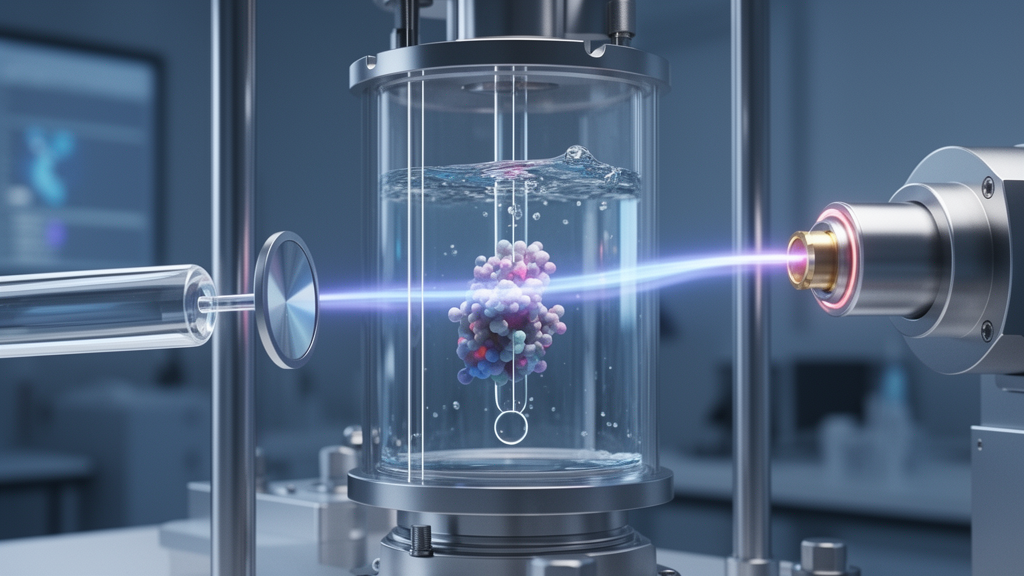
Individual biomolecules can be examined with nanoscale infrared spectroscopy under near-physiological aqueous conditions at the BESSY II synchrotron, following an international experimental study led by Helmholtz-Zentrum Berlin für Materialien und Energie. The researchers validated an improved scanning near-field optical microscopy technique, known as s-SNOM, using ultra-thin silicon-based membranes between an atomic force microscope tip and samples immersed in water. Their nano-IR measurements, which reached spatial resolutions of a few tens of nanometres, reliably matched established far-field infrared reference spectra. The results provide a methodological foundation for studying biomaterials and, potentially, catalytic processes in liquid environments.
Conventional infrared spectroscopy can reveal the chemical properties of molecules, biological samples and soft matter, but its far-field measurements require a certain sample size and consequently provide statistical information about molecular populations rather than individual molecules. In s-SNOM, an infrared beam illuminates the tip of an atomic force microscope as the tip scans the sample. The backscattered light carries local optical information about the near-field interaction between the tip and the sample, with a resolution of up to 10 nanometres. This makes the technique well suited to examining individual proteins, DNA and other molecular structures. Applying it to biological samples in water presents a major experimental challenge because water strongly absorbs infrared radiation.
The study addressed this obstacle with ultra-thin silicon-based membranes that act as protective films while remaining transparent in the mid-infrared range. Earlier proof-of-concept studies had established that in-liquid s-SNOM could be performed with silicon nitride or silicon carbide membranes placed between the microscope tip and sample. What remained missing was a comprehensive benchmark showing whether local nanoscale measurements obtained through such a film could be related reliably to established far-field infrared spectra. The research team systematically tested different membrane materials and examined samples in both dry and aqueous environments at the BESSY II infrared beamline. The tested specimens included bovine serum albumin, DNA molecules and fibrils of the protein alpha-synuclein, a protein associated with Alzheimer’s disease.
To connect the experimental observations with a physical account of what occurs at the nanoscale, the researchers combined their measurements with the finite dipole model. This model describes the tip-sample interaction in the presence of the membrane and liquid. The analysis showed that nano-IR signals from individual biomolecules could accurately mirror standard far-field infrared signatures even within the altered optical environment created by the protective film and surrounding water. That agreement enabled the researchers to chemically map biological structures with a resolution down to a few tens of nanometres. Published in Analytical Chemistry, the work is an experimental validation and methodological advance; it does not demonstrate a specific biological effect, a disease mechanism or the clinical usefulness of the technique.
The findings support using s-SNOM to investigate biological samples in aqueous environments under conditions closer to those in which they naturally occur, as well as chemical processes in catalytically active materials. The method may allow researchers to examine protein dynamics and molecular interactions with high spatial resolution while samples remain in liquid. Its demonstrated scope is nevertheless limited: the study evaluated selected biomolecular specimens and particular membrane configurations rather than establishing performance across every material or biological system, and it remains dependent on ultra-thin protective films and specialized nanoscale infrared instrumentation. By extending earlier demonstrations of in-liquid nanoscale spectroscopy with a systematic comparison to conventional infrared references, the BESSY II study supplies a clearer basis for judging when individual-molecule nano-IR measurements can reproduce established spectral signatures in water.
Subject of Research: Experimental validation of in-liquid nanoscale infrared spectroscopy for individual biomolecules
Article Title: BESSY II: High-resolution insights into individual biomolecules and catalysts
Article References: BESSY II: High-resolution insights into individual biomolecules and catalysts. Original publication (Bibliographic details unavailable.)
Image Credits: AI Generated
DOI: Not provided
Keywords: nano-IR spectroscopy, s-SNOM, biomolecules, BESSY II, infrared microscopy, silicon membranes, aqueous environments, atomic force microscopy, finite dipole model, BESSY, High-resolution, insights
Cite Scienmag News
Bethany Barker. (October 26, 2026). BESSY II study validates in-water nano-IR spectroscopy of individual biomolecules. Scienmag. https://scienmag.com/bessy-ii-study-validates-in-water-nano-ir-spectroscopy-of-individual-biomolecules/
Bethany Barker. "BESSY II study validates in-water nano-IR spectroscopy of individual biomolecules." Scienmag, 26 October 2026, https://scienmag.com/bessy-ii-study-validates-in-water-nano-ir-spectroscopy-of-individual-biomolecules/. Accessed 26 October 2026.
Bethany Barker. "BESSY II study validates in-water nano-IR spectroscopy of individual biomolecules." Scienmag. October 26, 2026. https://scienmag.com/bessy-ii-study-validates-in-water-nano-ir-spectroscopy-of-individual-biomolecules/


