


A study shows that if communities think outsiders are stealing their forest resources, they are more likely to want to increase their own harvest.

Credit: Matt Clark / Imperial College London
A study shows that if communities think outsiders are stealing their forest resources, they are more likely to want to increase their own harvest.
The research, led by Imperial College London and Max Plank Institute of Evolutionary Anthropology researchers, shows why effective boundaries around a community’s common-pool resource are key to sustainable management of that resource.
Common-pool resources, such as forests, fisheries, and groundwater, need to be managed effectively to reduce over-harvesting and environmental damage. Researchers knew that strong boundaries around a community’s common-pool resource could promote effective management, but they weren’t exactly sure why.
The new research – in collaboration with mangrove-dependent communities in Tanzania – reveals that boundaries don’t just keep others out, but also promote good conservation practices by community members.
Without effective boundaries, communities can be subject to theft from neighbours. The study reveals that if they then believe that this theft is causing deforestation, then they are more likely to want to increase their own harvest – potentially initiating a ‘race to the bottom’.
Secure boundaries, however, lead to collective decisions within the community that keep harvests sustainable.
Lead researcher Dr Matt Clark, from the Centre for Environmental Policy at Imperial College London, explained: “For lots of natural resources, we want to keep people out because of the direct damage that it might cause to the ecosystem. But what we show is that secure boundaries can actually have much greater effects than just stopping the direct harvest from outsiders: they can actually shape the culture of sustainable resource management.”
Tragedy of the commons?
These conclusions are based on the results of two research papers by the international team looking at the mangrove forests of the island of Pemba in Tanzania in collaboration with local communities. Between 90-95% of the population in Pemba relies on directly harvesting wood to meet their daily cooking needs, much of which comes from mangroves.
The first paper, published in Nature Sustainability, presents a general computer simulation examining how resource scarcity and competition between groups can spur conservation actions in some places but not others.
Nobel Prize-winner Elinor Ostrom identified that secure boundaries (social and physical) were virtually always associated with successful management of common-pool resources. However, how these successful management principles emerged and persisted in communities has not been well understood.
The results of the simulations suggest that where communities have little control over the security of their resources, it can erode rules or norms around sustainable harvesting.
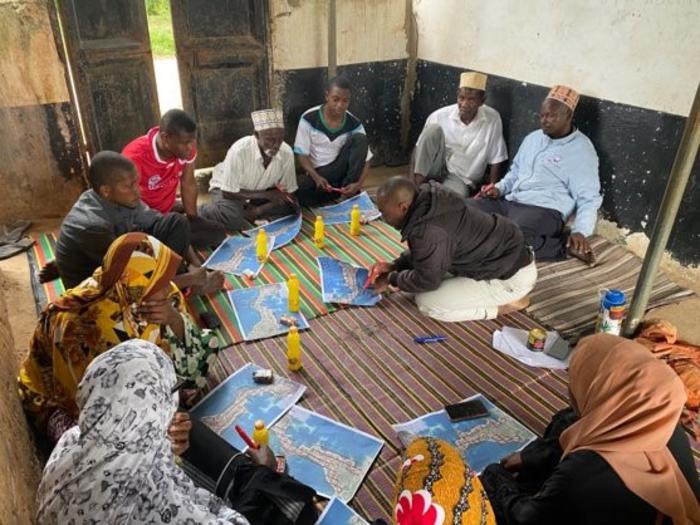
The second study put this model to the test, with the results published in Conservation Biology. Dr Clark and second author Haji Hamad, from the local Zanzibar Department of Forests, travelled around Pemba conducting a ‘participatory mapping activity’ with community members over a period of nine months.
The team surveyed 423 people in 43 mangrove-dwelling communities, asking questions about their perceptions and behaviours, as well as mapping changes in the local mangrove forests.
They found that, contrary to the ‘tragedy of the commons’ idea that people will act selfishly until a resource is depleted, communities will impose their own limits on harvesting to reduce depletion, via community conservation committees. However, this only held true when they acted to ensure the borders of their area of forest were secure – that they perceived a low risk of theft from neighbouring communities.
If the opposite were true, and the perceived risk of theft was high, then community members tended to prefer looser harvest limits for themselves, resulting in a more degraded mangrove ecosystem.
Designing successful conservation
The results revealed several other important drivers of forest protection. For example, following the establishment of government-sanctioned protected areas in 2015, some neighbouring communities self-organised agreements to prevent the displacement of tree-cutting from the protected lands into their nearby forests.
Dr Clark said: “This kind of study is only possible somewhere like Pemba – a small island where we can do comprehensive research and complex dynamics can be unravelled – but what it reveals could be widely applicable to conservation plans for common-pool resources around the world.
“It’s only through our close collaboration with the Zanzibar Department of Forests that we can conduct this research and also it’s what makes this research so exciting: we’re producing it directly with the folks who will be able to make best use of it.
“In the end, what our study shows is that awareness of damage to critical natural resources is not enough to spur action, particularly when we think ‘others’ are causing the damage.
“This insight helps us understand the drivers of environmental and cultural change – and how we can design successful conservation actions based on them.”
Journal
Conservation Biology
Article Title
Effects of perceptions of forest change and intergroup competition on community-based conservation behaviors
Article Publication Date
4-Apr-2024
Cite Scienmag News
Courtney Benton. (April 30, 2024). Believing environmental damage is done by others can cause ‘race to the bottom’. Scienmag. https://scienmag.com/believing-environmental-damage-is-done-by-others-can-cause-race-to-the-bottom/
Courtney Benton. "Believing environmental damage is done by others can cause ‘race to the bottom’." Scienmag, 30 April 2024, https://scienmag.com/believing-environmental-damage-is-done-by-others-can-cause-race-to-the-bottom/. Accessed 4 September 2026.
Courtney Benton. "Believing environmental damage is done by others can cause ‘race to the bottom’." Scienmag. April 30, 2024. https://scienmag.com/believing-environmental-damage-is-done-by-others-can-cause-race-to-the-bottom/

